


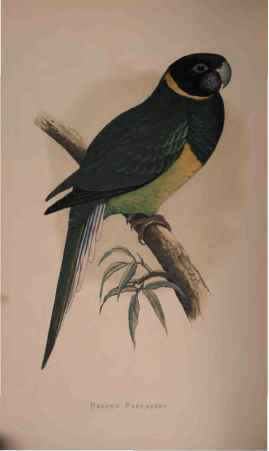
Bauer's Parrakeet. Psittacus Zonarius. Psittacus viridis, (!) Platycercus Baueri, P. cyanomelas, P. zonarius
Description
This section is from the book "Parrots In Captivity", by William Thomas Greene. Also available from Amazon: Parrots in Captivity.
Bauer's Parrakeet. Psittacus Zonarius. Psittacus viridis, (!) Platycercus Baueri, P. cyanomelas, P. zonarius
Psittacus Zonarius. Synonyms: Psittacus viridis, (!) Platycercus Baueri, P. cyanomelas, P. zonarius, etc.
French: Perruche de Bauer.
German: Der Ringsittich.
THIS handsome Broadtail has a number of aliases, and is called, amongst other appellations, The Port Lincoln Parrakeet, the Zoned Barnardius and other equally fanciful designations; by Gould it is named Bauer's Parakeet, and this designation we have thought it best to adopt in these pages, as in addition to the authority of the author of "The Birds of Australia", that of Vigors and Horsfield may be cited in support of it.
It is a trifle larger than the Rosella, but not as large as Pennant's Broadtail. The plate gives a good idea of the colouring, which we need not stop to particularise; merely remarking that it bears a great resemblance to another species of the same sub-family, the Platycercus semitorquatus of Gould; from which, however, it is readily distinguished by the red circlet above the upper mandible in the latter species.
In captivity this Parrakeet has, in our experience, but little to recommend it to the notice of amateurs; for in a cage it is dull and listless, and is not to be trusted in the aviary with companions weaker and more defenceless than itself. It never learns to speak, as far as the writer of these pages is aware, and though its voice is not often exerted to its utmost power, the bird takes fits of screaming now and then.
In a large aviary, however, this disagreeable trait in its character is not so noticeable as it must be in the house, and if it has no companions it can bully, even to death, Bauer will get on very well in an out-door aviary of large size; in which, needless to remark, it would not permit any tree or shrub to live very long, seeing that it is as great a whittler as the rest of its family.
M. Alfred Rousse, of Fontenay-le-Comte, reports a brood in 1884, from an acclimatised pair of these birds, but we are not aware that his success in this respect has been repeated elsewhere; for these Parrakeets are not common even in their native land, South Western Australia, and are very seldom imported; so that they command a high price in the market, and are bought by amateurs at from £3 to £4 a pair.
The female is not quite as large as her mate, is duller in colouring than he is, and has the head smaller and somewhat more flattened; otherwise the sexes are indistinguishable.
Like most of the Broadtails, the Bauer is hardy and a frugal feeder, preferring Canary-seed, but eating hemp and oats, which last should always be offered to it when first imported, as it is usually fed on them during the voyage, and an abrupt change of diet is often productive of disastrous consequences.
If it is desired to breed these birds in captivity, a healthy acclimatised pair of adult birds should be selected, and a properly constructed out-door aviary, of not less than ten feet by six, set apart for their special use; or, if it be desired to associate them with others of their congeners, these should be of size to cope successfully with the Bauers, which, as we have said, are tyranically disposed towards weaker subjects than themselves; but in this case the area of the enclosure should be proportionately greater.
The Bauer breeds in the hollow branches, technically "spouts", of the gum trees in its native Valleys, and a decaying log, or an artificially constructed wooden nest must be supplied for domestic purposes in the aviary; when the birds being of an inquisitive turn will soon commence to explore the new article of furniture, and probably end by making the use of it for which it was placed in their abode.
If the floor of the open portion of the aviary can be laid down with grass, it will not only add materially to the appearance of the place, but tend to the comfort and amusement, and consequently the health of the inmates; which, it must be remembered, are ground Parakeets; that is to say, seek, in their wild state, the greater part of their food among the growing grasses of their native land, upon the seeds of which they mainly subsist.
It is said that they also eat the larvae of the white ant, so common in decaying logs in the Australian bush, and this is by no means improbable; but in captivity these birds, and their congeners, with one or two exceptions, do extremely well without insect food, at least for some generations; for, ultimately, all aviary bred Parrakeets, of whatever species, appear to degenerate, and it is just possible that this deficiency in the matter of animal food may be at the bottom of the vexatious deterioration in size, stamina and appearance, that is so very noticeable among the more easily obtained species of Australian Parrakeets; whether Grass Parrakeets, Broadtails, or New Zealand Concinni: so that amateurs who find their stock degenerating, might try and recuperate it by a liberal supply of insect food.
Bauer's and Barnard's Parrakeets are not unfrequently confounded, not only with each other, but with a third congener commonly called the Australian King-necked Parrakeet, Platycercus semitorquatus, but only by persons who are unacquainted with the birds themselves, which differ most materially from each other in general appearance.
It is probable that we shall treat of Semitorquatus during the course of this work, if not in the present volume; but its place will depend upon how soon we are able to obtain a living specimen, as an acquaintance, if only of a few weeks' duration, with a bird, is worth all that one could read about it in a year, and re-produce at secondhand; a determination that will account for the somewhat erratic course of description that we have adopted in these volumes, where no scientific arrangement is attempted, but a chronological order adopted instead. Our plan may not be without some inconvenience, but it has this merit, at all events, to recommend it to our readers, we are personally acquainted with the birds we write about; or, if in a few instances we should be unable to obtain living specimens of species necessary for the completion of the work, the account will be taken from reliable sources.
The Hon. And Rev. F. G. Dutton Sends The Following Account Of Bauer's Or The Port Lincoln Parrakeet
I have not kept this bird myself, but as I have a friend who has one, I wrote for an account of it, which I subjoin:-
"Polly has led too respectable a life to have any story attached to her." (This is not quite the case, for I myself let out Polly once, who immediately showed the usual disposition of all long-tailed Parrakeets to stray; and was eventually found, having taken up with but mediocre company at some distance. - F.G.D.) "Her disposition is exceedingly sweet; emphatically it may be said of her that her bark is worse than her bite. Only once has the latter made the least impression, and that under circumstances of great aggravation - the former would have finished Job's patience, without any need of his friends' intervention; and almost daily upsets the temper of the whole family. It is not so much loud or shrill as simply exasperating. Her whistle is vary pret and she evidently has a good ear for music, as she picked up the There's nae luck about the house, on her own account, during her voya from Australia; but in that respect her career has been a blight one - not having fallen into the possession of a whistling family.
She eats anything that is given her, and I grieve to say is anythink but a teetotaller; she drank up with avidity and no bad results spoonful of whiskey, which was given her once as an experiment.
Only twice has her health given any cause for uneasiness, and the warmth brought her round at once. No care is ever taken of his and it is only lately we have even thought of covering her up night, and then only for fear of cats. Her cleanliness, alas! leave much to be desired. She abhors washing, and only expresses a wi for a tub about twice a year, and then evidently bitterly repents in shivering sulkiness. She undoubtedly thrives under the no t system, and we have left off trying to force it on her.
I can think of no other particulars respecting her. She is a d little engaging creature, and shows her discrimination by thorough objecting to children. During her quiet moments, to know her is love her - in her more demonstrative hours, she might be useful viewed as a heavy cross in life.
Since forwarding the above I saw a very charming Port Lince exhibited in the last Crystal Palace Show (1886). It whistled a tui said a word or two, and seemed most anxious to court the notice every one. It gave me a very high idea of the attractiveness of Pi Lincolns as pets."
Continue to:


My Books

