


Double-Fronted Or Le Vaillants Amazon. Psittacus Le Vaillanti. Chrysotis Le Vaillanti, Gr.; Psittacus ochrocephalus, Lchst
Description
This section is from the book "Parrots In Captivity", by William Thomas Greene. Also available from Amazon: Parrots in Captivity.
Double-Fronted Or Le Vaillants Amazon. Psittacus Le Vaillanti. Chrysotis Le Vaillanti, Gr.; Psittacus ochrocephalus, Lchst
Psittacus Le Vaillanti, Russ. Chrysotis Le Vaillanti, Gr.; Psittacus ochrocephalus, Lchst.
German: Der doppelte Gelbkopf, Russ. '
THIS remarkably fine bird rivals the world-renowned Grey Parrot as a mimic, and volumes might be filled with anecdotes, more or less authentic, of its performances in this respect, but cui bono? It is found in the northern ■ portions of South America, including Guiana, Surinam, and Venezuela.
A glance at the illustration will give the reader a more perfect idea of the bird, than ten pages of letter-press could do. It is one of the largest of the Chrysotis sub-family of the Psittacidoe, considerably exceeding in size the Grey Parrot, and approaching that of the Cockatoo, but its short tail, barely four inches in length, gives it the appearance of being a smaller bird than it really is.
The dense forests of its native land abound in nuts and fruits of many and various kinds upon which the Amazon Parrots subsist for the most part, although not averse to maize, for the sake of which they often make incursions on the cultivated grounds, and pay for their thievish propensities with their liberty, for the cultivators catch them with limed twigs, and forthwith sell them into hopeless slavery. Such Parrots, however, rarely become absolutely tame, and never make good talkers; to educate, thoroughly, one of these creatures it must be brought up from the nest by hand, and by the time it can eat alone it will not only be perfectly familiar with its foster-parent; but have probably learned to repeat some words, if not a sentence or two.
Like most of the productions of Tropical South America, the Double-fronted Amazon is perfectly hardy, and would certainly become acclimatised in oar woods were it not for the unhappy propensity, common, alas! to every class of society in these civilized (?) islands, to shoot and destroy a strange bird the moment it ventures to put in an appearance; so that experiments, of the highest interest to naturalists, have been utterly frustrated, though not undertaken without considerable expense, simply on account of this wanton and barbarous habit of "potting" anything strange and unusual in the shape of a feathered fowl: indeed so strong is this inherited propensity in some people that more than one stranger has been hooted, and even stoned in a remote village, for no other reason in the world than because he was a stranger: and to the same cause is doubtless referrible the irresistible propensity common to the entire fair sex, of picking to pieces, metaphorically, a sister whom they chance to see for the first time: but after all, our boasted nineteenth century civilization and refinement is a very thin veneer, strain it but a little, and it forthwith cracks, and shows, unpleasantly enough, the disagreeable savagery that lies hidden close beneath. Well, probably our coat of paint, or gilding, or whatever we like to call it, will grow thicker in due time, and become a real thing, and then we shall cease to stone and stare at a stranger, whether male or female, and to kill strange birds.
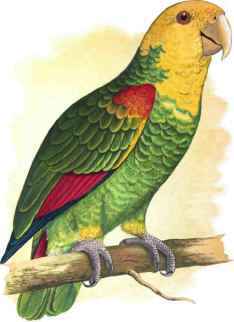
DOUBLE - FRONTED OR VAILLIANT AMAZON.
To return to our Double-fronted friend, of which a very good example, from which our illustration is taken, exists in the Zoological Gardens in the Regent's Park, where it has lived, without water, for several years. Now, although we are perfectly well aware, as a writer in that grandmotherly Review, The Saturday, recently pointed out, that Parrots can exist without drinking, we maintain that it is unnatural for them to do so; and granted that in their wild state some of them, Psittacus erithacu8 for instance, seldom resort to the water-courses, it should be remembered that in the countries where these birds are found the dew falls very heavily, and the leaves during the night are saturated with moisture, which, on more than one occasion, we have seen birds, Parrots included, eagerly sucking before they left their roosting-places to seek their food in their accustomed haunts: but in captivity, where, as often as not, their food consists of dry seed, they have no opportunity of drinking dew, and require to be supplied with water, if they are to be kept in health. It is no answer to say that they can live without drinking; the question is, does it make the poor things suffer? and there can, we think, be no doubt that it does. In no other part of the world with which we are acquainted does the absurd custom prevail, and when we have mentioned it to foreigners, our statement has been received with an astonishment bordering on incredulity.
On the authority of an observer (Beobachter) in Venezuela, Dr. Russ, in his excellent Handbook, remarks: "Of all Parrots found in this region the one under consideration learns to speak the most readily and distinctly"; and this appears to be the general verdict with Le Vaillant's Amazon, which English dealers commonly speak of as the Double-fronted; why, it would be rather difficult to say, seeing that the face of the bird is all of one colour, namely, a pale yellow; the shoulders are red, and the rest of the body green, darker above, and of a lighter shade on the under surface.
The Hon. And Rev. F. G. Dutton's Account Of The Le Vaillants Amazon (Chrysotis Le Vaillanti)
According to my experience, the cleverest and most accomplished birds are found in this family, though their powers of talking vary a good deal with individuals. I have had three, varying from one, quite the cleverest and most charming Parrot I ever had, to another which was quite as distinguished for its want of cleverness and amiability.
My clever one I bought in Brest, from an old couple. I suppose the man had been a sailor: the home appears to have been a place where strength rather than choiceness of language was the rule. It would have been impossible for me to have kept the bird, had it not been French. Its language was enough to make one's hair stand on end. But it sang several songs, did the soldiers1 exercises, and had many other phrases, all of which it repeated whenever I wished it. I imagine it would always have done so for the person who fed it; otherwise it would not talk for all the world. It would always talk for any labourer or any man with a gruff voice, be he French or English, and swear too. It laughed with as vulgar a laugh as one can well conceive. I gave one hundred francs for it, but it was well worth three hundred. I suppose its talent was too much for it, for it died about two years or so after I bought it, of cancer on the brain.
Before this I had been very much taken with one I had seen in some lodgings in London, and so procured one for myself from Liverpool. I bought it quite young, and it only proved a moderate talker while I had it. I ought to have said that my French one was absolutely good-tempered: I could do anything with it. I had to hold it while it underwent a cruel operation in the hope of cure. Of course during the operation I held it in a towel. But the moment it was over, it had not the least resentment.
The Liverpool one was not so good-tempered, but I do not know that I kept it long enough to try. I doubt if I was patient enough:
I ought to have kept it longer, for I rather think these birds take several years to get to their full powers.
The last one I had I bought partly from pity, and partly in memory of "Cocot", the French one. It had lost an eye, but I was assured it had been a fine talker. However it never uttered a word with me, and was incurably morose. I made it sit on my finger, and taught it not to bite me, but it would dash at anybody who went near the cage. I eventually lost it by turning it out. It never would eat anything but hemp seed, and this of course stopped my having any chance of taming it by giving it luxuries. Few Parrots resist spongecake or pea-nuts, but this refused everything but hemp seed. I expect it had been caught old. If I were buying a "Double-fronted" Amazon, for that is the name by which dealers call them, I should try and buy a cock bird; and for that purpose I should choose one with as yellow a head as possible. The amount of yellow may not entirely be a question of sex. I dare say as the birds get older they get a greater amount of yellow on the head, but I always think the male bird has a yellower head than the female, and for talking I would always rather have a male bird, just as I would for singing.
I have come to the conclusion that as a pet for a cage bird, for my experience is confined to cages, as I have no aviary, the best Parrot is a Jardine's Parrot (Poeocephalus Gulielmi), the next, a Double-fronted Amazon, and the third, a Grey.
Continue to:


My Books

