


Many-Coloured Parrakeet. Psittacus Multicolor. Psephotus Multicolor. Platycercus Multicolor
Description
This section is from the book "Parrots In Captivity", by William Thomas Greene. Also available from Amazon: Parrots in Captivity.
Many-Coloured Parrakeet. Psittacus Multicolor. Psephotus Multicolor. Platycercus Multicolor
Psittacus multicolor, Russ, KHL., Tmm.
Synonyms: Platycercus multicolor, Vgrs., Wgl., Fnsch.;
Psephotus multicolor, Gld., Bp., Gr.; Euphema multicolor.
German:
Der vielfarbige Sittich.
AVERY beautiful, but most unsatisfactory bird is the Many-coloured Parrakeet: a glance at the engraving will convince the reader of the correctness of the former assertion, and our word may be taken in confirmation of the second; for we are by no means alone in our opinions: "A glance at the illustration", writes Mr. Wiener, "will convince the reader that the Many-coloured Parrakeet is one of the most beautiful birds of his tribe. The female in my possession happens to have endured for years, but I feel sure that some day she will be so unreasonable as to die, without any palpable reason, as several of her mates did long ago."
"Lebhaft und anmuthig, ebenso liebenswurdig ah prachtig", writes Dr. Russ, "dock kommt es vor, das auch er plotzlich ohne ergrundbare Ursache erkrankt und stirbt." (As lively and charming, as it is desirable and beautiful, it nevertheless happens that it will suddenly and without accountable reason fall sick and die."
Another writer speaks of these birds as if he had found them hardy, but as he also says that the female is all but indistinguishable from the female Redrump (Psittacus hoematonotus), his experience of the species was probably limited.
As Dr. Russ says, the male is a handsome fellow, the general colour of his plumage is rich emerald green, darker above than on the lower surface of the body, the forehead is yellow, the crown of his head deep crimson, the shoulders and the sides yellow, the flight feathers and the longest tail feathers deep greenish blue, the abdomen and the thighs blood red.
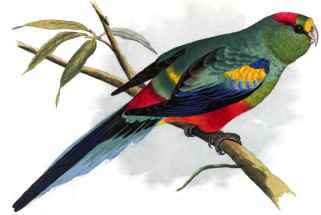
MANY-COLOURED PARRAKEET.
The female, as usually happens among birds, is much more soberly attired: her forehead is yellow, but of a paler shade than in the male, the top of her head green, the back and secondaries of the wings grey, the neck and breast reddish grey, the primaries green with black extremities, the abdomen yellowish green, the under tail coverts yellow, the tail greenish blue, but lighter than in the male, and her shoulder patch, instead of being yellow is red; so that she bears a considerable resemblance, not to the female Redrump, but to the female of the Beautiful Parrakeet (Psittacus vel Psephotus Pulcherrimus), from which however she can be distinguished by the larger extent of her red shoulder patch, while from the young male of the latter species she will be known by her breast of reddish brown, and the deeper colour of her wings and tail.
Not very numerous in their native country, these birds are not frequently imported; but when they do arrive, they are readily sold to amateurs at a high figure, notwithstanding the fact that they seldom endure for any length of time in captivity, for they and the following species, called the Paradise Parrakeet, are really Lories, and during the greater part of the year feed on the pollen and nectar of the Eucalypti and other flowering trees of their native land, for which sponge-cake is at the best but a poor substitute.
During the winter there is no doubt that these birds subsist on seeds, but these are always soft, and to keep them alive in this country nature should be imitated for them as nearly as can be: thus their millet and canary seed must be soaked in cold water for some hours, and then left to drain before being given to them; soft sponge-cake and bruised figs must also be supplied, and in summer, in addition to the above, they should have an abundance of groundsel tops, cabbage or brocoli flowers, mignonette, dandelion flowers, and so on, and especially the blossoms of the lime-tree: nor should half a dozen mealworms per diem be omitted for each bird.
Attention to these rules will enable the amateur to keep these beautiful birds successfully, and doubtless to breed them too; but with every care they are apt to look a little puffy one day, to be found the next morning by their disconsolate owner dead; the cause, constipation, a flow of blood to the head, or a rupture of a blood-vessel in the brain: or, pining for their natural food, they sometimes fall into a decline and gradually fade away, though their usual exit from this troublesome world is painfully sudden and unexpected.
The Many-coloured Parrakeets are very gentle and inoffensive creatures, never interfering with the other inmates of the aviary, nor even attempting to defend themselves when attacked, so that care must be taken not to place them with any of the strong-billed and mischievous varieties of their compatriots; they may be rendered very tame by the judicious administration of their favourite morsels, to obtain which they soon overcome their natural timidity and fear of man.
In their native country they breed in the hollow brandies of trees, laying three or four white eggs on the bare wood; and have usually two broods during the season. We have no authentic record of their having been bred in this country, or even on the continent; for although some were advertised recently as "aviary-bred", we cannot believe that the birds so offered saw the light in this changeable clime.
It is a pity they are so delicate and hard to preserve, for, with one or two exceptions, they are the most beautiful and desirable of all the Australian Parrakeets. When in good health they are very lively and active, and the male has a soft and musical voice, of which, especially during the pairing season, he avails himself pretty freely.
As might be expected from their gentle and inoffensive disposition, the sexes are strongly attached to each other, and are really much more truly deserving of the appellation of Love-birds than the short, squat little creatures upon whom it is usually bestowed.
We should take it as the greatest of favours if those readers who may attempt to keep these beautiful birds as recommended by us, or upon any other plan, would communicate the result of their endeavours to us through our publishers, for it is only by such interchange of experiences that we can ever hope to arrive at a solution of the difficulty hitherto experienced by amateurs in preserving this and the species that forms the subject of the following chapter.
When in health, and gradually weaned off to seed, sponge-cake and bruised figs, not forgetting the mealworms, the Many-coloured Parrakeets are not particularly susceptible to cold, but during severe weather avail themselves of the cozy shelter of a hollow log: in fact they get on much better without, than with, artificial heat in winter, and we have seen them successfully wintered out of doors, during the severe seasons of four and five years ago, and never saw finer, or, apparently, more healthy and vigorous birds.
M. Alfred Rousse, of Fontenay-le-Comte, records a case of successful reproduction of the Many-coloured Parrakeet last year.
Continue to:


My Books

