


Passerine Or Blue-Winged Parrakeet. Psittactis passerinus, Bchst., Linn.. Psittacula passerina, Wgl., Bp., Fnsch.
Description
This section is from the book "Parrots In Captivity", by William Thomas Greene. Also available from Amazon: Parrots in Captivity.
Passerine Or Blue-Winged Parrakeet. Psittactis passerinus, Bchst., Linn.. Psittacula passerina, Wgl., Bp., Fnsch.
Psittactis passerinus, Russ, Bchst., Linn., etc. Synonyms: Psittacula passerina, Wgl., Bp., Fnsch., etc.;
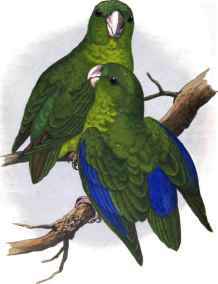
PASSERINE OR BLUE WINGED Parakeet.
Psittacula passerina, gregaria, et modesta, Lchtst., etc.
German:
Der Sperlingspapagei.
THIS nearly least of all the Parrot family, is truly deserving of the name of ' Lore-bird', which is so generally bestowed upon other species, for it really is "inseparable", and must be bought and kept in pairs.
Known to amateurs from the time of Buffon and Bechstein, and probably from a very much earlier date, there are few birds more worthy of the notice of connoisseurs: scarcely the size of a plump cock Sparrow, the short tail makes it appear even less, and at the same time gives it a kind of unfinished look, that detracts somewhat from its personal appearance, otherwise so quaintly and quietly pretty.
"The little blue and green Parrakeet", says Bechstein, "is as social and affectionate as the preceding (the Bed-faced Love-bird), but much more rare and dear."
"It is a native of Brazil", adds the old German author, "and cannot learn to speak."
The general colour of the plumage is deep green, the rump and the wings are sapphire blue, but scarcely to be noticed except when the bird is flying about, when the contrast of colours becomes very conspicuous.
The female is green all over, but with a whitish or greyish tinge about the head and neck, resembling very closely the female of the Madagascar Love-bird, no less than the female of the rarer Gregarious Parrakeet of the West Indies.
The species usually imported into this country comes from South America, where it is sufficiently common, but we have frequently seen a bird that very closely resembled it in the woods of the basin of the Murray river in Australia, which, by the way, we do not recollect to have seen described by any author, Gould included, to whose works we have had access.
The Blue Wing has been very frequently bred on the continent, especially by Dr. Buss, who obtained it in the third and fourth generation. Our own birds have, as yet, only produced eggs, although one hen laid five, which were all fertile, and would have been hatched but for a thunderstorm that broke over the district when they were nearly ready to come out of the shell; whether the jar of the thunder killed the wee birdies, or frightened their mother from the nest, and so the eggs caught cold, who can tell ? Yet she was not easily startled, and sat so closely that she injured her health by her devotion to the family that was not to be; and to such an extent that when we found the eggs were spoilt, and removed them, the poor little hen drooped and appeared so ill, that we took her out of the aviary with the double object in view of nursing her up, and at the same time preventing her from going to nest again until she was quite restored.
But alasl 'the best laid schemes gang aft agley': poor Blue Wing took the separation so terribly to heart, that after shrieking himself hoarse, and dashing wildly about the aviary, in vain attempts to find an avenue of escape, we turned her in again, when, so great was his joy, he fell off his perch in a fit, in which he very nearly died: but after a few minutes he seemed to rally himself by an effort, and managed to fly up to the perch upon which his wondering little wife was sitting, with something not very unlike tears in her usually bright black eyes, and pressed himself as closely as possible to her side: in this situation we left and found them after the lapse of some hours, when we discovered that he was almost incapable of supporting himself upon his feet, so we took the unfortunate little couple into the house, and - let us draw a veil over the close of the sad, sad tragedy. - How one's best intentions will miscarry now and then, and, where we meant nothing but good, carry woe and desolation to the very objects of our care.
Strange to say, not only does the male Blue Wing, fond as he is of his wife, not assist her in the weary task of incubation, but, as far as wo could discover, even feed her while she is sitting on her eggs, which are usually four or five in number, roundish, and pure white: the period of incubation would seem to be about eighteen days; and there are said to be two or three broods in the year.
These little birds are very frugal in their habits, preferring canary seed to any other, but eating freely of bread soaked in cold water, and squeezed nearly dry: they do not seem to care much for green food, but nibble a little fresh grass now and then.
They do not drink much, and we have not seen them bathe.
Their cry is harsh, and loud, but is not very frequently heard: the pairs converse with one another in a little subdued chatter, that sounds rather prettily, but they are usually silent and undemonstrative when under observation, which, as they are very quick, is not of frequent occurrence without their knowledge. We have watched one, through a loop-hole, for a quarter of an hour at a time, and have never seen him budge, his keen black eye fixed intently on ours all the while; and as soon as we looked away, he was off like a shot to the furthest corner of the aviary.
Although so timid at other times, the hen Blue Wing sits as devotedly on her eggs as any bird with which we are acquainted, even suffering her cocoa-nut husk to be taken down and carried to a distance without deserting her charge.
In their wild state these birds breed in the hollow branches of trees, but in the bird-room or aviary seem to prefer a medium-sized cocoa-nut husk for their nesting-place: they make no nest, properly so called, but content themselves with removing the superfluous fibre from the interior, and smoothing it down for their use.
They are better kept in a place by themselves, two or three pairs together, but are not to be trusted to the tender mercies of Budgerigars, Madagascars, or Bed-faced Love-birds. A male, however, will mate with a female Madagascar (Agapornis carta), and even, a friend writes us, with a female Red-face (Agapornis pullaria), but whether .the progeny of such unions, if progeny there were, would be capable of reproduction, as another acquaintance of ours is inclined to believe, we cannot say, though we doubt the fact: but if so, these three birds would be simply local varieties of the same, and not three distinct species as they are generally considered to be.
Will some of our readers make the experiment, and kindly acquaint us, in due time, with the result?
There is another species of Love-bird that is often confounded with that under consideration: the resemblance between the two is so considerable that even Dr. Buss considers it an open question whether it is anything more than a variety of the ordinary Blue-winged Parra-keet; but we think it is. In the first place it is a decidedly larger bird, has a smaller beak, and the only blue about its person is on the under wing coverts, where it is not, of course, seen unless the bird is flying.
The female, too, differs considerably from the ordinary female Blue Wing, especially by her greenish yellow face, which is very perceptible when the birds are seen together. In a general way we object to the multiplication of species as leading to confusion; but where the differences are so marked as they are between the ordinary Blue Wing and the bird called Der Sperlingspapagei ohne blaue Unterflugel by Russ, the Psittacus Santi Thomoe of Kuhl, we have no alternative but to separate them, or abandon specific distinctions altogether.
Since writing the above we have observed that our widowed Blue Wing does not seem to be in the least affected by the loss of her poor husband, whose sad fate we have related on a preceding page, but on the contrary is getting over her moult nicely, and is looking strong and hearty, and we have no doubt will be quite ready to accept the attentions of a new husband when we present her with one in the Spring.
So much for the relative strength of attachment in the two sexes; the male died because he could not live alone for an hour, and the female, apparently, loses this constant mate unmoved, and bestows not a thought upon his memory. It seems almost a libel on the fair sex, but it is true, nevertheless; the power of love is greater in the male than in the female, as a rule, throughout creation: there are exceptions no doubt, but these rather confirm than disprove our assertion.
"As far as my experience has gone", writes our friend Mrs. Cassirer in this connection, "I find the male birds, as a whole, far more sweet-tempered and devoted to their families than the hen birds."
Need we add another word?
Continue to:


My Books

