


Red-Winged Parrakeet. Prittacus erythropterus. Aprosmictus erythropterus, Gld.; Psittacus melanotis, Shw
Description
This section is from the book "Parrots In Captivity", by William Thomas Greene. Also available from Amazon: Parrots in Captivity.
Red-Winged Parrakeet. Prittacus erythropterus. Aprosmictus erythropterus, Gld.; Psittacus melanotis, Shw
Prittacus erythropterus, Russ. Synonyms: Aprosmictus erythropterus, Gld.; Psittacus melanotis, Shw.;
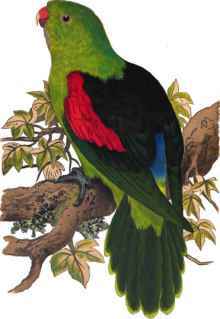
RED-WINGED PARRAKEET.
Platycercus erythropterus, Vgrs.; Ptistes erythropterus et coccineopterus, Gb.
German: Der rothflugelige Sittich.
THIS delightful Parrot is not an uncommon inhabitant of the greater part of the Eastern Australian "bush", but more especially abounds in the northern parts of the great island continent; yet it is among the rarest importations from that land of Parrots, and, consequently, commands a high figure in the bird-market, from £3 to £5 and upwards being the price of a pair.
The greater portion of the plumage is rich grass-green; the back, shoulders, and wing coverts are velvety black; a broad red, or rather crimson, patch ornaments the centre of the wing, and the rump is blue: the eyes are reddish, and the beak orange red.
According to Gray, the female is almost entirely green, the red on her shoulder reduced to very small proportions, and the velvet black of the back and wing coverts entirely wanting. Mr. Wiener, on the other hand, states that "the plumage of the female is less bright, and the red on the wing less extensive", but says nothing about the absence of the velvet mantle. Mr. Gedney agrees with the former writer; "The hen", he writes, "is less brilliantly coloured, her body plumage being dull green, of a palish hue, merging to yellow on the abdomen, with a strip of red upon the wing, and a blue patch at the base of the tail. She lacks the rich velvet black which makes the back of her mate so strikingly handsome, and her plumage is altogether inferior to that of the male bird."
In Lear's excellent Illustrations of the Psittacidoe, the female is represented, coloured, as described by Mr. Gedney, and the young male is distinguished from his mother by the extent of the red bands on his wings, and from his father by the absence of the black back; the young female is not depicted, but is said to resemble her mother.
There is no record of this species having been bred in confinement, although an aviarist in Germany had a solitary female that laid eggs: which would tend to prove that the achievement is not impossible.
The food of this species is the same that we have already recommended for the Cockatiel, and in addition a bough of lime tree, or poplar, or elm, covered with buds, may be given it to peck at, an inexpensive indulgence that will be much appreciated by the Red-wing, as well as some stale sponge-cake, and a few mealworms, now and then.
Mr. Wiener's experience with these birds is, on the whole, favourable. "The Red-winged or Crimson-winged Parrakeet", he writes, "is a timid, rare, and very beautiful bird, well adapted for cage life. Though the Crimson-wing may not learn to talk, neither will he scream; and his gentle manners, together with his brilliant plumage, will recommend him as a pet."
This author, nevertheless, proceeds to relate that two of these birds could fight so bitterly, when placed together in the same cage, that their speedy separation became imperative, in order to prevent the destruction of one, if not of both the combatants, and that although they were a genuine pair, which a subsequent owner succeeded, by a simple expedient, in reconciling so effectually that the birds mated.
"A few drops of aniseed oil", relates Mr. Wiener, "were spread on the plumage of the Blood-wing hen, and the effect was beyond all expectation, for instead of quarrelling and biting, the birds at once displayed great affection for each other, and there is every prospect of a brood resulting."
Whether this prospect was realised or not, we do not know: but we are inclined to adopt the negative view; for had the birds really reared a brood of young ones, we should doubtless have seen the success chronicled in some of the "Bird papers" with which we are acquainted, one or other of which is almost certain to get hold of a piece of important news, such as an account of the breeding of Bed-wings in captivity would be.
Mr. Gedney, from whom we have already largely quoted, also speaks in the most favourable terms of these handsome birds: "I can", he writes, "specially recommend them as cage pets on account of their great beauty and quiet nature."
They can, nevertheless, as we have seen from Mr. Wiener's account of the specimens he possessed, fight bitterly at times, so that it is scarcely wise to draw general conclusions from one's experience with a single pair, for doubtless the Red-wings, like all other birds and animals, vary in their several dispositions; one individual is meek and good-tempered, and another haughty and overbearing: there are exceptions to every rule, and the amateur who acquires a new bird, or a new pair of birds, would do well to watch them, and study their disposition, before turning them out among the established inmates of his aviary: and even when he thinks he has become thoroughly acquainted with them, he will do well to observe them carefully for some time, and watch their behaviour towards their fellow captives, when he has at last made up his mind to restore them to relative liberty in the aviary or bird-room.
This Parrakeet was classed by Swainson with the Lories, but erroneously so, for its food, in its native wilds, consists of seeds of all sorts, berries and insects belonging chiefly to the beetle kind (Cole-optera). Swainson asserted that it also partook of honey and pollen from the Eucalypti; but, if so, these are not indispensable to its well-being, as in the case of the Lories proper and the Trichoglossi, or Australian Lorikeets.
The food in confinement we have already mentioned, and upon it this bird will live in the house for a number of years, in the enjoyment of apparently perfect health, and certainly in the possession of unimpaired beauty.
The length of the Bed-winged Parrakeet is about twelve inches, and the bird is stoutly proportioned: it is not very strong of beak, nor much given to whittling; consequently, if it be desired to induce it to breed, a suitable nesting place must be provided for its accommodation, in the shape of a naturally or artificially hollowed log of wood, hung up in some quiet corner of the aviary, for the Red-wing is a timid bird, which, although tolerably tame when confined within the bars of a cage, soon becomes wild again when restored to comparative liberty in a large aviary.
That it is tolerably hardy is abundantly evidenced by the fact that a fine male of this species has survived for several years, without water, in the Parrot House of the London Zoological Society, in the Regent's Park.
A friend of ours who spent some years in Northern Queensland, assured us that the Red-wing was the commonest kind of Parrakeet in that part of the country; he also said that it lived in great measure on the blossoms of the "wattle-trees", a kind of mimosa, and that often when he shot them the honey used to run out of their beaks in a stream, and that the aborigines, when they killed one, always put its head into their mouths and sucked the honey from the birds' crop.
As we had our doubts of the correctness of these assertions, we cross-examined our friend pretty severely as to the accuracy of his recollections, then referring to a period of some years back, and he confessed that perhaps it was the Blue Mountain Lory that the natives used to treat in the manner he described, and from which he had seen the nectarious juices of the wattle trees flowing in a stream; but he was positive as to the correctness of his reminiscences in regard to the frequent occurrence of this Parrakeet, and in proof thereof showed us a goodly number of wings which he had taken from the birds he had shot and preserved.
So we were satisfied, for we could not bring ourselves to believe the first account given by our friend of the Red-wing to be correct, it being quite at variance with all that we knew of the bird and its habits; for persons who are not naturalists are scarcely to be trusted, in a general way, with regard to the accuracy of their recollections of animals, especially when they are suddenly called upon after the lapse of a few years to relate their experience; and it is by neglecting the thorough sifting of such evidence, that so many mistakes have crept into works on Natural History; there is always some risk of taking information at second-hand, but occasionally there is none other to be had, in which case.the statements made require testing in every possible way.
Dr. Russ is certainly in error when he says: "Heimat ganz Austra-lien", (it extends over the whole of Australia,) for it is confined to the eastern, and especially the north-eastern, portions of that country.
We are with the doctor, however, entirely, when he says: "It is remarkable for its elegance and amiability, and is as enduring as most of the genus. It is a pity it so seldom reaches the dealers' shops."
Let us hope that as its various good qualities become better known to the philavian public, a demand will be created that will result in a more abundant supply of the Red-winged Parrakeet in the bird-market than has hitherto been the case. And as a female in the possession of Herr Professor Kamphauson has actually laid eggs in Dusseldorf there seems no reason why the bird should not be bred, by and bye, in our aviaries.
Seeing that the Red-wing is a gentle and tractable bird, it should learn to speak, and acquire the use of articulate language, at least to as great extent as any of its relations, such as the Rosella, Cockatiel, and others of which we have read accounts, as well as seen and possessed examples: the fact being that with patience and perseverance any bird can be taught to imitate the human voice; even such unlikely subjects as the Canary bird, not to speak of the Bullfinch; for individuals of both the latter Species have spoken distinctly to our knowledge: the former used to say " Pretty Dick, pretty Dick, pretty little Dickee; kiss, kiss, kiss, pretty little Dickee": and the latter used to bow, spread out his tail, and repeat "Hip, hip, hurrah!" with the most remarkable correctness of intonation; he would also say, Peter (Pee-ter), his own name, quite distinctly, and we have no doubt would have learned many more words, had he not succumbed, prematurely, to an attack of that terribly fatal and insiduous disease, bird-fever, or bird-typhus as some writers and dealers name the frightfully infectious malady that now and then sweeps off the whole of the inmates of an aviary, with cruel and implacable swiftness.
When this fell disease makes its appearance in a bird colony, the only chance of safety for any of its members consists in removing the yet healthy individuals to quite new, and, if possible, remote quarters, separately, where this can be done, and ruthlessly destroying the old cages, in which the infection will linger for many months, and possibly for years: and that the destruction, total and complete, of the old tainted residences is the only certain way of preventing a recurrence of the disaster, is borne out by facts in our possession, where aviarists who had "thoroughly disinfected", with carbolic-acid, sulphur, boiling water, and exposure to the air for many days, and even weeks, the cages in which an outbreak of "fever" had taken place, found that new birds, previously healthy, when placed in them, often after a long interval, contracted the malady, and died in a few days.
For this terrible complaint there seems to be no remedy, its Symptoms are listnessness, loss of appetite, ruffling up of the feathers, great thirst, sometimes slight, rarely severe, diarrhea, loss of strength, and death in two or three days, sometimes in about as many hours. As we have said, there is no cure, it must be at once stamped out, and it is far better to immediately destroy the affected individuals by means of a merciful drop of prussic acid, and remove the survivors to more healthy quarters, maintaining the strictest quarantine until all chance of danger is past.
As the complaint has a decided period of incubation, extending over a period of three or four days, it is always best when buying a new bird, to isolate it from its future companions for at least that space of time, when, if it still continues to appear "all right", it may be introduced to its new associates, without fear of its conveying to them the germs of a terrible disease: prevention is better than cure, even where the latter is at least a possibility; what then when there is absolutely none?
Red-wings being expensive birds, it will, of course, be policy to secure them, as far as possible, from the risk of infection, and to make them as happy and comfortable as they can be made in captivity, in order to tempt them to reproduce their kind in the aviary; although natives of a warm country, they will stand the cold of our winters in an unheated room indoors, but we have not ventured to test their endurance out of doors, although we are disposed to believe that they would not, under such conditions, be more delicate than many of their compatriots.
With regard to the remark on page 2 of the first number of Parrots in Captivity, that "Like all the Parrot tribe, with one or two doubtful exceptions, the nesting place of Goffin's Cockatoos is in the hollow of some dead branch", our esteemed correspondent, Mme. Cassirer, of Paris, writes: "Why 'doubtful'? Are the accounts of the nest built of sticks of the Quaker Parrot (Bolborhynchus monachus cinereicollis), given by Azara, Darwin, Castlenau, and Burmeister, and in captivity in South America by Azara, by Schmidt in Europe, by Dr. Brehm, and Mulzel in the Zoological Gardens of Berlin - not sufficient to convince you? Do you not believe the accounts of the nests of the Peach-faced Love-birds (Agapornis roseicollis) given both by Drs. Brehm and Buss, and also of the Grey-headed Love-bird?" We are convinced: and cry ' Peccavimus.'
Continue to:


My Books

