


Rose-Hill Or Rosella Parrakeet. Psittacus eximius. Psittacus capitatus, Shw., Khl.; Psittacus omnicolor, Bchst.; Platycercus eximius, VGRS., Gld
Description
This section is from the book "Parrots In Captivity", by William Thomas Greene. Also available from Amazon: Parrots in Captivity.
Rose-Hill Or Rosella Parrakeet. Psittacus eximius. Psittacus capitatus, Shw., Khl.; Psittacus omnicolor, Bchst.; Platycercus eximius, VGRS., Gld
Psittacus eximius, Russ. Synonyms: Psittacus capitatus, Shw., Khl.; Psittacus omnicolor, Bchst.; Platycercus eximius, VGRS., Gld., etc.
German: Der Buntsittich oder die Rosella.
French: La Perruche omnicolore.
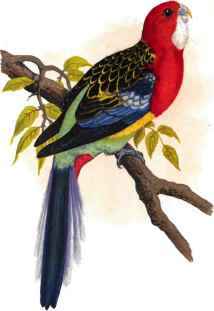
ROSE - HILL OR ROSELLA.
"NOT only is this bird distinguished for the rich colouring of its plumage, but by its lively and active habits, and, in the breeding season, by the comical way it has of singing and dancing"! Dr. Russ thus commences his description of the Rosella, which certainly is one of the handsomest of the Australian Parrots, and at tho same time one of the most familiar and easily managed of all its congenors! it is about the same size as the Cockatiel, but of rather stouter build, with shorter tarsi and stronger feet and claws: it is found in Tasmania, and all the southern parts of Australia, where it breeds in hollow boughs from October to January, laying from five to seven and oven nine eggs at each setting.
The head and neck are bright red, the throat yellow, the cheeks white with a bluish shade, the back greenish olive, the tail green and blue: the back feathers are black edged with green.
The sexes are alike in colouring, but the female is a more sedate personage than her mate, who is vivacity personified; she is a trifle smaller than he is, and the tints of her plumage rather less vivid than his.
The young resemble their parents, but are much less brilliant in appearance: they grow slowly, and seldom assume the adult plumage until quite twelve months old.
The Rosella is a very hardy bird, caring nothing for our severest winters, providing the aviary in which he is placed is sheltered from the north-east winds, and he has some snug box, or hollow log, to which he and his wife can retire during the coldest nights.
In the matter of diet, he will do very well on canary, hemp, and oats, with bread-crumbs, and green food of all kinds added: water he should always have access to, although the authorities at the Zoological Gardens in the Regent's Park are of a different opinion; but in Australia, we have seen flocks of them frequenting the water-holes and creeks at all hours of the day, and so thirsty are they, that they will drink salt-water if they cannot get any other.
The Rosella has very frequently been bred in Germany and in France and Belgium as well as in this country, and may now be almost looked upon as a European bird; the greatest obstacle in the way of its successful rearing being the great resemblance of the sexes, which renders it difficult to secure a pair: the female is rather more subject to egg-binding than the other members of the family which have been bred in our aviaries, and requires to be carefully watched at the commencement of the nesting season, so that she may be placed under treatment at the very first indication of illness.
In the matter of inability to lay her eggs, prevention will be found to be always better than cure, and if the bird be strong and healthy, and has had access to old lime, there will be little fear of her being attacked by this distressing complication: when, however, it manifests itself, the bird must be captured, given a dose of castor-oil, have the vent anointed with the same, and be placed in a warm room: then, when the egg has been laid, she had better not be returned to her mate for some time - not at all if she appears to be in the least drooping.
There is no doubt that during their breeding season in Australia the Rosalias eat a considerable number of insects, notably coleoptera and white ants, which they find in hollow logs and branches: and in captivity we would recommend that a few mealworms, or even scoured gentles be given them when about to nest, as well as when there are young ones to be fed.
It will be readily understood that seven or eight young Parrakeets will consume a large amount of food, and so bread, soaked in cold water, must then be placed at the parents' disposal, as well as boiled oats and maize: hay-seed the Rosellas enjoy vastly, and a few handfuls will afford them not only occupation but amusement, and be a wholesome change of food as well.
These birds are susceptible of being tamed, and will even learn to repeat a few words, that is to say the male will, for his lady-wife has not much talent in this direction.
The Rosella is a very noisy bird, almost as much so as the Cockatiel, and is, consequently, scarcely to be recommended as a cage-pet to persons of weak nerves: in a large aviary, however, he will do very well indeed, and constitute one of its chief attractions, for he is, apparently, quite conscious of his personal charms, and is never weary of displaying them to the best advantage: everlastingly in motion, and everlastingly warbling, or chattering, he keeps the whole place in a commotion, and must on no account be trusted with other birds weaker or more defenceless than himself, for, despite his rich dress and gentlemanly deportment, he is a decided "tartar", and, especially during the breeding season, brooks no intruder near his domicile.
In the Australian bush the Rosella is of very common occurrence, frequenting especially the neighbourhood of cultivated lands, where it commits sad havoc with the crops, and is consequently detested by the farmers, who shoot and snare it whenever they get the chance, and destroy its nest without mercy or compunction, which is a stupid thing to do, as these birds always command a good price in the home market, and find ready purchasers in the Australian towns: but the farmer, whether Australian or English, is not a far-seeing personage and for a slight temporary benefit has no notion but to forego a future emolument that is not very prominently placed before his eyes; and really not always, even then, will he perceive and avail himself of the promised boon.
There is no doubt that a farmer, or anyone else for that matter, who would undertake to keep and breed, not only the commoner, but especially the rarer species of Parrots, whether in Australia or in South Africa, would make a good speculation, and find a ready market for the produce of his aviaries: in this country the climate is too changeable to permit of the success of such an undertaking, unless perhaps in the extreme south, and even there in a warm and sheltered situation only; but in France a Perrucherie is by no means an uncommon sight, and is a highly remunerative speculation to boot: Parrots, as a rule, are as easily kept as Pigeons, are very nearly, in fact, considering that the Pigeon has but two young to a nest, and the Parrot has, usually, five or six, quite as prolific, and, with the exception of some of the fancy sorts of the former bird, command a much higher price, and we wonder that Parrots are not more frequently kept on a large scale than they are, for they are excellent eating, and their feathers in much request for ladies' hats and bonnets.
A strong, well-built aviary, plenty of hollow logs, that is all that is needed for a Perrucherie: with the exception of the Cockatiels, however, which we have never found to interfere with their fellow-captives, most of the Parrots would require an aviary to themselves, but as the greater number of species are gregarious, several pairs of the same kind may, usually, be kept together, and, providing there is plenty of nesting accommodation about, will not interfere with each other's arrangements: many species, indeed, breeding better in company, than when one pair only is kept.
It is needless to reiterate that a sufficiency of nesting accommodation must be provided, or adieu to peace, and to all hope of increase in the Perrucherie: but when this has been attended to the birds will soon settle quietly down, and rarely meddle with one another, for Parrots, on the whole, are sociable birds, and get on better in company than when kept in solitary confinement in a cage; though some misanthropic individuals seem by their conduct to contradict point blank this assertion: nevertheless that there are exceptions to every rule is well known, establishing rather than overturning it: and that this is the case with Parrots, the experience of every aviarist who has kept them in any numbers will, we think, confirm.
When forming a collection of Parrots in an aviary, it will be well to group together the species that more nearly approach each other in size and habits: thus we would not recommend placing Sulphur-crested Cockatoos in the same enclosure with any of the Love-birds, although some species are usually so amiable and accommodating, the Cockatiel for instance, that they will get on in any company, minding their own business with praiseworthy assiduity, without ever inquiring what their neighbours are doing, what they are going to have for dinner, who their relations are, or what means they have for getting on in life, as so frequently happens with the superior creature man.
Needless to plant trees or shrubs in an aviary of Parrots, but hollow logs, trees even, will be a great boon to the inhabitants, affording them not only snug retreats in which to deposit their eggs, and hatch and bring up their young, but also an infinite fund of amusement, not to say delight, and exercise to boot, for nearly all the Parrots are born "whittlers", and if they have not a handy log "convenient", as an Irishman would say, on which to exercise their powerful mandibles, they will find some other and more objectionable mode of whiling away the time, by quarrelling among themselves, or even turning to and plucking out their own feathers by the roots, until they leave themselves quite bare.
As soon as the young of one brood can feed themselves, it is desirable to remove them to other quarters, lest they interfere with the domestic arrangement of their parents, and prejudice the production of another brood. Of course overcrowding must be carefully avoided, and if a separate aviary can be given to each species, so much the better: but this is not absolutely, nor even imperatively necessary, as most of these birds are fond of company, and thrive better in the society of their fellows than when kept alone by themselves.
A male Rosella kept in a cage by himself, especially when he has been brought up by hand, makes a very nice pet, if somewhat noisy, for he gets very tame, and learns to speak fairly well: but a pair are most objectionable, for the male becomes intensely jealous, and spiteful, and his shrieking propensities are quadrupled. A hen Rosella is a very quiet, gentle little bird, seldom or never shrieking, and as she is quite as handsome as her mate, though a trifle smaller, she should be preferred as a cage pet: she is not very intellectual we must admit, but otherwise she is superior to her more demonstrative partner.
Independently of the subject of our next two chapters, there are several varieties of Rosellas to be met with in Australia; for instance, one called by the dealers "the large Rosella" otherwise the Adelaide Parrakeet (Psittaeus platycercus Adelaidoe, Gld.), and the small, or Earl of Derby's Parrakeet, which is found in West Australia only; and in addition to these, Gould enumerates other specific varieties, which all bear a strong family likeness to the bird under consideration, and by an unpractised eye are scarcely to be distinguished from it.
Continue to:


My Books

