


Yellow-Pumped Parrakeet
Description
This section is from the book "Parrots In Captivity", by William Thomas Greene. Also available from Amazon: Parrots in Captivity.
Yellow-Pumped Parrakeet
In its native land, is surely rather extraordinary, especially as it is frequently kept as a cage-pet by the colonists, and being a grass-seed feeder is by no means difficult to preserve in captivity.
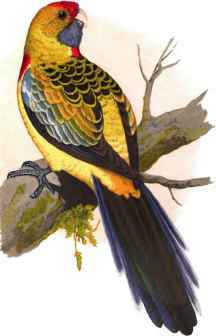
It was described by Latham, but the engraving accompanying his text is very distorted, and conveys an exceedingly poor idea of the bird, which is really a handsome creature.
In his great work, The Birds of Australia, Gould describes this species with his usual felicity, and gives a graphic portrait of it: it is to be regretted that so little is known of this charming Parrakeet in this country, for it is hardy, lively, and beautiful, not too noisy, as Parrakeets go, and susceptible of being rendered very tame; its capacities for the acquisition of knowledge are not very great, but a young male brought up from the nest will learn to repeat a few short words about as well as the Rosella.
In the vast primeval forests of the Great Southern Land the Yellowpumped Parrakeet is at home, and, of course, seen and heard too, to the best advantage; the glaucous green of the foliage of the Eucalypti forms a not inharmonious contrast to the golden yellow shades of his plumage, and his cries pass unnoticed amid the concert of Nature which they contribute to maintain; in confinement, however, he is, as we have said, not inordinately noisy, and may be kept in a parlour without fear of any one being driven out of the house by his cries.
In its native woods this bird breeds in the hollow limbs of trees, a rule to which we know of no exception in Australia, save that of Pezoporus formosus, making no nest, but depositing its eggs on the bare wood; it is shy, however, and the nest is difficult to be discovered, and more difficult still to be plundered, when long and careful watching has revealed its site, which is so carefully selected as to be almost inaccessible to man or beast. The breeding season extends from September to February, and there are, usually, two broods* in the season, of four or five young ones, which remain in company with the parents until the following spring, when they separate, and each pair sets up housekeeping on its own account.
It is curious to mark the resemblances that approximate the different kinds of Parrots to each other, no less than to consider the distinctions by which they are differentiated, and to observe by what strong evidence it is shown that they must all have been formed upon one original plan, rather than, as the Evolutionists say, have descended, in the lapse of ages, from a common ancestor. That "lapse of ages" is a very handy bridge to get over a difficulty on: but which was the common ancestor? was it a Macaw, or a Madagascar Love-bird? a Grey Parrot, or a Budgerigar?
"The common ancestor has perished, but the links of the chain that connect the whole Parrot family with him remain", it may be replied: well, we prefer another theory, which has the advantage of requiring neither axiom nor postulate to prove its very truth.
The Evolutionist when confronted with a difficulty, meets it by assuming "ages", and saying that this species "has taken to doing so and so", and this other to "doing in such another manner", and "this or that characteristic has been acquired, or relinquished", in virtue, of course, of some inherent power existing in the creature itself to modify its structure. The falsity of this doctrine has been demonstrated over and over again, but it is nevertheless gaining ground; it is the "fashionable" theory of the day, and like all other outcomes of fashion will have its day.
Lories, for instance, are Parrots which "have taken to living among blossoming trees, and feeding off the nectar and pollen of the flowers, instead of seeds and grains. Accordingly, they have acquired a shape well adapted to their new habits, including the short tarsi, and the long filamentous tongue characteristic of these birds", but if anyone should ask when this change of form, this divergence from the original Parrot type took place, he will be told that it all happened long ago, is expected to accept that answer as satisfactory and conclusive, and to ask no more questions, which are embarrassing. "Maman", said a French child to her parent one day, "where is France situated?" "In Europe, my love": "and where is Europe, Maman?" "In the world, my dear": "but where is the world, Maman?" "In the universe, Miss": "but where is that?" "Tais-toi donc, imbecile, tu m'embetes!"
What a distance we have wandered from our Yellow-rumped friends to be sure! France, the world, the universe, and we know not where beside; but not further than the Evolutionist from a true solution of the problem of life. It is a favourite theory with the apostles of the new belief that every one who dissents from their views is a fool; so be it - we prefer our folly to their wisdom.
It is curious, to say the least, that a theory propounded by its author to account for the extinction of a species, should be evoked to explain the origin of species in general by philosophers of quite a different school.
Professor Owen thus writes in reference to the Origin of Species, by the late Mr. Darwin: - "The influence of the contest for existence, amidst the changes of the circumstances to which an animal has been adapted, on the extinction of species, was first propounded by the author, in his fourth memoir on Dinornis, 1850, (Trans. of the Zool. Society, vol. iv., p. 15.) The same principle has since been evoked to explain not only the extinction but the origin of species. Mr. Wallace (Proceed. Linn. Society, August, 1858, p. 57,) assumes that a variety may arise in a wild species, adapting it to changes in surrounding conditions, under which it has a better chance of existence than the type-form from which it deviated, and of which it would take the place. Mr. C. Darwin had, previously to Mr. Wallace, conceived the same application of this principle, which he illustrates in his work On the Origin of Species, by many ingenious suppositions, such as the following: - 'To give an imaginary example from changes in progress on an island, let the organization of a canine animal which preyed chiefly on rabbits, but sometimes on hares, become slightly plastic; let these same changes cause the number of rabbits very slowly to decrease, and the number of hares to increase; the effect of this would be that the fox, or dog, would be driven to try to catch more hares; his organization, however, being slightly plastic, those individuals with the lightest forms, longest limbs, and best eye-sight, let the difference be ever so small, would be slightly favoured, and would tend to live longer, and to survive during that time of the year when food was scarcest; they would also rear more young, which would tend to inherit these slight peculiarities. The less fleet ones would be rigidly destroyed. I can see no more reason to doubt that these causes in a thousand generations would produce a marked effect, and adapt the form of the fox or dog to the catching of hares instead of rabbits, than that greyhounds can be improved by selection and careful breeding/ Yet this condition of things, if followed out to its full consequences, seems to lead only to my original inference, namely, an extinction of species; for, when the hares were all destroyed the long-legged dogs would perish. At most there could but be a reversion to the first form and conditions. For, as the hares decreased in number, that of the rabbits would increase; the changes of organization that fitted the dogs for catching hares being such as would detract from their power of unearthing rabbits. A variety with a shorter and stronger foot might arise, and would be the first to profit by the preponderance of the burrowing rodents. The individual dogs with the strongest and shortest limbs, let the difference be ever so small, would be slightly favoured, live longer, rear more young inheriting the rabbit-catching peculiarities; the less fossorial varieties would be rigidly destroyed, etc. It is an argument in a circle." - (Owen: Palaeontology, p. 435.)
Exactly so: and if in the foregoing somewhat lengthy extract we read Parrot instead of 'dog', and blossoms and seeds instead of 'hares and rabbits', we have the case of our Psittacidoe to a nicety, and equally untenable, the only real explanation of the origin of species being, as Professor Owen says: the existence of "a continuously operative secondary creational power", which even the late Mr. Darwin admitted in the following terms: - "Certain elemental atoms had been commanded suddenly to flash into living tissues", but limits the number of original progenitors to four or five: while "Analogy", he adds, " would lead me one step further, namely, to the belief that all animals and plants have descended from some one primordial form, into which life was first breathed." (p. 414.) Surely a most unnecessary hypothesis.
"Observation", continues Professor Owen, "of the actual change of any one species into another, through any or all of the above hypothetical transmuting influences, has not yet been recorded; and past experience of the chance aims of human fancy, unchecked and unguided by observed facts, shews how widely they have ever glanced away from the gold centre of truth."
That man has the power of producing and perpetuating varieties in many species of domesticated animals is undoubted, we need only point to the many breeds of dogs, pigeons, and poultry; but these varieties are not distinct species, they breed inter se, and the progeny is fruitful; while the offspring of species that bear a much closer resemblance to each other than a pouter-pigeon, for instance, does to a fantail, are barren, because the parents belong to different species and are not descended from one another, witness the case of the horse and the ass; but the columbine cross to which we have referred is capable of reproduction, because the parents, though having little likeness to each other, are varieties of the one species, and not at all distinct: man cannot make species, though he can produce varieties, neither can "circumstances" or "changes of condition"; to create is the prerogative of the Most High, whose works are inimitable.
To return to our Yellow-rumped Parrakeets: they are nice, quiet, gentle birds, susceptible of being perfectly tamed, are easily fed and kept in captivity, but are by no means descended from either a Great Vaza Parrot, or a Black Cockatoo.
Continue to:


My Books

