


Chapter LI. Leadbeater's Cockatoo
Description
This section is from the book "The Speaking Parrots: A Scientific Manual", by Dr. Karl Russ. Also available from Amazon: The Speaking Parrots.
Chapter LI. Leadbeater's Cockatoo
Paittacus Leadbeateri, Vgrs.
Leadbeater's Cockatoo (Ger., Leadbeater's Kakadu, Leadbeater's Kakatu, Inkakakadu; Fr., Cacatois de Leadbeater, Cacatois a huppe tricolore; Dut., Driekleur Kakketoe of Leadbeater's Kakketoe) - Distinguishing Marks - Domestic Character.
This cockatoo, which is in truth the most beautiful of all, was first described by Vigors in 1831. It is marked as follows: A narrow band of rose-colour on the forehead; the feathers on the forehead and front of the head white, with a light rose-colour at the base; the crest is formed by sixteen pointed feathers bent towards the front, which are vermilion at the base, then a broad stripe of yellow, again red, and then white at the end, so that the folded crest appears white, and only when the crest is erected in excitement can the splendour of the three colours be seen; the back and sides of the head, the throat, lower part of the back, and all the under parts of the body, light rose-colour; the upper part of the back and the wings are white; the inner web of the flights and all underneath are a dark rose-colour; the tail is white above, and underneath at the base, rose-colour; the beak is a yellowish-grey white; the cere and nostrils are hidden by little rose-coloured feathers; the eyes are black, deep-brown, or reddish-brown; the eye cere is yellowish-white; the feet bluish-grey, with black scales and claws. It is about the size of a crow (length, 12 1/4in. to 13 1/2in.; wings, 10in. to 10 5/8in.; tail, 5 1/4in. to 6in.). The female is said by Gould to have a shorter crest, a narrower yellow band, and to be whiter underneath, with a tinge of rose-colour.
It is a native of South and West Australia. Gould says it is a striking ornament to the primeval forests there, and appears at certain times in large flights at particular places. Its voice is not so shrill and piercing as that of other cockatoos, but rather soft and plaintive; neither is it so noisy and excitable.
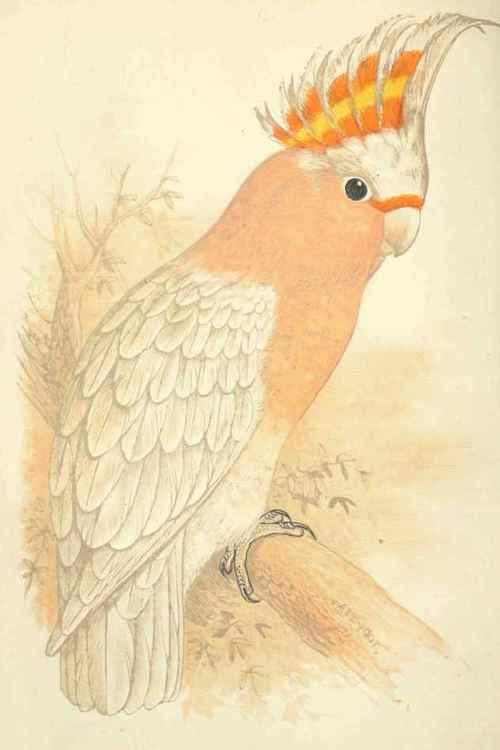
LEADBEATER'S COCKATOO. (Psittacus Leadbeateri).
Opinions concerning the different specimens of this bird differ just as much as in those of the cockatoos already treated, and, of course, from the same cause. Although in general Leadbeater's Cockatoo is gentle, affectionate, and peaceable with other birds, yet there are some among them which are so indescribably wild and vicious that every attempt at training them must fail. Mr. A. E. Blaauw writes that a Leadbeater's Cockatoo, which he had just received after the tiring journey from London to Amsterdam, came at once on to his outstretched finger, erected its splendid crest when desired, and chattered and piped most charmingly. Moreover, it was just as gentle towards strangers; yet there were some individuals whom it could not bear and always pecked and screamed at without apparent reason. Dr. Lazarus finds that the Leadbeater's Cockatoos come into the market very little, or not at all tamed, and that they are much less vivacious, pleasing, and gifted than the others. In spite of great trouble, he was neither able to tame his own nor to teach them to speak a single word, not even to whistle a simple call. At the same time they were distressing screamers. Moreover, the forcible taming which is always successfully tried with Jacos, Amazons, etc. (see page 37), made a Leadbeater Cockatoo, on the contrary, only the more wild and vicious. And, though this bird belonged to the exceptions of which I have before spoken, yet it is significant to find that it will not be tamed even by hunger and thirst. On the whole, this species coincides in all material respects with the preceding varieties. It cannot, indeed, be reckoned amongst the most eminenty gifted speakers, for a Leadbeater's Cockatoo will probably learn at most to chatter a few words or sentences.
A specimen of this kind was first placed in the Zoological Gardens, in London, in 1854, and since 1863 it has appeared in our bird shops often enough to be considered a well-known object to fanciers. Its brilliant appearance misleads many a purchaser, who, on acquiring it, is at a loss how to manage it, and consequently gets rid of it again as soon as possible.
Continue to:


My Books

