


Eruptions Of The Acute Specific Diseases. Variola Equina Or Horse-Pox
Description
This section is from the book "The Horse - Its Treatment In Health And Disease", by J. Wortley Axe. Also available from Amazon: The Horse. Its Treatment In Health And Disease.
Eruptions Of The Acute Specific Diseases. Variola Equina Or Horse-Pox
It is a matter of history that at one time it was an accepted doctrine, in regard to the origin of vaccine matter, that the disease in the cow which was described as cow-pox was the result of infection from a disease in the horse which attacks the heels of the animal and is named "grease".
According to Professor E. M. Crookshank, in his classical work on the pathology of vaccination, the disease was thus described by Jenner:
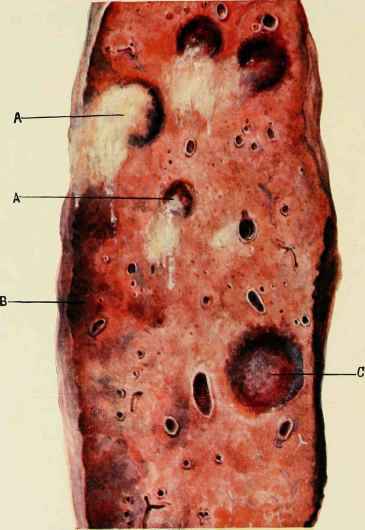
EMBOLISM OF LUNG.
A. A. Embolic abscesses.
B. Pulmonary haemorrhage;
C. Empty abscess.
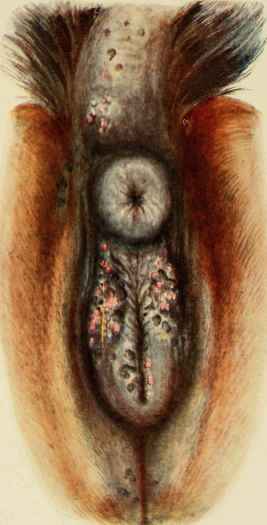
VARIOLOUS ERUPTION.
Showing vesicles, pustules, and ulcers on labia and tail of mare.
"There is a disease to which the horse from his state of domestication is frequently subject. Farriers have named it the grease; it is an inflammation and swelling in the heel, accompanied at its commencement with small cracks and fissures, from which issues matter possessing properties of a very peculiar kind.
" If the men who dressed the horses' heels were called upon to milk cows, they communicated to them the malady known as the cow-pox."
Several cases are recorded in proof of this statement, and from one particular case Jenner was led to believe that the virus which produced cow-pox might be obtained from other parts of the body of the horse.
It is now perfectly well known that the facts as stated are correct, but that the explanation is wrong. The fact is that the horse suffers from a form of variola, and also suffers from cracked and greasy heels, and when horse-pox, equine variola, attacks a horse which happens at the time to be suffering from grease, the characteristic eruption of horse-pox is quite likely to appear in the already irritated skin of the heel, and in such case the matter of greasy heels, together with the variolous contagion, might every now and then be carried to the udder of the cow and produce cow-pox. It would, however, probably be more correct to look upon the recorded outbreaks of cow-pox which followed the act of milking by the hand of a man who had dressed the greasy heels of a horse as mere coincidences. It is quite certain that the matter of ordinary grease will not produce cow-pox; it is equally true that the horse is subject to a genuine variola, which, when transmitted to the cow, induces the other form of variola, i.e., vaccine disease.
Horse-pox, or variola, although it undoubtedly occurs in this country in isolated cases, has never assumed the virulence which it exhibits on the Continent. In Professor Crookshank's work on vaccination several extensive outbreaks are described. The first one which has been recorded occurred in 1860, and it is stated that in less than three weeks there were more than a hundred cases. The horses suffered from slight fever, rapidly followed by the local symptoms, swelling of some of the joints, and an eruption of small pustules on different parts of the body, especially on the lips, nostrils, buttocks, and generative organs. In about a fortnight the pustules dried up, the crusts with patches of hair fell off, leaving marked scar's.
In some instances the pustules appeared inside the nostrils, giving rise to a suspicion that the animal was affected with glanders. Cases have occurred in this country of eruption of small pustules on the legs, outside of the nostrils, and on different parts of the body, simulating the form of glanders which affects the skin and is known as farcy. These cases, which have been described as pseudo-farcy, were in all probability horse-pox.
Treatment
In this affection there is little requiring to be done in the shape of treatment beyond upholding the animal's general health by careful feeding and stable management. If the bowels are constipated, two or three small doses of sulphate of magnesia given in the drinking water will act as a corrective; it may be desirable to administer a little nitrate of potash in the food once daily during the existence of the disease, to prevent undue swelling of the legs. Local treatment should consist in sponging over the seat of eruption night and morning with a ten-percent solution of carbolic acid, and dusting a little boracic acid and flour over the pustules.
The diseased animal should be isolated and placed under the care of special attendants.
All brushes, cloths, rugs, bandages, and stable utensils used for the purpose of the sick, should not be brought into contact with the healthy. After the disease has disappeared, these, as well as the stable and its fittings, must undergo thorough disinfection and cleansing.
Continue to:


My Books

