


Fracture Of The Lower Jaw
Description
This section is from the book "The Horse - Its Treatment In Health And Disease", by J. Wortley Axe. Also available from Amazon: The Horse. Its Treatment In Health And Disease.
Fracture Of The Lower Jaw
Fracture of the lower jaw may take place through the neck of the right branch or the left, or both. It may proceed vertically through the body and divide or separate the two branches from each other. It may pass transversely through the body of the bone behind the incisor teeth, or it may detach the styloid process, or sever the condyle from its branch, and in various other ways the bone may be chipped or broken.
External violence in one or another of its many forms is accountable for this mishap, to which in rare instances the bone is predisposed by disease. Kicks from other horses, falls, and collisions are the more common causes, but it sometimes results from the teeth becoming fixed in narrow spaces, and from the careless use of the gag while performing dental and other operations on the mouth and throat. In young colts, the parts of whose bones are not yet firmly united together, one branch is sometimes partly or completely torn away from the other through their connection at the body. At the same time the central incisor teeth alone or together with others are loosened, and perhaps also more or less displaced.
Symptoms
In vertical fracture through the body of the bone there is at first considerable flow of saliva from the mouth. The lower lip is constantly being moved sharply up and down, and in gathering his food the animal breaks off abruptly. If there is much displacement mastication is interfered with, and the food is dropped from the mouth. The lips remain somewhat separated from each other, and on opening the mouth the mucous membrane will be found to be torn or placed on the stretch by the parting pieces, or not, according to the presence or absence of displacement and the extent to which it has proceeded.
When the breakage occurs across the body of the bone behind the incisor teeth, the chin is more or less depressed, the mouth remains open, allowing a free escape of saliva and maybe more or less protrusion of the tongue. Crepitation is perceived when the broken parts are moved one upon the other. In consequence of the pendulous and disabled state of the lower lip the patient fails to gather his food, or if he succeed it is in a very small measure, and only accomplished with great difficulty and at the expense of much suffering.
In fracture of the coronoid process the angle of the jaw on the side of the injury will be found to be slightly lower than the opposite angle. Mastication is seriously interfered with, and the movements of the jaw lose their natural swing and become restricted and irregular. The animal cannot masticate hard food, and will only take aliment of a soft and sloppy character.
Fractures through the neck of the jaw between the molar teeth and the tusk, without displacement, are sometimes difficult to identify at first, the only symptoms observable being a marked shyness in feeding, in the act of which the saliva becomes churned into foam.
Presently, however, a diffused swelling appears around the bone over the seat of the fracture. This may encroach upon the "mental" nerve as it escapes through the foramen on the outer side of the bone at this part, and for a time partial paralysis of the lower lip is likely to result. If the broken parts are displaced a crepitus or rubbing sensation may be excited by moving one part upon the other.
Treatment
Where displacement exists the parts should first be brought into their natural position and retained there by suitable means.
If the body of the bone be split vertically through the centre and the parts are displaced, they may be brought into position again by seizing the corner incisor teeth between a pair of large pincers and steadily but forcibly pressing them together. If they are raised one above the other, they must first be brought into line by depressing one piece or raising the other, as the case may be. If this cannot be effected by the hands, the pincers properly padded must be employed.
Should the teeth have undergone any displacement they must be properly readjusted, after which the broken bone may be fixed in position by means of copper wire or whip-cord tied round the incisor teeth.
To guard against displacement the patient must be made to stand in the pillar reins, and for two to three weeks his food should be soft and sloppy, such as scalded bran and chaff, boiled roots, etc.
In fracture of the branches or the body of the lower jaw the cradle designed by Mr. Walker of Bradford, shown in fig. 333, may be used, or a piece of gutta percha, first soaked in hot water, should be moulded on to the under surface and sides of the lower jaw, and made to fit into the hollow (intermaxillary space) between its branches. By then punching four or five holes through the front border on either side, and one or two into the upper border, it may be made secure by strings or straps passing in front of the face and behind the ears.
Mr. Walker's cradle is composed of two lateral portions, fitting to the sides of the face, suspended from behind the ears by a padded strap a, and kept in position by a brow-band B, throat-strap c, and jaw-straps F F F F, with a central portion of wood padded with leather D, to fit between the branches of the jaw, and two flanges ee to rest on the first molar on each side of it, the side plates having an arrangement for adjusting their length and screws H H for clamping them when adjusted. In order that the flanges should have a level bearing and allow the animal to eat, the first molars on which they rest must be shortened by tooth shears (fig. 334) or rasp (fig. 335). The apparatus should be so adjusted as to lie evenly and without pressing more on one part than another.
In the absence of these appliances an adhesive compound of Burgundy pitch, Venice turpentine, and a little bees'-wax may be plastered over and round about the seat of fracture in a succession of layers until a thick strong covering has been obtained. This when set will give considerable support to the broken parts.
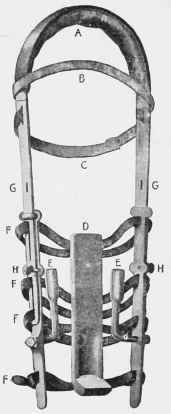
Fig. 333. - Walker's Face-Cradle.
A, Padding to protect Poll. B, Brow Band. c, Throat Lash. D, Pad for submaxillary space. To be made of wood and well padded with leather.
E, E, Flanges to rest on first molars.
F, F, F, F, Straps passing under lower jaw. G, G, Supplementary Strap Slits. H, H, Thumb-screws for lengthening or shortening the plate: designed by Mr. Broad, Bath.
Where both branches of the jaw are fractured Fleming recommends that the space between them be completely filled up by a large firm pad of tow impregnated with an adhesive mixture, then one bandage after another (covered with the resinous mixture) applied around the jaw, face, and nose. These, when the mixture has hardened, act as a cradle. The animal may be allowed to drink thick, nutritious gruel out of a wide shallow vessel, or the gruel may be injected into the mouth or rectum or both. The standing position (for the horse) must be maintained, and attention be given to the retaining apparatus that it be not displaced nor cause abrasion.
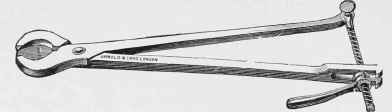
Fig. 334. - Tooth-Shears.

Fig. 335. - Tooth-Rasp.
Continue to:


My Books

