


Ichthyosis
Description
This section is from the book "The Horse - Its Treatment In Health And Disease", by J. Wortley Axe. Also available from Amazon: The Horse. Its Treatment In Health And Disease.
Ichthyosis
This disease is characterized by more or less hypertrophy of the skin as a whole, but especially by the free and morbid outgrowth and accumulation of epidermis upon it.
In man it is congenital and hereditary, and it may be so in the horse, but the seldom occurrence of the disease in this animal has not afforded an opportunity of our forming a definite opinion on this point.
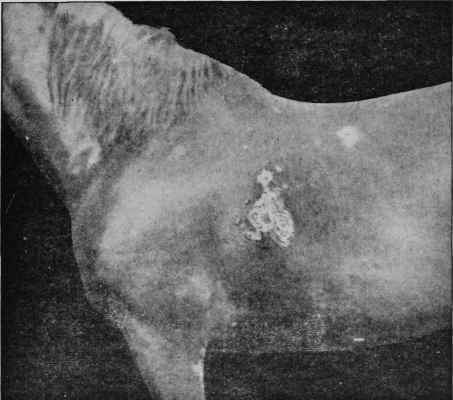
Fig. 268. - Ichthyosis.
In the ox it is more common, but inasmuch as it seldom calls for treatment its congenital and hereditary nature still remains a matter to be determined.
Ichthyosis is intimately related to a dry and scaly condition of the skin termed Xeroderma, and between the two affections there does not appear to be any well-marked line of demarcation. When, however, the epithelial collections are considerable, and accumulated into well-defined scales or flakes, the disease is termed Ichthyosis. It would appear, therefore, that xeroderma and ichthyosis represent degrees of the same disease, distinguished from each other by the larger and more compact or flaky condition of the epidermis which is formed in the latter.
Symptoms
Generally the skin is harsh, dry, thickened, wrinkled, and dirty, and the hair about the diseased parts stares. Patches are seen here and there consisting of superimposed layers of epidermis, which may be removed in thick flakes or hard, compact, horny layers. Sometimes the epithelial growth assumes the form of a more or less cylindrical outgrowth or horny excrescence which requires to be cut off. Some of these epithelial developments are black and dirty, while others wear a white shiny appearance not unlike mica.
In the early period of formation they are covered with a bran-like epithelium which desquamates, but later develops into dense flaky patches.
Ichthyosis is a purely local disease, confined to the skin, and so long as it does not appear on parts to which the harness is applied the patient may suffer but little inconvenience from it.
It cannot, however, be cured, and when, as sometimes occurs, it seriously attacks these parts, the chafing of the collar or saddle altogether incapacitates the animal from work.
Where it accumulates in large heaps it may be removed by hot water in which a little soda is dissolved, after which the skin round about it may be massaged and the affected part smeared with vaseline.
Continue to:


My Books

