


Mammitis
Description
This section is from the book "The Horse - Its Treatment In Health And Disease", by J. Wortley Axe. Also available from Amazon: The Horse. Its Treatment In Health And Disease.
Mammitis
The importance of the udder cannot well be exaggerated. Upon its integrity and efficiency depends the life of the foal in nearly all cases, foster mothers being difficult to procure, and milk substitutes unsatisfactory. In the chapter dealing with the generative functions, with pregnancy, and parturition the changes wrought in the mammary glands previous to giving birth to young are described, and should render the following remarks on mammitis more intelligible. It is permissible, perhaps, to say here that previous to the foal's birth the mammae enlarge, become more dense, pendulous, and vascular; the teats undergo development, enlargement, distension; the last sign of approaching parturition being the formation of semi-transparent pendulous bodies which attach to their orifices, and are familiarly known as the "wax".
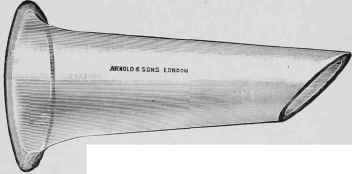
Fig. 235. - The Vaginascope.
At the time of parturition the udder, which, it will be remembered, is divided into two sections commonly called quarters, is filled with milk ready for the new-comer. Though the development be normal there is increased temperature and sensibility of the mammae: a natural or physiological engorgement as distinguished from a pathological one. There may be discomfort, amounting to pain even, with the former state, and its importance will be appreciated when it is remembered that impatient mares endanger the life of the young by refusing them permission to suck; nay, more, inflict fatal injuries, not infrequently, upon the foal, while exercising its instinct to "bunt" an udder which does not freely yield nutriment. There are great differences in the temperament of mares, a subject upon which one is tempted to enlarge, but this is not the time or place; suffice it to say that some will endure a good deal of pain in the interest of their young, while in others, notably very young mothers, maternal affection is sometimes almost entirely wanting.
Causes
A hyperaemic or congested condition of the mammae at the time of parturition, or for some days previous to that act, is common, and among experienced breeders and veterinarians it is a moot question whether or no such congestion should not in some cases be mechanically relieved by hand-milking. That the tense and painful state of the glands constitute a danger to both parent and offspring is generally conceded, and the propriety, or otherwise, of manual interference is a question upon which no hard-and-fast rule can be laid. While it has to be borne in mind that the first milk secreted contains a valuable laxative principle (calostrum), of which the foal should partake, a substitute may be obtained where the relief of the engorged mammae is of paramount importance.
Mammitis is due to over-repletion with milk, injuries, lying upon cold wet ground, exposure to east winds, to obstruction of the ducts within the udder, or impervious teats, and in some instances it is believed to be the result of imperfect circulation in the great posterior vena cava.
The Symptoms
The symptoms of engorgement and actual inflammation of the udder may be considered together, as the former is not immediately distinguishable from the latter and is in the majority of cases its precursor. When due to over-repletion the malady is gradual in its manifestation. If arising from external violence, inflammation is suddenly developed, the affected parts being swollen, tense, hard, and showing a want of elasticity on manipulation.
In the case of simple congestion sensibility to the touch is not very marked, and the impression of the finger will not be left upon the enlarged gland, showing the absence of inflammatory effusion. Bodily temperature is not appreciably affected, nor is the appetite impaired.
Where actual inflammation exists, the skin of the affected quarter is very tense and shining, the teat greatly enlarged, and if much redness is not seen it is because the skin of this part is commonly very dark in colour. The implicated quarter pits on pressure of the finger, owing to a superficial infiltration of the tissues with fluid exudation. The base of the teat communicates a feeling as of clots or coagula, the presence of which may be confirmed by drawing the teat, or by the introduction of a teat-syphon, when a more or less blood-stained fluid is discovered, containing granulated masses of clotted milk. Pus cells, calostrum, and broken-down epithelium will be found floating in the watery fluid which makes up the bulk of the material coming from an inflamed quarter. In contradistinction to the simple state of congestion above referred to there is more or less constitutional disturbance, the temperature rises considerably, the appetite is somewhat impaired, and there is much local pain. With good management and prompt treatment the gland may be restored in the course of a few days, and the secretion of milk re-established gradually.
Failing success by simple measures, to be presently alluded to, the function of the quarter may be arrested for the season and remain predisposed to a similar attack after birth of another foal. A degraded secretion, composed of part milk, and some pus, serum, etc, may continue, but the formation of an abscess is not so likely to occur as when the inflammation runs high and the teat is altogether occluded from the first by solid matter. Instead of the formation of pus, and the gradual pointing of an abscess, it sometimes happens, especially where the origin was external violence, that the whole quarter dies. Its sensibility is gradually lost, it becomes cold, a line of demarcation is observed between the living and dead or dying tissue, and recovery is only possible by the casting off (sloughing) of this gangrenous portion. It need hardly be said that a mare which has lost a quarter should never be put to the stud again.
The terminations of mammitis may be briefly described as resolution or a return of the organ to a normal condition, induration or hardening, atrophy or wasting, gangrene or death of the gland, or the succumbing of the mare herself to the ravages of the disease.
Treatment
The early adoption of remedial measures is of the utmost importance, as in acute cases changes of structure of a permanent and unalterable character take place during the first few days of the malady.
Simple engorgement may be relieved by milking with the finger and thumb, an operation requiring some little practice to be efficiently performed, and not necessarily possessed by a good cow-milker. No great quantity is obtainable at one time; the operator must be content to repeat the performance several times during each day if much benefit is to be derived. He should depend, too, upon a soothing manner and gentle manipulation rather than upon severe methods of restraint calculated to annoy the patient, whose will is capable of more or less control of the milk to be yielded.
Inunction of the udder with lard or vaseline affords relief by enabling the skin to stretch. In some cases it is necessary to employ a milk-syphon, as blocking of the teat or great tenderness at the base may render hand milking impossible. The instrument must be introduced with much care, oiling the point first and employing only the gentlest means of pushing it up into the space existing between the glandular structure and the substance of the teat. The aperture of the teat being provided with a delicate sphincter muscle, its resistance must be overcome gradually, or its capacity to contract on subsequent occasions may be impaired, or even destroyed, thus allowing the milk to escape from the gland as fast as it is secreted. The ring teat-syphon (fig. 236) can be retained in position, where desirable, by tapes attached to the rings and passed over the loins of the patient, but it is extremely liable to come out, and has in some instances caused injury when the animal has lain down.
Where abscess commences to form in the gland it is very difficult to arrest the formation of matter, but it may be controlled in a measure by the administration of aperients and febrifuges, and the employment of mild stimulating embrocations to the udder. If the swelling becomes large, tense, and painful, with a disposition to bulge or "point" in one direction, it will be well to encourage the process by poulticing. Very great relief is afforded by opening the abscess with a lancet, but the operation should not be prematurely performed. When pus has been evacuated the abscess may be syringed out with an antiseptic lotion from time to time. The animal must be well sustained with nutritive food, but this should not be of a milk-making description in any trouble connected with the udder, the first consideration being to restrain the functional activity of the gland, allay inflammatory action, and prevent its sequelae.
Gangrene or death of the mammae must be treated with a view to conserving the life of the mare; since the affected organ or a large portion of it must inevitably be lost. Our efforts should be directed to sustaining her general health, while facilitating the detachment of the destroyed gland, and rendering the adjacent parts aseptic by frequent irrigation with a solution of carbolic acid or some other disinfectant.

Fig. 236.-Teat-Syphon.
The further treatment of the case will consist in the administration of mineral and vegetable tonics, together with a generous diet, pure air, and such gentle exercise as her condition will permit. The gland should be frequently fomented, the sloughing portion gently detached, and strict regard given to cleanliness of the apartment occupied, particularly in respect of the bedding and floor of the box, which should be kept clean, sprinkled with a carbolic powder in cold weather, or washed with a suitable fluid disinfectant if the temperature will permit it. Anything like force in removing the slough is to be deprecated, but its detachment may be considerably hastened by judicious traction where the mass does not, by its weight, assist in detaching itself. When the greater portion of the gland has sloughed, the gaping wound left behind is very formidable looking, and the disposition to repair is quite surprising to those who see such cases for the first time, a few days sufficing to fill up the greater part of the cavity, and a month usually serving to effect complete repair of the injured structures, leaving only a cicatrix of much smaller proportions than the tyro could possibly have imagined.
While the healing process is going on, the wound should be kept perfectly clean by gentle sponging, and frequent irrigation with some antiseptic solution should be employed to guard against sepsis or blood-poisoning.
Continue to:


My Books

