


Sprain Of The Check Ligament
Description
This section is from the book "The Horse - Its Treatment In Health And Disease", by J. Wortley Axe. Also available from Amazon: The Horse. Its Treatment In Health And Disease.
Sprain Of The Check Ligament
This ligament (fig. 366), it will be remembered, has its origin behind the knee, and joins the perforans tendon about one-third of the distance between the knee and fetlock-joint.
Sprain of this important structure is not uncommon, especially in draught-horses when engaged in moving heavy loads out of deep holding ground or over slippery surfaces. In race-horses and hunters it usually occurs in the last efforts of a hard finish, or towards the close of a long run when the muscles are tired, and the ligaments are called upon to bear an undue amount of weight and resist the impulse of velocity.
Symptoms
This accident is indicated by the appearance of a hot painful enlargement immediately below and behind the knee, accompanied by considerable lameness, the most prominent feature of which is that the heel of the foot is not brought to the ground in progression, and the weight of the body is quickly transferred to the opposite limb. When standing, the fetlock is maintained in a semi-flexed condition, and such weight as the foot receives is imposed upon the anterior part. With the effusion and swelling which follows severe sprain to this structure it may be difficult to determine accurately what parts are involved, and to what extent.
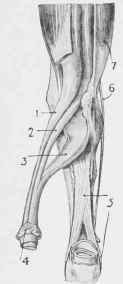
Fig. 366. - The Check Ligament.
3, Check Ligament.
4, Sheath.
5, Suspensory Ligament. 6, Extensor Pedis.
7, Flexor Metacarpi Exter nus.
In slight cases, too, where the lameness is not considerable, a good deal of care is needed to discover the seat of trouble. When this is so the leg should be raised and the canon forcibly extended on the operator's knee. At the same time the operator must firmly compress the ligament between the fingers along its length, noticing while so doing any tenderness which the animal may display, or any enlargement the part may show by comparison with the opposite ligament.
Treatment
The aperient dose recommended in connection with sprains of other structures is advisable here, and the lines of treatment in the last article should be followed, with the addition of placing a high-heeled shoe on the foot so that the injured ligament may be relieved from traction and put to rest. Care will be needed not to allow the heels to be raised too long lest in the course of reparation shortening of the tendons result.
Continue to:


My Books

