


Structure Of Bone
Description
This section is from the book "The Horse - Its Treatment In Health And Disease", by J. Wortley Axe. Also available from Amazon: The Horse. Its Treatment In Health And Disease.
Structure Of Bone
When a long bone is cut through it is found to consist of a hard outer shell of compact tissue enclosing a looser portion made up of thin bony plates, interlacing with each other to form a number of spaces, and called spongy or cancellated tissue. In the centre of this is a cavity (medullary cavity) containing a soft reddish-yellow substance, the medulla or marrow. The compact substance is thick in the shaft of the bone, but thin towards the extremities, which are chiefly made up of cancellated structure.
All bones are covered with a dense tough fibrous membrane termed periosteum. It serves as a matrix in which the blood-vessels ramify and break up into smaller and smaller branches, prior to entering into the bone tissue through small openings on its surface. A similar fibrous membrane, though more delicate, also lines the interior of bones, and is known as endosteum. This membrane is very thin, though rich in blood-vessels, and affords nourishment to the inner portion of the bone and to the marrow contained in it. Besides the vessels passing into the interior from the periosteum, the long bones have also a nutrient artery, for which a special opening is provided in the shaft of the bone called the medullary foramen, and others less considerable situated around the extremities (articular foramen).
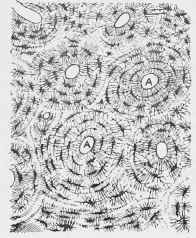
Fig. 281. - Transverse Section of Bone.
A a, Haversian Canals. The small irregular black spots are the Lacunae; the lines radiating from them are the Canaliculi.
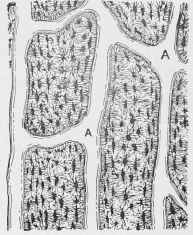
Fig. 282. - Longitudinal Section of Bone A A, Haversian Canals.
The intimate structure of bone can only be made out by microscopic examination under a power of 300 to 400 diameters. Although bone looks the hard material that it is, we have already pointed out the provisions which exist in it for an ample supply of blood to circulate in its interior, and repair the waste of tissue that is here as elsewhere constantly taking place. How this is effected will presently be seen.
Continue to:


My Books

