


Mechanical Aids To Delivery
Description
This section is from the book "The Horse - Its Treatment In Health And Disease", by J. Wortley Axe. Also available from Amazon: The Horse. Its Treatment In Health And Disease.
Mechanical Aids To Delivery
Mechanical aids in difficult operations become indispensable to success, and it is of the first importance that whoever undertakes their use should clearly understand the particular purpose for which they are designed, as also their most effective mode of adjustment. These qualifications cannot be imparted by any written description, but must be acquired by experience and practice.
In proceeding to deliver a mare, the uterus should first be freely explored until the precise position of the foetus has been determined; then the steps necessary to bring it into a natural presentation and effect its removal should be carefully considered.
In this connection it should always be in the mind of the operator that where two feet are presented they may not belong to the same animal, and before delivery is attempted he should fully satisfy himself that he is not dealing with twins, from each of which a foot may proceed.
Where but one foal exists, it is equally important to be assured that the feet in the passage are both fore-feet or hind-feet, and not one of each. The application of force while these precautions are neglected would endanger the life of both dam and offspring.
It may be found that the existing malposition is such as can be rectified by a little judicious employment of the hands alone, or that the use of ropes, repellers, hooks, or pulleys, or all these several appliances, will be called for in the course of delivery. Besides the mechanical aids, it must not be overlooked that the mare may be made to lend herself to the process of delivery by being placed in certain special positions. By raising the hind-quarters with litter, the foetus may be thrown forward and more room afforded the operator in rectifying the presentation, or it may be desirable to place her in the reverse position by underpacking in front.
It is a good working rule to secure with ropes or other means all parts which are found to be in the passage whatever they may be, and to keep them under control until it has been fully decided that they are not necessary to delivery.
Many parts of the body of the foetus are available for the application of ropes and other instruments, by and through which to bring traction to bear upon the foetus.
A stop-noose may be applied round the neck, a light head-stall extemporized out of a strong cord may be fitted to the head. A running noose passed into the mouth and carried over the poll, or applied round the lower jaw, will aid materially in the application of force, and the same may be said of ropes applied above the hock or knee, or the fetlock, or the foot.
When no sufficient hold can be secured by these means, hooks of various descriptions may be brought into use; but it must be understood that, while in trained hands they are most useful auxiliaries, in the hands of the unskilled they may prove dangerous and even deadly instruments. Hooks or crotchets may be sharp or blunt, single or double (figs. 557). Some are attached to ropes, and others are fixed to handles. The crutch or repeller (fig. 558) is another means of moving the body of the foal backwards into the womb when it is desired to make room for securing and changing the position of one or more of the extremities. Blunt hooks connected with a rod will be found useful to anchor on to the angle of the mouth or the orbit of the eye, when these parts are placed beyond the reach of the hand, and in critical cases, when the mare is in danger and a firm hold is imperative, sharp ones may also be made available in connection with the latter. In applying them, however, care should be taken to implant them well into the orbit, and to avoid the use of excessive force, lest we should tear out and injure the walls of the uterus.

Fig. 557. - Hooks or Crotchets a, Sharp; b, blunt; c, double.
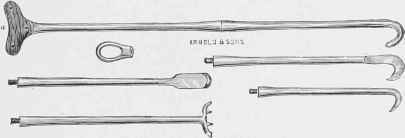
Fig. 558. - Gowing's Parturition Instrument a, Crutch or repeller.
When no sufficient hold can be secured by any other means, double hooks or crotchet forceps (figs. 559), blunt or pointed, may be employed.
Double crotchets will be found serviceable in a variety of conditions, and especially when no sufficient hold can be secured by other means. These instruments may be made to enter the tissues and take a firm hold of deep-seated tendons or ligaments, or be anchored on to bones.
In employing these several aids to delivery it should be understood that everything which it may be found necessary to introduce into the uterus or genital passage should be thoroughly clean and disinfected, and the same precaution also applies to the hands of the operator, whose nails should be cut short as a safeguard against injury to the womb.
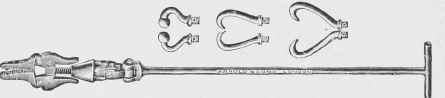
Fig. 559. - Pollock's Obstetric Forceps, with double Hooks.
Continue to:


My Books

