


The Rate Of Growth In The Horse 1. Part 2
Description
This section is from the book "The Horse - Its Treatment In Health And Disease", by J. Wortley Axe. Also available from Amazon: The Horse. Its Treatment In Health And Disease.
The Rate Of Growth In The Horse 1. Part 2
The height of a horse, it is hardly necessary to state, depends mainly on (l) the length from the elbow to the ground; (2) the length and obliquity of the arm-bone (humerus); and (3) the length of certain spines of the dorsal vertebrae, the spines which give rise to the more or less arched ridge known as the withers. 1
In the living animal it is impossible to measure the length of the vertebral spines, and only possible to estimate roughly the length and obliquity of the humerus, and hence it will be necessary in studying the rate of growth in the horse to trust chiefly to the length of the fore-limb as measured from the elbow to the ground. In man the limbs belong to the common or ordinary vertebrate type, but in the horse they have departed as far from the general plan as highly useful structures well could, for instead of five digits, as in man, there is but one complete digit, and in their hard parts the limbs are infinitely more highly specialized than is the case in any other mammal, and more profoundly altered than even the wing of a bat.
Influenced by the doctrine of recapitulation (the belief that each animal climbs its own ancestral tree), not a few were wont to believe that when a sufficiently young horse embryo was examined, the fore-limbs at least, as in the early Eocene "fossil horses", would be pentadactylous, i.e. have rudiments of five digits. This, however, is not the case; at no stage in the development (in the life-history as distinguished from the ancestral history) of the horse are there any visible rudiments or vestiges of the first and fifth digits. In other words, the horse is at the most tridactylous, and only one of the digits - the one corresponding to the human middle finger in front and the human middle toe behind - ever comes into use.
In the case of the horse, the first rudiments of limbs appear in the form of short bud-like outgrowths between the twenty-first and twenty-eighth days. The growth is at the outset so deliberate that even at the end of the fifth week the limb rudiments (fig. 560) are only 2 mm. (about 1/8 inch) in length. After a time, however, the rate of growth is accelerated, with the result that before the middle of gestation (the twenty-fourth week) is reached they are relatively as large as in the full-grown horse. Having reached this size, it might be assumed that they would continue to maintain the same proportions up to the time of birth. This assumption would, however, be wide of the mark, and in fact would never be made by anyone aware of the great relative length of the legs in the new-born foal (fig. 561). To have a chance of surviving in a wild state - of escaping prowling wolves or hungry hyaenas, jackals, and hunting dogs - a foal must almost from the moment of its appearance on the scene be capable of keeping up with the troop into which it is so unceremoniously introduced - sometimes apparently to the annoyance of the ever-watchful leader and head of the family. 1 To succeed in this it requires legs long enough to gallop at least as fast as the older members of the herd. It is doubtless for this reason that during the second half of the period of gestation the limbs grow very much faster than the trunk, with the result that for some weeks before birth they are relatively not only extremely long, but so wonderfully perfect in all their parts that, as in certain other wild ungulates, a foal is no sooner ushered into the world than it is galloping merrily along, carefully shadowed by its dam.
1 Than the height at the withers it would be difficult to find a less trustworthy index of the size of a horse. The height at the elbow is a safer guide, or, seeing that a horse (like a man) propels itself by the hind-limbs, the height at the croup should be taken into consideration.
1 Stallions in a wild state sometimes endeavour to compel mares to leave their foals; thus all the more ensuring that only vigorous offspring survive.
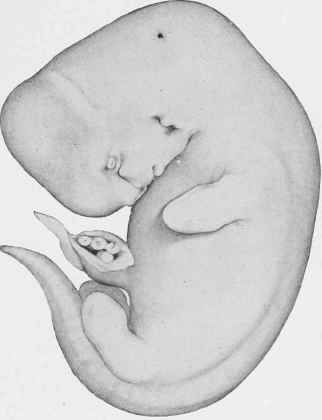
Fig. 560. - Horse Embryo (five weeks).
The smallest horse embryo in my collection measures 7 mm. - just over ¼ inch. This, a twenty or at the most twenty-one days embryo, is somewhat fish-like in form, but quite limbless. Soon after the end of the third week limbs appear in the form of minute buds. At the end of the fourth week (fig. 562) they are easily recognized, and by the end of the fifth week they are 2 mm. in length; at the end of the fourth week a horse embryo measures 10 mm., and is not unlike a human embryo of the same age; by the end of the fifth week it is 5-6 mm. longer. At first the limb buds are simple paddle-like, structureless outgrowths, but during the fifth week rudiments of the skeleton appear; while during the sixth week they are so rotated and flexed that the position of the elbow and wrist (commonly called the "knee") can be made out in the fore-limb, and in both fore- and hind-limb there are indications of three digits (2-4). Even at the end of the sixth week, when the embryo is 2 cm. in length, the fore-limbs only measure 4 mm., and the hind-limbs are but little longer (fig. 563). Marked progress is made during the seventh week, with the result that before the eighth week is reached the limbs have all the distinctive equine characters and are about one-third of the total length of the embryo - the embryo measuring 3 cm., the limbs nearly 1 cm. Before the eighth week is reached not only are the elbow and "knee" evident, but the fetlock and frog of both fore- and hind-limbs are fairly well moulded, and in the latter the true knee (stifle) and hock are well defined (fig. 564), the distance from the hock to the tip of the developing hoof being 7 mm. By the end of the eighth week we have a horse in miniature. At this stage (the total length of the embryo being 6.5 cm.) the distance from the withers to the tip of the curved and pointed hoof is 3.3 cm., from the elbow 1.9 cm., while the length from the hock is 1.3 cm.
Continue to:


My Books

