


Fans And Blowers
Description
This section is from the book "Cyclopedia Of Architecture, Carpentry, And Building", by James C. et al. Also available from Amazon: Cyclopedia Of Architecture, Carpentry And Building.
Fans And Blowers
The term fan is commonly applied to any form of apparatus for moving air in which revolving blades or propellers are used, while the word blower is used only in those cases where the wheel or propeller is enclosed in a casing.
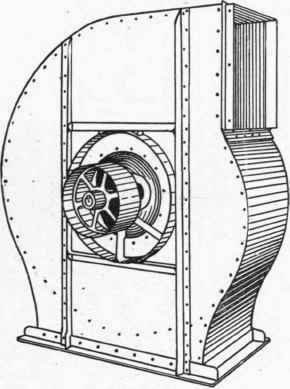
Fig. 11.
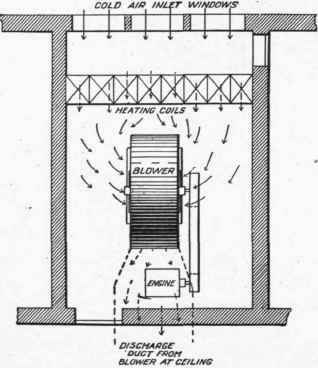
Fig. 12.
Referring to Part I,' Fig. 17 shows the usual form of fan or wheel used in the common type of blower and Fig. 11 represents the usual form of a regular steel plate blower with full housing. Where a blower is connected with a heater having a steel plate casing it has an inlet only on one side, but when used in connection with a heater of the type shown in Fig. 9 it should have inlet openings upon both sides as shown in Fig. 12.
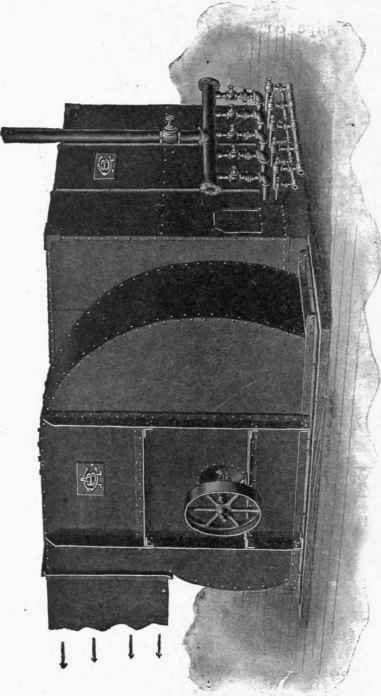
Fig. 13.
The discharge opening can be made in any position desired, either up, down, top horizontal, bottom horizontal or at any angle. Fig. 13 shows a top horizontal discharge blower connected with a beater.
Where the height of the fan room is limited, a form called the three-quarter housing may be used in which the lower part of the casing is replaced by a brick pit below the floor level. Such a construction is shown in Fig. 14 with a direct-connected engine. Another type of fan known as a disc wheel may be used where the air passages are large and the resistance to air flow is small, but for ordinary ventilating work the encased blower is to be preferred. The cone fan shown in Fig. 20, Part I, is a very efficient form and may be used in a wall opening as there shown or made double and enclosed in a steel plate housing.
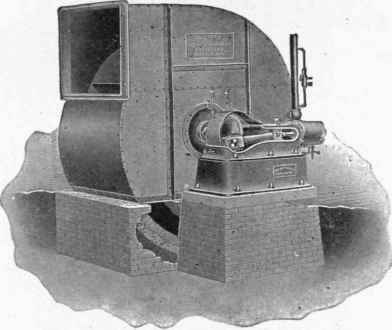
Fig. 14.
Continue to:


My Books

