


Construction Of The House. Part 2
Description
This section is from the book "The House: Its Plan, Decoration And Care", by Isabel Bevier. Also available from Amazon: The House: Its Plan, Decoration And Care.
Construction Of The House. Part 2
Superstructure Of The House
(I) Framing Balloon, Braced.
(2) Walls Materials, Wood, Stone, Brick, Shingles.
(3) Floors Construction, Single, Double, Manner of laying, Deafening, Sweeping molding.
(4) Chimneys, Built from ground, Walls of flues (eight inches thick), Lined with fire clay or flue lining.
(5) Doors.
(6) Windows.
(7) Closets.
(8) Devices for Strength, Warmth, Dryness, Safety from fire, Preventing shrinkage.
(9) Porches.
(10) Roofs Material, Manner of laying.
Of the two kinds of framing, that known as the braced is the more expensive and stronger.
Balloon And Braced Framing
The balloon frame is considered strong enough for all practical purposes and is quite generally used. See illustration. Owing to the greater expense of building stone or brick houses, and the fact that they are more apt to be damp than frame houses, wood is the material more generally used.
Frame
The construction of a wooden building is, in general, as follows: The walls consist of a frame of studs or light timbers, 2 in. by 4 in. or 2 in. by 6 in., set about sixteen inches apart from center to center. The outside is covered with rough boards, then with clap-boards or shingles.
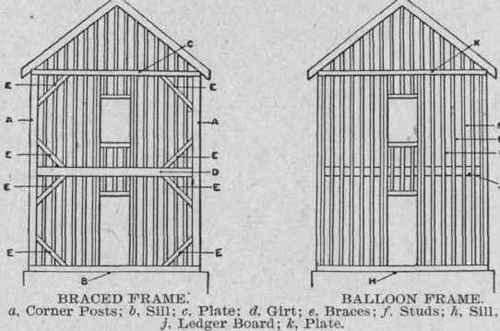
In the full braced frame all pieces are fastened together with mor-tise-and-tenon joints. In the balloon frame the pieces are simply nailed, the frame depending upon the boarding for its stiffness. A combination of the two is common.
Lath And Plaster
Inside the walls are covered with laths and plaster The interior partitions are made of studding covered on both sides with laths and plaster. The laths should be green, that is, not dried, for the wet plaster would cause them to warp. The first coat of plaster, called the "scratch coat" because it is scratched or roughened in order to hold the next coat, should be allowed to dry thoroughly before the second coat is laid over. Much of the falling, cracking and annoyance with plastering comes from the lack of this precaution.
The Sill
The studs of the outside wall should stand on a heavy timber called a sill, which rests on top of the cellar wall. At the top of the walls the horizontal piece, called the plate, is placed, on which rest the lower ends of the rafters forming the roof pieces. The rafters are covered with boards and these with shingles.
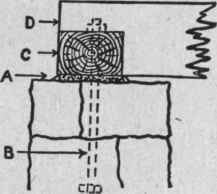
SILL PLACED ON WALL. a, Cement; b. Anchor Bolt; c, Sill; d, Girder.
Girders
The girders are the heavy timbers set level with the beams of the first floor, on which stand the studs of main interior partitions.
Shingled Houses
Shingle houses are much in favor in some localities and make very attractive and inexpensive homes. Cedar shingles "weather" to a grey tint that is pleasing, but many prefer the brown or green stain. Shingle houses are a little more expensive than plain wooden ones.
Continue to:


My Books

