


A Proportional Reducer
Description
This section is from the "Studio light a magazine 1916" book, by Sara F. T. Price. Also see Amazon: Studio light a magazine 1916.
A Proportional Reducer
Most photographers are aware that the various reducers used for lessening the density of negatives differ in the effects they produce. Some of them attack the shadows of the negatives, cutting into the shadow detail; others attack the highlights chiefly, scarcely affecting the shadows at all; while yet others are intermediate in action between these two extremes.
The typical reducer which attacks the shadows most is that named afterMr. Howard Farmer, which consists of a solution of hypo to which has been added enough ferricyanide of potash to make it yellow. If the effect of this reducer is measured, it is found to be similar to that shown
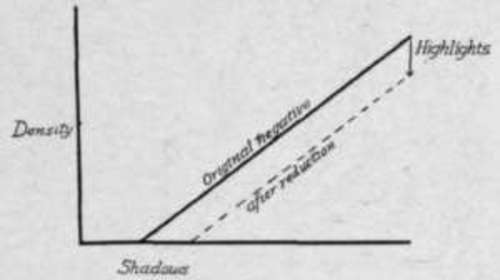
Fig. 1 - Farmer's Reducer
In Figure 1, that is, it subtracts an equal amount of density from every part of the negative. Since this removes the same amount of density from the highlights as from the shadows, the proportional effect upon the shadows is naturally much greater than upon the highlights.
FROM AN ARTURA IRIS PRINT
By J. E. Abbe Lynchburg, Va.
FROM AN ARTURA IRIS PRINT
By J. E. Abbe Lynchburg, Va.
The effect of increasing the exposure in making a negative is to add density to all parts of the negative to almost the same extent, so that a reducer which removes density to the same extent from all parts, as does this ferricyanide reducer, may be said to undo exposure, and it is a valuable reducer for negatives which have been over-exposed.
Figure 2 shows the action of the persulphate reducer. Persuiphate attacks the highlights far more than any other part of the image so that if a negative is too contrasty the highlights can be lessened by persulphate without affecting the shadows. The persulphate reducer, however, will not correct an over-developed negative. What is required in an over-developed negative is that each point of the gradation should be reduced proportionally just as the over-development has increased it proportionally and the result would be that of correct development. This effect is shown in Figure 3, where it is seen that the same proportion of each density is removed by the reducer.
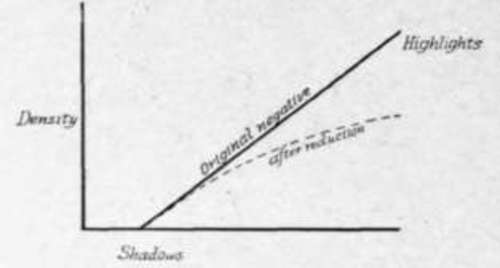
Fig. 2 - Persulphate Reducer
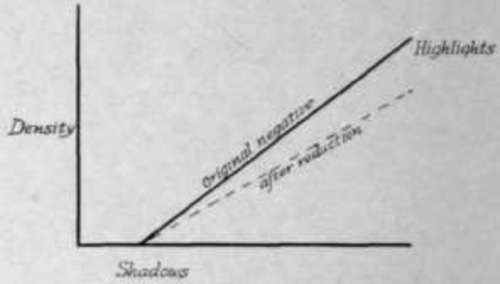
Fig. 3 - Proportional Reducer
If a negative could be said to have a density of 100 in the highlights and a density of 4 in the shadows, a proportional reduction of 25% would remove 25 parts of silver from the highlights to 1 part from the shadows.
It has often been stated that proportional reduction is obtained by means of permanganate, but experiment shows that all reducers heretofore used, except persulphate, behave like ferricyanide; that is to say, they reduce the shadows proportionally more than any other part of the negative and they therefore will not correct over-development as a proportional reducer should do.
Far away in the Solomon Islands, Mr. Norman Deck found a short time ago that the use of a combination of permanganate and persulphate would give a proportional reducer, and he published an article in the Australasian Photo Review on the subject. Not having facilities for making accurate tests and measurements he suggested that the subject should be investigated further. The Kodak Research Laboratory has taken up the work and has found that by a slight modification of the formula a truly proportional reducer can be obtained.
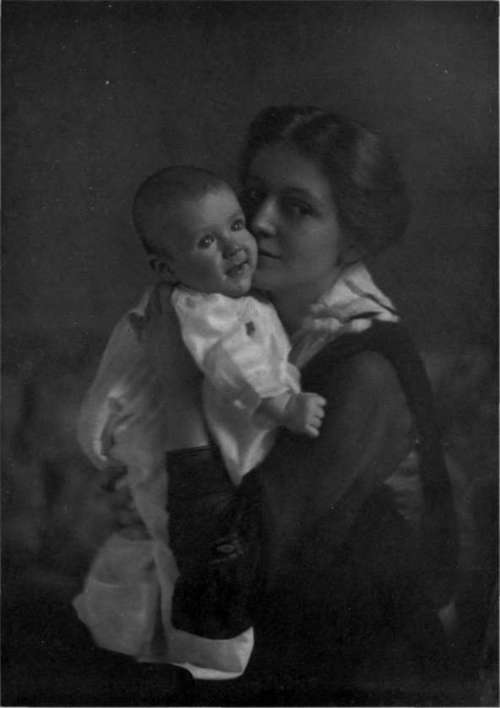
FROM AN ARTURA IRIS PRINT
By J. E. Abbe Lynchburg, Va.
In the experimental work, which has been done with great care, it was found that different plates behave rather differently and that if slow, fine grained plates were used there was a tendency towards loss of shadow detail with a reducer properly balanced for use with high speed plates. But, fortunately, the differences between plates generally used by photographers were found to be of no practical importance in this respect, and with the formula here given all plates and film in ordinary use will show proportional reduction, so that the formula can be safely employed to correct negatives which have been over-developed. While temperature will affect the rate of reduction, the proportional nature is not changed.
The formula is as follows:
Solution A
Permanganate of Potash 4 grains 10% Sulphuric Acid . . ½ ounce Water....... 82 ounces
Solution B
Persulphate of Ammonia 2 ounces Water.......64 ounces
For use, take one part of A to three parts of B for three minutes reduction. For six minutes reduction dilute above with an equal volume of water. Following reduction it is advisable to immerse the negative for five minutes in a 1% solution of meta-bisulphite of potash or bisulphite of soda, then wash for a few minutes.
Tozol For The Professional Photographer
Tozol is a simplified developing agent with convenient and economical features, as well as vigorous action as a reducer of silver salts. A stock solution of the developer is made by simply adding the sodas, bromide and alcohol to an ounce of Tozol, and this stock solution may in turn be readily varied to suit the various brands of Artura and other developing papers.
Prints developed with Tozol developer have strength and brilliancy with richness and depth of tone. It is specially suited to the various grades of Artura and Azo, but may readily be adapted to Velox and Bromide papers. The following formulae are very simple to compound:
Stock Solution
Dissolve in 30 ounces of hot water in the order named: 1 oz. Tozol.
3 ozs. C. K. Sulphite of Soda. 2¼ ozs. C. K. Carbonate of Soda. 45 grs. Potassium Bromide. 4½ ozs. Wood Alcohol.
Developer for Artura Iris and Azo
Stock Solution .......... 2 ozs.
Water...... 14 ozs.
Sat. Solution Potassium
Bromide .... 4 drops.

FROM AN ARTURA IRIS PRINT
By J. E. Abbe Lynchburg, Va.
Developer for Artura Chloride or Non-Curling
Stock Solution ............4 ozs.
Water............12 ozs.
Developer for Artura Carbon Black
Stock Solution ............4 ozs.
Water............12 ozs.
Carbonate of Soda Sol.
Continue to:


My Books

