


March. Sun-Dial
Description
This section is from the book "Busy Hands: Construction Work For Children", by Isabelle F. Bowker. Also available from Amazon: Busy Hands: Construction Work for Children.
March. Sun-Dial
Spring
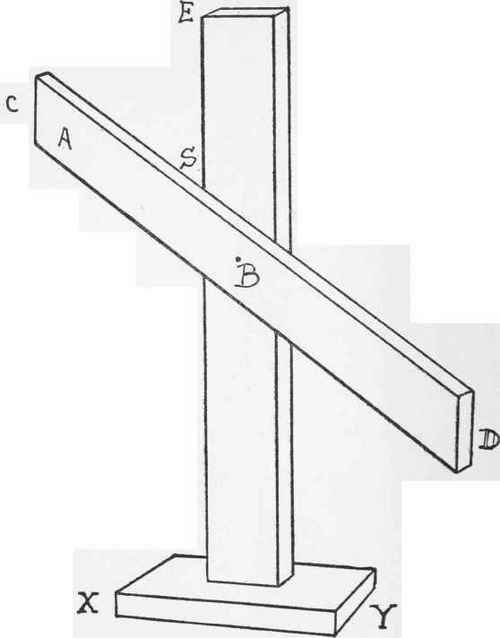
Fig 1.
Tell the children the history of time-keeping, viz.: clepsydra, sand-glass King Alfred's candle, shadow-stick and sun-dial.
Material: Two pieces of board 1 in. x 3 in. x 2 ft.; one piece of board 1 in. x 3 in. x 6 in.; one piece of strawboard 6 in. x 10 in.; one piece of strawboard 5 in. x 5 in.; one piece of strawboard 1 /2 in. x 6 in.; two strips of heavy paper 1 in. x 4 1/2 in.; hammer, pencil, ruler and paste.
Of the three pieces of board make a stand (Fig 1), allowing the board A to swing easily on the nail B.
On the 21 st of March at noon take the stand out into the sunshine.
Place the base X-Y in a north and south line.
Move the board A, Fig. 1, so that the shadow made by the end C, will fall directly on the shadow made by the end D. (Fig. 1.)
When the ends of the board A throw but one shadow, hold the board firmly in that position and mark the angle E-S-C, Fig. 1, on the 5x5 piece of strawboard.
Remove the cardboard from the stand, and continue the hypothenuse of the right triangle until it intersects the edge of the strawboard, at O. (Fig. 2.)
Four and one-half inches from S (Fig. 2) make a dot, D.
Through D draw a line parallel to the edge X.
Cut out the triangle, S-D-M.
Lay the 6 x 10 piece of strawboard on the desk, with the long edge toward you.
One-half inch from the lower left-hand corner, on the short edge, make a dot. One-half inch from the lower right-hand corner, on the short edge, make another, and draw a line connecting the dots. (X-Y, Fig. 3.)
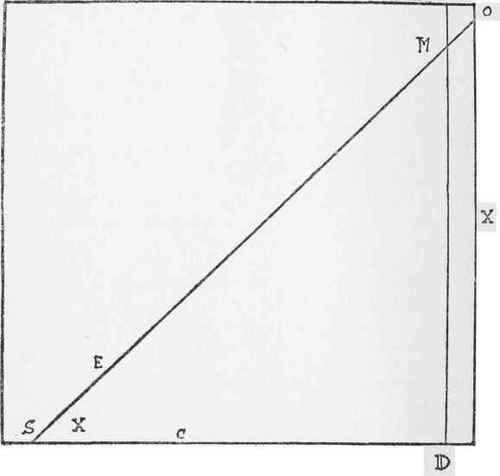
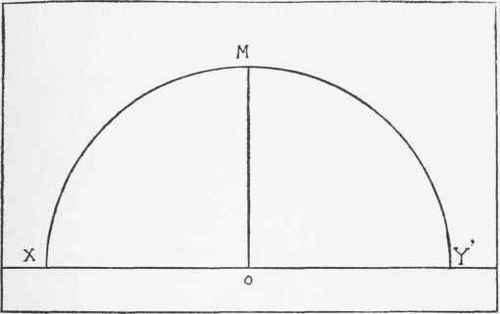

Fig 4
Bisect the line. (0, Fig. 3.)
On the 1/2 x6 strip of cardboard make a dot half an inch from one end. (R, Fig. 4.)
Four and one-half inches from this dot make another at T.
Make small holes through the dots.
Put a pin through one of the holes and fasten the circle-divider to the 6x10 strawboard at dot 0, Fig. 3.
Draw the semicircle, X-M-Y.
Draw the line, M-o, Fig. 3, parallel to the short edges of the strawboard.
In front of the letter o, Fig. 3, print "South"; above letter M, "North"; near letter X, "West"; near letter Y, "East."
The sun-dial must always be held so that the word "East" is toward the eastern part of the horizon.
Fold the two heavy strips of paper (1 x 4 1/2 ) lengthwise.
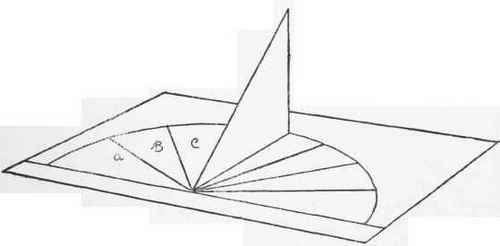
Paste the triangular piece of cardboard to the large piece on the line M-o (Fig. 3), so that angle E-S-C of Fig. 2 is on dot 0 of Fig. 3.
Let the children experiment and find the hour lines A-B-C,
Fig 5
Note: The angle secured by using the stand (Fig. 1) shows the altitude of the sun at the place where it is sighted.
Should the 21st of March be cloudy, the next sunny day will answer the purpose.
The obtaining of the angle, E-S-C, Fig. 2, might be done by two or three pupils at noon and the result reported to the class.
The styles (triangular cardboards,Fig. 2.) might all be cut and the angle E-S-C marked, before the class was ready for making the sun-dial.
Continue to:


My Books

