


Breeding Cage For Small Birds
Description
This section is from the book "Cassell's Cyclopaedia Of Mechanics", by Paul N. Hasluck. Also available from Amazon: Cassell's Cyclopaedia Of Mechanics.
Breeding Cage For Small Birds
The illustration shows a breeding and flight cage, which may have a mahogany front and zinc drawers. The cage may be 33in. long, l4in. deep by 11 in. wide, or it may be 28 in. long, 15 in. deep by llin. wide. The cage is divided into two compartments by slides running from front to back, but when pairing or feeding these slides should be replaced by wired partitions, the wires being 3/4in. apart to permit the birds to put their heads between them easily. A four-compartment cage made on the above plan might be 31 in. long,25in. deep by llin. high. It is, perhaps, rather low, but it answers for Norwich birds. The lower part could be used, when necessary, as a flight cage by removing the partitions. False bottoms must be provided with a i-in. beading all round to keep the sand, etc., from falling off. Zinc can be used for the seed drawers, but the water should not be kept in a zinc vessel, as this metal is said to be injurious. The cage wires should be g in. apart, but the partition wires should be 3/4in. apart, so that the young birds may be easily fed. The bottom stay should be 3|in. high, with the lower inch cut off to form the front of the false bottom. Fix a perch parallel with the bottom stay about 2 in. behind it and 1 1/2 in. lower than the top of the stay.
This forms a feeding-perch. A perch should also be fixed on each side of the cross-piece for the young birds to stand upon while being fed. An egg drawer should be provided for each compartment. As cleanliness is an important consideration, the front should be removable, which is easily arranged by forming a framework of wood 1/2 in. square just large enough to fit inside the front. In this framework build the front, and fasten it to the body with a couple of small brass hinges at the top. A small thumbscrew on each side towards the bottom should enter from the outside into the front and thus keep all tight. On raising the front, the perches come out and the whole of the inside of the cage is easily reached at cleaning time. Whitewash is frequently used for the interior of the cage, but blue enamel is better, as its smooth, hard surface affords no protection to vermin, and it is easly cleaned.
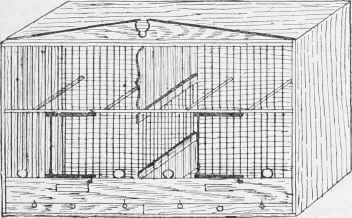
Breeding Cage for Small Birds.
Continue to:


My Books

