


Enlarging With Fixed Focus Hand Camera
Description
This section is from the book "Cassell's Cyclopaedia Of Mechanics", by Paul N. Hasluck. Also available from Amazon: Cassell's Cyclopaedia Of Mechanics.
Enlarging With Fixed Focus Hand Camera
The accompanying sketch shows an arrangement for making either enlarged negatives or prints. In the bottom of a lidless box M cut an opening 4 7/8 in. by 3 1/8 in.; fit grooves A A top and bottom, to carry the negative B (the box is standing on end). Make a box D of the size and shape shown (see also ground plan), having an opening at F a little smaller than the hand camera H, and with a close-fitting fillet run round it on the outer side at J, forming a recess, into which the back of the camera fits, and is supported on the bracket E. The bracket is either detachable or hinged at 0 O. At the rear of the box is fastened another fillet P, at exactly 13 in. from the lens stops. Cut a slot right down one side rather greater in width than the thickness of a whole-plate printing frame. The frame should now be built up at the same side flush with the outside of the box, and a further piece screwed on, pi-ojecting i in. each way beyond the opening, and fitting close to exclude light. Now insert the frame, facing the lens, and screw another fillet behind it, so that it just runs easily between them.
The frame is assumed to measure 10 1/2 in. by8 1/2in. Next cut from a block of wood C a recess to form a bed for the condenser N, the centime of which must be exactly opposite the centre of the negative, the lens, and the printing frame. A lid may be hinged to D. The camera and other loose parts may then be stored inside. Now construct a board 36 in. by 8 in., hinged in the centre. Put two screws in the extreme end; these, by engaging with holes in D, ensure its being always in the same place. Now place the other parts roughly in position. Fix, with drawing-pins at the corners, the sheet of ground glass, rough side outwards, in the printing frame, and insert it in D. Having put the negative B in position, focus very accurately by moving the box to and fro. The condenser and light are next manipulated until the corners of the negative are illuminated and an evenly lighted screen is obtained. Then screw the block in position in M, and fit the points for the other parts as before. Instead of using a condenser, a piece of magnesium wire may be burnt behind the negative, the light being waved about, so that the negative may be evenly illuminated. In this case a sheet of ground glass should be placed a few inches behind the negative.
To use the apparatus it will merely be necessary to insert the negative, then place in the printing frame a sheet of clear glass, free from bubb'es or scratches, and of the same thickness as the ground glass mentioned above. Place upon this, face downwards or outwards, a sheet of bromide paper, and, having turned the light down very low, insert through K. If preferred, a sheet of card-board, which can be slid out after placing the frame in position, may be made to run in front of the printing frame. The above dimensions are worked out on the assumption that the lens is of 5-in. locus.
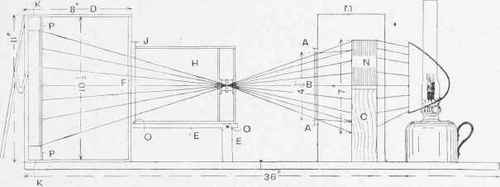
Enlarging with Fixed Focus Hand Camera.
Continue to:


My Books

