


How To Make Glass-Fronted Hanging Cupboard
Description
This section is from the book "Cassell's Cyclopaedia Of Mechanics", by Paul N. Hasluck. Also available from Amazon: Cassell's Cyclopaedia Of Mechanics.
How To Make Glass-Fronted Hanging Cupboard
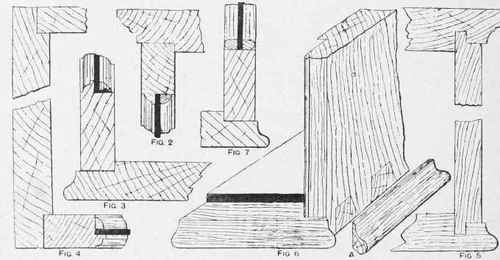
Fig. 1 is an elevation of a small glass-fronted cupboard suitable for hanging on a wall. The top is 1 1/4in thick, the bottom 1 in. thick, and the sides and back 3/4 in. thick. The sash forming the door is Jin. thick, finished size. The top is rebated and moulded, the moulding being returned along the ends to form a small cornice (see Figs. 2 and 5); the bottom is prepared in a similar manner (see Fig. 3). The ends are rebated front and back (see Fig. 4). Fig. 5 shows how the end is fixed to the top and bottom, whilst Fig. 6 gives a better method of fixing the bottom to the end or side by means of dovetails, the pins being cut on the bottom. A. loose piece of moulding is then planted on to cover the dovetailing, and the sash is mortised and tenoned together. If desired, a chamfer may take the place of the ovolo moulding on the stiles and rails, or the sash may be made square and a bead mitred round and fixed with panel pins, as shown in Fig. 7. The sash is hinged with brass butts, and a straight cupboard lock fixed on the left-hand stiles, the keyhole only requiring to be cut, and a small thread escutcheon let in on the face of the stile. The middle shelf is fixed on movable fillets.

Fig. 1.
Glass-fronted Hanging Cupboard.
Continue to:


My Books

