


Lead Flashings "Burnt-In 'To Stone
Description
This section is from the book "Cassell's Cyclopaedia Of Mechanics", by Paul N. Hasluck. Also available from Amazon: Cassell's Cyclopaedia Of Mechanics.
Lead Flashings "Burnt-In 'To Stone
The method of burning-in lead flashings abutting against stonework is illustrated by the accompanying figure. A groove, about 1/2 in. to 5/8 in. wide by 1 in. to li in. deep, is cut into the stone, the back of the groove being a little wider than the front. Into this the lead flashing is fixed as shown at A; a piece of dry deal, about 2 ft. long by 2 1/2 in. wide by 14 in. thick, made to the section as shown at B, is fixed over the groove and kept close by means of struts or weights. On the upper edge, three or four pouring holes and air-vent holes or notches are cut as shown by the dotted lines, into which molten lead is poured to fill up the groove. A greater length than 2 ft. cannot very well be done at one pouring, and to prevent the lead flowing out at the ends they should be stopped with clay or putty. After pouring the lead, the piece of wood is removed, any feather-edges on the lead are trimmed off, and the face is hatched with a blunt hand-chisel to a herringbone pattern. Sometimes the face of the groove lead is staved to make it fit tight after shrinkage by cooling, but this is not a good plan, as the stonework is " stunned," and this results in a crumbling away after being wetted and exposed to frost.
Flashings are not stepped in tooled stone walls, but are fixed in grooves cut parallel and raking with the roof.
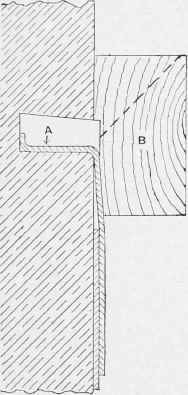
Lead Flashings "Burnt-in" to Stone.
Continue to:


My Books

