


Pressure On Retaining Wall
Description
This section is from the book "Cassell's Cyclopaedia Of Mechanics", by Paul N. Hasluck. Also available from Amazon: Cassell's Cyclopaedia Of Mechanics.
Pressure On Retaining Wall
The following is the method employed in computing the pressure exerted by earth on a retaining wall of any thickness, with the earth at a given angle of repose. The earth above the line of repose adheres to that below, and the angle of repose is only reached after a long period of exposure to the weather, so that there is no tendency for the whole mass to move at once. The bisection of the angle of repose with a vertical line gives the line of rupture, and the wedge of earth between the line of rupture and the back of the wall is considered to be the amount pressing on the wall, or where fracture would originate if the wall yielded. Let ABC be this wedge of earth, AB a vertical line at the back of the wall, A C the line of rupture, and c. g the centre of gravity of the wedge. Draw a vertical line W through the centre of gravity touching the line of rupture and equal in length on any given scale to the weight of the wedge of earth. At its base draw the horizontal line marked T, which will be at one-third the height of the wall, and cut it off to the length shown by a line from the upper extremity of W parallel to the slope of the line of rupture.
Then T will equal the thrust on the wall by the earth at the back.
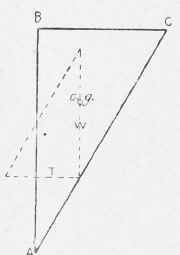
Pressure on Retaining Wall.
Continue to:


My Books

