


Air-Pressure Engines
Description
This section is from the book "The Engineer's And Mechanic's Encyclopaedia", by Luke Hebert. Also available from Amazon: Engineer's And Mechanic's Encyclopaedia.
Air-Pressure Engines
Engines in which the difference of pressure of air of different densities is employed as a motive force. From the extreme lightness and mobility of air, it has been frequently proposed to employ it as a medium for transmitting motion to machinery at a considerable distance from the prime mover. Amongst the first who attempted this is the celebrated Papin, who invented the steel-yard safety-valve. He employed a fall of water to compress the air in a cylinder, through the medium of an intervening piston; and he connected this cylinder to another, at the mouth of a mine a mile distant, by means of a pipe of that length. In the second cylinder was another piston, the rod of which was intended to work a set of pumps; but, contrary to expectation, the compression of the air in the first cylinder produced no movement in the piston of the second. Papin subsequently attempted to bring his scheme into use in England, but did not succeed. Afterwards, however, he erected great machines in Auvergne and Westphalia for draining mines, but so far from being effective machines, they would not even begin to move.
He attributed the failure to the quantity of air in the pipe, which must be condensed before it can condense the air in the remote cylinder; he therefore diminished the size of this pipe, and made his water machine exhaust instead of condense, and had no doubt that the immense velocity with which air rushes into a void, would make a rapid and effectual communication of power. But the machine stood still as before. Near a century after this, an engineer at an iron-foundry in Wales erected a machine at a powerful fall of water, which worked a set of cylinder bellows, the blow-pipe of which was conducted to the distance of a mile and a half, where it was applied to a blast furnace; but notwithstanding every care to make the conducting pipe very air-tight, of great size, and as smooth as possible, it would hardly blow out a candle. The failure was ascribed to the impossibility of making the pipe air-tight; but above ten minutes elapsed after the action of the piston in the bellows, before the least wind could be perceived at the end of the pipe, whereas the engineer had calculated that the interval would not exceed six seconds. The foregoing particulars are taken from Dr. Robinson's Natural Philosophy, art.
Pneumatics, and an explanation is offered of this curious phenomenon; but on account of its prolixity, we omit it; but the following remarks, which appeared in the Franklin Journal, are deserving of notice: " If we take a particular care, and calculate the resistance of air moving through pipes according to acknowledged principles, we shall find nothing mysterious in the above result. It will be found, that if the blow-pipe is 3 inches in diameter, and only a mile long, the air at one end must be kept constantly condensed by a pressure equal to 54/10 atmospheres to produce a velocity of 128 feet per second; and yet this velocity gives only 2,304 gallons per minute, only about half the quantity used in the furnaces of Europe; a blast furnace there expels 720 cubic feet of air per minute, (Mech. Philos. Vol. VIII. p. 784,) if we calculate the velocity of water issuing from a pipe a mile long, and 3 inches in diameter, under a 9-foot head and fall, to be 1 foot per second. Now, as equal velocities are known to be generated in all fluids by equal heads, all other circumstances being equal, it will follow that a 9-foot head of air, or 1/800 of a head of 9 feet of water, will generate in air a velocity of 1 foot per second in a tube 3 inches in diameter and a mile long. Again, it is known both from theory and experiment, that the heads of pressure generating velocities in fluids, are as the squares of the velocities; now the square of 1 is 1, and the square of 128 is 16384, therefore the head of pressure due to the velocity of 128 feet, is obtained by the following proportion, as 1: 16384:: 9: 147456, and this number divided by 800 gives 1841/3 equal to a pressure of 54/20 atmospheres, as before said: now if we suppose this velocity doubled, or 256 feet a second, in order to discharge air enough for a blast furnace, the head of pressure must be four times as great, or upwards of 21 atmospheres.
This would require a machine of 3425 horse power, provided a horse can work eight hours a-day, raising 140 lbs. 200 feet per minute. Notwithstanding the failure of both of the plans of Papin, and the plausible arguments against them just quoted, they have been recently revived in this country. Mr. Samuel Wright has taken out a patent for transmitting power to machinery by means of condensed air; but we have not heard of any erections on the principle. Mr. Hague, however, has taking out patents for effecting the same object by the rarefaction of air by an air-pump, and has established several machines upon this* principle, the successful operation of which leaves no doubt that the failure of Papin must have arisen from some defective arrangements or imperfect workmanship. We have selected a few of those machines to which Mr. Hague considers the principle as peculiarly applicable.
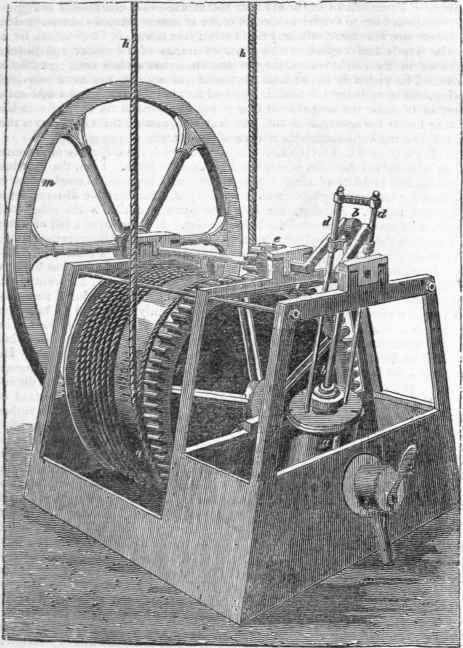
The first of these which we shall describe, is a crane for raising goods into lofty warehouses. In the engraving on page 28, a represents a working cylinder vibrating upon gudgeons, one of which has passages leading to the top and bottom of the cylinder; b piston rod connected to the crank; d d guide rods; e pinion on axis of the crank, driving / a toothed wheel on the axis of the drum g; i the valve-box, in which the hollow gudgeon of the cylinder turns, and, admitting the atmosphere to press upon one side of the piston whilst the air is drawn from the opposite side by an air-pump worked by a steam-engine; k the spanner for reversing and regulating the motions of the machine; e pipe leading to the air-pump; m fly-wheel. Mr. Hague proposed to erect a series of these cranes round Docks and Basins, the whole to communicate with a large main or pipe, in which a vacuum should be maintained by pumps worked by a steam-engine. The advantage consisted in the employment of steam power, where no shafting can be introduced.
Mr. Hague erected some engines of this description in some collieries at Stourbridge, which we have heard gave great satisfaction.
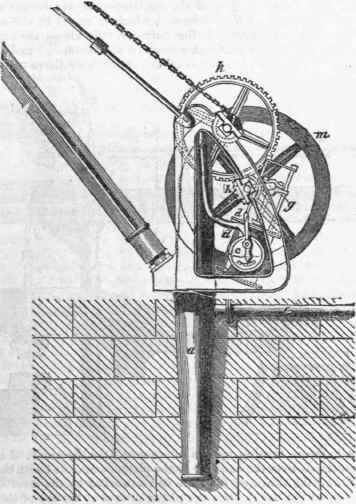
The figure on page 29 presents a swing-round crane, upon the same principles as the former, and may be supposed to form one of a range round a dock basin, a is a hollow cast-iron post, upon which the crane turns, and is firmly imbedded in masonry; from the upper end proceeds a pipe b turning air-tight in a stuffing-box, and communicating with a cylinder d by means of a three-way cock c. The cylinder vibrates upon gudgeons, in one of which are formed two hollow passages, the one leading to the top, and the other to the bottom, of the cylinder. A pipe e proceeds from an aperture/in the crane post to an air-pump, worked by a steam-engine, or any other power, and which may be situated in any part of the docks, the air being rarefied alternately above and below the piston of the vibrating cylinder, whilst the atmosphere presses upon the opposite side of the piston; the alternate motion of the latter turns the crank g and the piston h, which drives the wheel k fixed upon the axis of the chain barrel I, and thus raises the load; m is a fly-wheel, by means of which the reciprocating motion of the cylinder imparts a rotatory action to the crank.
The last example we shall give of the application of Mr. Hague's patent, is that of a tilting or powerful forge-hammer, which is raised by the atmosphere pressing upon a piston connected to the hammer, (the air on the opposite side being rarefied by means of an air-pump situated at a distance,) and which falls, by its own weight, upon the admission of the atmosphere above the piston.
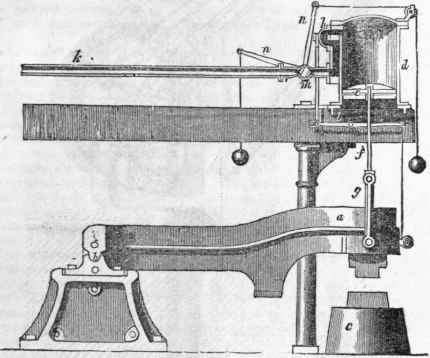
a b is the hammer turning upon a fulcrum at b; c the anvil; d a cylinder, situated immediately over the hammer; e the piston, connected with the hammer by the bar f, and the slings g; h a slide valve, worked by the lever I, which is struck by a pin on the bar f, when the piston arrives at the top of the cylinder, which depresses the valve so as to shut off the communication with the air-pump, and admit the atmosphere, permitting the hammer and piston to fall by their own weight. Towards the close of the descent, the hammer, by means of a line attached to it and to the lever l, reverses the position of the lever / and of the slide valve, thus re-opening the communication between the cylinder and air-pump, k is the pipe leading from the cylinder to the air-pump, and m a cock for shutting off the communication with the air-pump when the hammer is not at work; n n spanners for opening and shutting the cock.
Continue to:


My Books

