


Alcohol. Part 3
Description
This section is from the book "The Engineer's And Mechanic's Encyclopaedia", by Luke Hebert. Also available from Amazon: Engineer's And Mechanic's Encyclopaedia.
Alcohol. Part 3
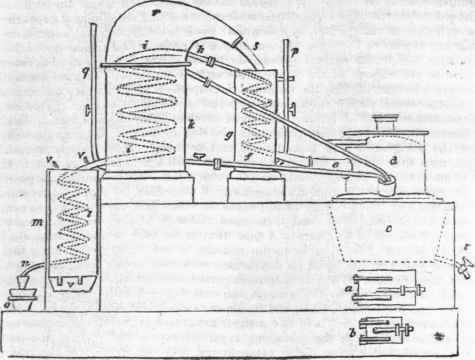
A number of spiral pipes surround the tub on the inside, the ends of only two of which are shewn in the figure to avoid confusion. Now, as the upper part of the tub is always the warmest, a current of air is produced in these pipes, which serves to cool the water in which they are placed. The worm f being surrounded with a medium of about 180° Fahr, returns to the still the greater portion of the watery part of the vapours, so that by this apparatus spirits of great strength may be obtained at a single operation.
Berard's Improved Still. This invention consisted in the application of a lofty neck and head to the body of a common still, which, being exposed to the cooling influence of the air, a considerable condensation took place in those parts, but the liquor thus re-formed was not permitted to run back immediately into the boiler, but to fall upon partitions with raised ledges, so that the ascending vapour had to traverse over the successive layers of fluid in the partitions, and became for the most part condensed in its passage, only the strongest or purest spirit passing beyond the head.
Instead of a more particular description of Berard's method, we shall proceed to the notice of Mr. Derome's still, in which the method is introduced with considerable improvements. This apparatus consists of seven vessels or parts performing separate offices: namely, a boiler A; a distilling column B C; a rectificator C C; a condenser I Q; a refrigerator p; and a reservoir s; in which the supply from another vessel U is regulated. It is considered preferable to have two coppers like that at A, set in the masonry close to each other so that the heated air from the burning fuel under one copper may be conducted under the other. Two communications are also to be made between the two coppers, the first by a pipe proceeding from the bottom of A to the upper part of the other; the second by another pipe rising from the top of the latter, (not represented) and descending through the top of A to the bottom of the vessel, to carry all the vapour generated underneath the liquid therein. At a b is a glass tube to show the exact height of the liquid in the copper.
The interior of the distillery column, B C where the separation of the alcohol takes place, is full of shelves perforated with small holes, through which the vapour from A necessarily passes as it ascends, and comes in contact with the wine or liquid to be distilled, that passes through the same apertures; both the wine and the spirit are thus retarded in their progress, and become intimately mixed. The small tube c d is of glass, to show the state of the process going forward in the rec -tificator C C, which is only an extension upwards of the column beneath, containing similar perforated shelves, and provided with a glass tube e f to show the state of the process in this part. The vapour rising to the top of the rectificator passes out through the neck H into a long worm, coiled horizontally in the condenser I Q, which is a copper cylinder. This vessel contains wine that becomes heated by passing through the worm. To collect the spirit that becomes condensed in the worm, the lower side of each coil has an opening into a short tube, of which there are as many as there are coils to the worm.
To these tubes there are cocks, to draw off, as may be required, the products of any or all of them (the most distant from the rectificator being of course the strongest spirit,) either into the refrigeratory, by the upper long inclined tube represented, or by the lower one back again into the rectificator for a second rectification. The condenser is divided into two chambers, by a partition o, with a communication between them at the lower part; there are also three manholes closed by lids M N O in the condenser, for the convenience of having it cleaned; and it has a cock F to draw off its contents. The wine is constantly supplied to the condenser by the pipe K L, and as constantly flows off by the tube D E. p constitutes the refrigeratory or cooler, and is also a copper cylinder containing a worm, that receives the condensed vapours through the pipe I m, and delivers the cooled product through the opening V. The cooler is constantly supplied with cold wine by the pipe R, which enters at the bottom of the vessel, and the wine passes off at the top of the vessel by the pipe K L into the condenser I Q.
W is a cock, to empty the cooler; S is the reservoir which contains the wine; it has a cock p, by the opening of which the quantity of wine to be supplied to the apparatus is regulated; and in order that this may be equal, the liquid is kept at a uniform height by means of a ball cock q T, the pipe to which is connected with the principal reservoir, which, for example, may be the vessel U.
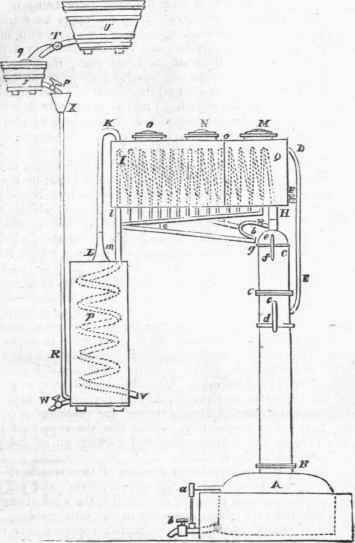
Mode of conducting the operation. The cock p being opened, the wine from U passes through all the vessels into the two coppers, to the desired height, which is ascertained by the two glass gauges. The distilling column is charged with as much wine as will prevent a free passage of the vapour; and when the condenser and cooler are full, the entrance of more wine is stopped, and the communication is not re-established by the cock p until the wine in the coppers has parted with its alcohol, and the liquid in the condenser is hot enough to be introduced into the distilling column. After this, a small stream, proportioned to the size of the apparatus and the rapidity of the work, is kept constantly running from S, and then begins what is termed the continued process, all the previous work being only preparatory. After this, the supply of the vessels with wine, the evaporation, condensation, and cooling, go on independently, requiring only attention to the fire.
Winter s Patent Distilling Apparatus consists of two vessels of a peculiar construction, which may be applied to stills of every form; and will enable the distiller to extract the whole of the spirit contained in the wash at one operation, instead of the repeated distillations necessary in the usual mode. These two vessels contain condensers, which, as in Solimani's apparatus, are surrounded by a fluid maintained at such temperatures, as to condense any desired portion of the aqueous parts of the vapour from the still before it enters the refrigerator. The apparatus is shown in the annexed Fig. 1. A is a tube by which the vapours enter from the still into the first receiver B; C a conical surface or plate; D the principal vapour tube, which being closed at the top, the vapours descend by the small tubes G into the chamber F. These small tubes are placed all around the principal tube, which are inserted in the holes shown in the engraving just above D. The apparatus is surrounded with water heated to 170°, and is contained in the tub or bath T, shown in section; and as the vapours contained in the tubes are, by this arrangement, separated into small portions, a rapid condensation of the aqueous parts takes place.
Continue to:


My Books

