


Alcohol. Part 5
Description
This section is from the book "The Engineer's And Mechanic's Encyclopaedia", by Luke Hebert. Also available from Amazon: Engineer's And Mechanic's Encyclopaedia.
Alcohol. Part 5
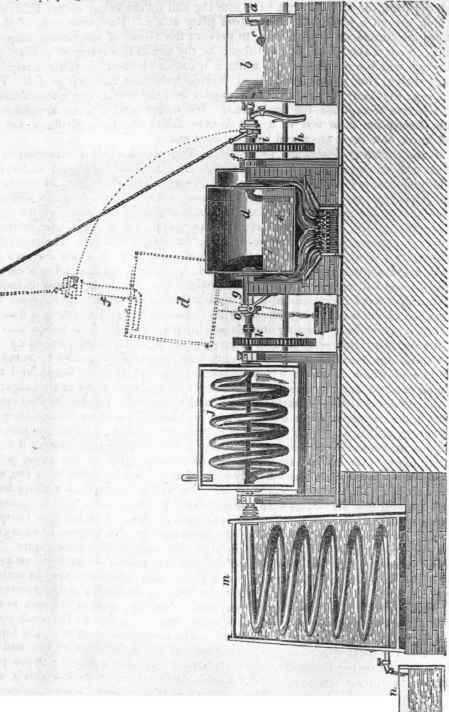
The continuous motion of the liquid prevents the formation of empyreuma, however fierce the fire may be; and by the agitation of the liquid, and the intensity of the heat applied, a rapid production of vapour is caused, which immediately enters the hollow axis g, and passes into the coiled worm of the rectifier j. It is here necessary to observe, that this capacious worm revolves in the direction pointed out by the arrow: consequently whatever portion of the vapour becomes condensed in it, runs out at every revolution back through the hollow axis g into the still, and the hollow axis g is for this purpose made tapering wider towards the still, so as to give the liquid a descent to run freely into it. The vessel j is, therefore, properly termed a rectifier, as it separates the water from the diluted alcohol before passing out of it into the refrigeratory m. In this it arrives in a state more on less concentrated, according to the temperature maintained m the rectifier, which is regulated as usual by a thermometer. The spirit may consequently be drawn at one operation at almost any desired strength.
An interesting feature ,n these new arrangements, is the mode of applying the syphon, which is constantly supplying the still with fresh wash, in the place of that which has been vapourized; and this operation is uniformly continued during the rotation of the vessel, owing to its passing through a tubular axis. The syphon in like manner enables the still to be discharged without stopping the machinery. When it is necessary to recharge the still with the fire under it, a thick cast-iron sliding plate is drawn from the back, so as to interpose itself between the fire and the still, and thus prevent any injurious effects to the contents of the latter
The following engraving represents an apparatus which has been proposed for distillation by means of steam or heated air, acting through the medium of an extensive metallic surface upon a thin film of liquid, in 01 d?r to promote a speedy evaporation at a comparatively low temperature, a is a tall cylindrical vessel containing the fermented wash to be distilled, which is supposed to be supplied regularly by a pipe from the brewhouse. By turning the cock in the pipe b, the wash flows upon the exterior surface of the conical evaporator c, formed of thin copper. The liquid is first received into a small basin, surrounding the cone near its apex, having numerous small perforations at the bottom, by which means the liquid is equally diffused in a thin stratum over the surface of the cone c. d is the opening into the cone c, by which the heating medium is admitted, and provided with a valve or cock for regulating the temperature; and the heat being maintained at about 180° but a small portion of aqueous vapour would rise with the spirituous, and the spirit would thus be separated at the commencement of the process from those matters which usually contaminate spirits of home manufacture.
That portion of the wash that escapes evaporation owing to the low heat, (and which would consist chiefly of water and extractive matter,) will run off at the bottom of the cone by a circular gutter, and from thence pass out by an aperture or pipe, as at e, while the more spirituous rises between the inner cone c and the outer cone f f, enters the neck g, and from thence proceeding through the spiral worm, shown in the wash vat a, is received into the recipient h, partly in the form of vapour, and partly in the liquid state; having in its passage through the worm communicated so large a portion of its heat to the wash in which the worm is immersed, that a slight additional heat will be sufficient to separate its alcoholic constituents. A small portion of strong spirituous vapour will collect in the upper part of the vat a, which may be conducted off by the tube o into a separate recipient or refrigeratory, as the spirits thus produced will be of superior purity. The more volatile portion of the vapour passes onwards through the open tube i into the great refrigeratory h This is a large cylindrical vessel or vat, with a strong false bottom at f, into which are soldered a great number of small thin pipes t t rising vertically and open at both ends, the upper extremities being soldered into the bottom plate of the chamber m.
The portion of the vat above the false bottom I is kept filled with cold water by a service-pipe inserted at the lower part, the vapour, therefore, rising up through the pipes t t, is exposed very much subdivided to a very extended metallic surface, surrounded by cold water, by which its caloric will be very rapidly abstracted; the condensed liquid which then runs back down the pipes, meets with the rising vapour in its progress, and, by that means, condenses a further portion at a higher temperature than would have otherwise been accomplished, which is the object of causing the vapour to proceed upwards instead of forcing it downwards, as in the ordinary practice. By these arrangements it is expected that very little vapour will reach the upper chamber m if the water is not allowed to get above 80°; but if the supply of cold water should be insufficient for the purpose, the vapour must proceed, of course, from the tube n to another refrigeratory. To a bevelled wheel at q are attached two long bars, or scrapers r r, the edges of which scrape or brush against the surface of the cone to clear it of sediment or incrustrations, which will then fall to the bottom; the bars are connected by a ring at s; such an apparatus will be useful in the distillation of liquids that contain much extractive matter.
From the above description it will be seen that the distillation is carried on without intermission, the wash being admitted in a small stream, in such quantity as to allow the alcoholic portion to be evaporated in its passage over the heated surface of the cone c, and the remaining portion to pass off in a stream by the waste pipe at e, as long as fermented wash is supplied from the brewhouse. It has been stated, though we know not upon what authority, that it has been found difficult to separate the alcoholic from the aqueous parts of fermented liquors, by simply causing them to flow over a heated surface; and that preference has therefore been given to stills constructed upon the combined principles of Adam and Solimani.
Continue to:


My Books

