


Alcohol. Part 7
Description
This section is from the book "The Engineer's And Mechanic's Encyclopaedia", by Luke Hebert. Also available from Amazon: Engineer's And Mechanic's Encyclopaedia.
Alcohol. Part 7
For a further account of distillatory apparatus, we refer our readers to the article Distillation, under which head will be found a description of a great variety of stills and apparatus connected therewith, which the length to which we have extended the present article prevents our noticing in this place.
K at the bottom while the clear liquor is running. The discharge cock being closed, the sediment may be stirred up with a quantity of water, to take up whatever saccharine or fermentable matter it may contain; this should be allowed to subside again, and the clear liquor then to be added to the former in the vat beneath. To promote the fermentation, a quantity of yeast is now to be added to the liquid, in the proportion of three pounds to every hundred pounds of potatoe pulp.. During the fermentation, which usually occupies from fifteen to twenty days, the temperature of the liquid should be preserved at from 90° to 100° Fahr., and the atmosphere of the room where it is conducted, at from 80° to 85°. The patentee having discovered that the introduction of hydrogen gas facilitates the fermentative process, besides increasing and improving the product, further directs that the vat should be furnished with a tube i, along which the gas is to be forced, by means of a pump, into the liquid.
The tube, after descending to the bottom of the vessel, takes a horizontal serpentine course; in this part it is perforated with numerous small holes, through which the gas escapes and bubbles up through the liquid.
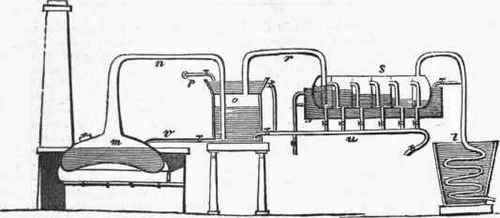
This injection of the gas should be continued until the carbonic acid gas, in the upper part of the vat, contains an excess of the hydrogen. The patentee is of opinion that the introduction of hydrogen gas may be very advantageously used, not only in this process, but in the fermentation of all matters from which spirit or alcohol is to be extracted. When the vinous fermentation has ceased, the liquor is to be drawn off through the tube into the still k. This still is of the ordinary construction, except that instead of having a large head, or capital, it has a long neck rising perpendicularly from the body, the object of which is, that the aqueous part of the vapours may be condensed before entering the inclined part, and fall back into the still, while the more volatile or spirituous pass on alone into the bent arm, and from thence into the refrigerator or worm-tub f, where it is converted into the ordinary first product of distillation, called low wines (which is a very weak spirit).
The low wines are then taken to another called the low wine-still, a section of which is shewn in the accompanying engraving.
When, by repeated distillation, the alcoholic mixture is brought to a certain degree of concentration, the affinity of the alcohol for the water with which it is still combined, aided by the great excess in the proportion of the alcohol to the water, becomes so great, that no further separation of the constituent parts of the mixture can be effected by distillation. Alcohol being much lighter than water, its spec. grav. is used as a test of its purity. Fourcroy considered it as rectified to the highest point when its spec. grav. was 829, that of water being 1000; and this is, perhaps, nearly as far as it can be carried by mere distillation. Alcohol, however, is not in this state pure (nor, indeed, is any process known by which it may be rendered anhydrous, or perfectly free from water); but it may be freed from a further portion of water by means of an alkaline salt For this purpose, muriate of soda (common salt), may be advantageously employed, by first depriving it of its water of crystallization by heat, and adding it hot to the spirit. It is, however, considered preferable to employ the sub-carbonate of potash.
About a third part of the weight of the alcohol should be added to it in a glass vessel, be well shaken, and then allowed to subside.
The salt will be found to have absorbed water from the alcohol which being decanted, more of the salt is to be added, and the process con tinued until the salt falls dry at the bottom of the vessel. The alcohol must now be subjected to final distillation in a water-bath, to deprive it of the red tint derived from the potash, as well as to free it from the alkali held in solu tion. A most important improvement upon this method of rectification has been invented by a French chemist. It consists in placing a quantity of dry muriate of lime, or other deliquescent salt, in a large shallow-covered vessel; in this is placed another vessel of smaller dimensions, and resting upon the bottom on short legs, and containing the diluted spirit (brandy for instance) to be concentrated; the outer, or larger vessel, is then covered down, and properly luted, to prevent the escape of the spirit. A series of double vessels are arranged beneath the former, charged with the deliquescent salt only; and nines of communication lead from one to the other, and are furnished with stop cocks.
These arrangements, as well as the process, will be perfectly well understood upon reference to the annexed diagram, a is the vessel containing the deliquescent salt; b, that containing the dilute spirit; the cover of a being well closed and luted, it is left for several days to attract the water from the spirit; and when the former is supposed to be fully saturated with aqueous particles, the spirit in b (considerably improved in strength) is drawn off into d by turning the cock c. This second vessel being also provided with a stratum of muriate of lime, the process of concentration recommences by a farther abstraction of the water contained in the spirit. In like manner the spirit may be successively operated upon by the salts contained in the vessels e and f, and, if required, by an additional number of vessels, until alcohol of the greatest purity is obtained. As each vessel is successively emptied, the saturated salt is taken away and replaced with a fresh quantity of dry salt, when it is ready to operate upon another portion of spirit let on from above. There is another method by which the strongest alcohol may be obtained, although the process, as usually conducted, is rather dilatory.
Continue to:


My Books

