


Chemistry. Part 11
Description
This section is from the book "The Engineer's And Mechanic's Encyclopaedia", by Luke Hebert. Also available from Amazon: Engineer's And Mechanic's Encyclopaedia.
Chemistry. Part 11
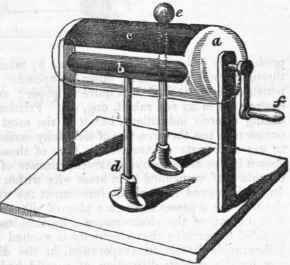
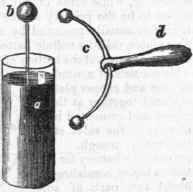
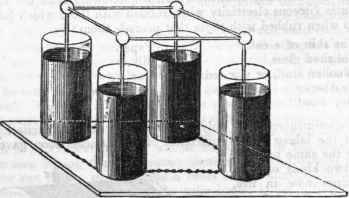
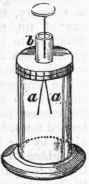
If the electricity-be accumulated in a large jar, or if several jars are connected, as in the accompanying sketch, they form an electric battery, and all the effects produced by lightning may be imitated by means of it. If electricity be passed through resin, phosphorus, ether, gunpowder, etc. it inflames them; it will penetrate a thick card or a quire of paper; and if in sufficient quantity, will destroy life in an eel, rabbit, dog, etc. Friction is not the only means of producing electric indications, but it is the most energetic; and when we have occasion to test the presence of electricity excited by other means, it is necessary to use a delicate electrometer. One of these, called Bennet's electrometer, shown in the accompanying sketch, consists of two small slips of gold leaf suspended by a brass wire within a glass cylinder. In the improved form of the instrument the wire which carries the leaves a a passes through a plug of silk within a glass tube b in the cap of the electrometer. By this instrument we are enabled to perceive that electricity is excited in the fusion of inflammable bodies, in evaporation, in the disengagement of gas, by the sudden disruption of a solid body, by change of temperature, by contact of dissimilar bodies.
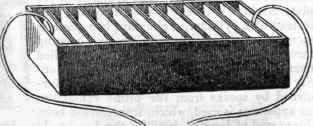
This latter has been considered by Volta and others as the origin of voltaic electricity, while some of our first chemists consider chemical action to be the primary source of voltaic energy. Voltaic electricity is usually procured by an arrangement of copper and zinc plates, called a voltaic battery. There are different forms of this apparatus, but the battery of Cruikshank is, on the whole, the most convenient This consists of a number of zinc and copper plates, soldered together at their edges, and cemented into grooves in the sides of a mahogany trough. To prepare the battery for action, a liquid consisting of about two parts of sulphuric acid one of nitric acid, and 100 of water, should be poured into the cells till they are nearly full; a wire must then be inserted at each end touching the outer plates. The wire connected with the zinc plate will give off positive electricity, and the wire attached to the copper plate, negative electricity. The galvanic or voltaic battery is a highly important agent in chemical research, both from its energetic decomposing power, and from the intense heat which it produces.
If the two wires are of platinum or gold, And are inserted into a glass of water, the water will be decomposed into its elements, oxygen and hydrogen; the oxygen will appear at the positive wire, and the hydrogen at the negative If the ends of the wires dip into two separate glasses of water, and a finger of each hand be immersed in them, a slight electric shock will be felt, the intensity of which will increase with the number of plates. If the number of plates is very great, or if of large dimensions, the phenomena are beautiful and striking. The battery of the Royal Institution, used by Sir H. Davy, in his researches, contained 2,000 pairs of plates, containing a surface of 128,000 square inches. When pieces of charcoal about an inch long, and one-sixth of an inch in diameter, were brought within one-thirtieth or one-fortieth of an inch of each other, a bright spark was produced, and more than half the volume of the charcoal became ignited to whiteness; and by drawing back the points a little from each other, a constant discharge took place through the heated air, in a space equal at least to four inches, producing a most brilliant ascending arch of light, expanded and conical in the middle. When any substance was introduced into this arch, it instantly became ignited.
Platinum melted in it like wax in the flame of a common candle. Quartz, the sapphire, magnesia, lime, all entered into fusion. Fragments of diamond, and points of charcoal and plumbago, rapidly disappeared and seemed to evaporate in it, even when the connexion was made in a receiver exhausted by the air pump; but there was no evidence of their having previously undergone fusion. Copper and zinc are not the only metals proper for forming a galvanic battery, but they are the least expensive. The following tables by Sir H. Davy will furnish a variety of combinations. The metal first named is positive in reference to those that follow.
With Ordinary Acids.
Potassium and its amalgams; barium and its amalgams; amalgam of zinc; zinc; amalgam of ammonium, cadmium, tin, iron, bismuth, antimony, lead, copper, silver, palladium, tellurium, gold, charcoal, platinum, iridium, rhodium.
With Alkaline Solutions.
The metals of the alkali, and their amalgams, zinc, tin, lead, copper, iron, silver, palladium, gold, platinum, etc.
With the Solutions of Hydro-Sulphurets. Arrangements consisting of one Conductor and two Imperfect Conductors.
Copper. | Nitric acid. | |
of potash . . . . | Silver. | Sulphuric acid. |
of soda................. | Lead. | |
Tin. | Any solution containing acid. | |
Zinc. | ||
Other metals. | ||
Charcoal. |
The most splendid effects of the voltaic battery achieved by Sir H. Davy were the decomposition of the alkalies and alkaline earths, as potash, soda, baryta, strontia, lime, and magnesia. These were found to be composed of a brilliant white metal combined with oxygen, which were separated and exhibited at the opposite poles of the battery. This mode of decomposition, arising from electric repulsion, has afforded a convenient basis for the arrangement of the simple substances for the convenience of study, and by its means they are divided into two classes. The first consists of those elements which are attracted from their compounds with substances of the other class, by the positive pole of the voltaic pile; and as bodies in opposite states of electricity attract one another, they have been called electro-negative bodies. The second comprises those elements that are attracted by the negative pole, which are therefore termed electro-positive bodies. Before giving a list of the simple substances, it will be necessary to allude to the theory of equivalents.
Continue to:


My Books

