


Chemistry. Part 4
Description
This section is from the book "The Engineer's And Mechanic's Encyclopaedia", by Luke Hebert. Also available from Amazon: Engineer's And Mechanic's Encyclopaedia.
Chemistry. Part 4
The colours, proceeding from the bottom, are red, orange, yellow, green, blue, indigo, and violet, according to Sir Isaac Newton's observation; but some modern observers state that there are only red, green, blue, and violet, in the spectrum, when it is formed as it should be, with a very small pencil of light. The violet occupying the upper part of the spectrum, is most diverted from its course, and is said, therefore, to be the most refrangible. The red is the least refrangible. This effect is very similar to that of elective attraction, for the same glass acts with different force on different rays; and this analogy is extended by the observation that different kinds of glass, as well as other substances, disperse light in different proportions. If these differently coloured rays of light thus separated by the prism be concentrated on one spot by means of a lens, they will reproduce colourless light. If the spectrum produced, as we have stated, be minutely examined, it will be found to have different properties in different parts. Thus the red end will most sensibly affect the thermometer; the lightest green rays are most illuminative, and the violet end produces the most decided chemical changes.
If the white luna cornea, the muriate of silver, be moistened and exposed to the different rays in the prismatic spectrum, it will be found that no effect is produced upon it in the least refrangible rays, which occasion heat without light. A slight discolouration will be occasioned by the red rays, but the blackening power will be greater in the violet than in any other ray; and beyond the violet, in a space perfectly dark, the effect was still perceptible This observation shows that there are rays more refrangible than those which produce heat and light. Sir H. Davy found that a mixture of chlorine and hydrogen acted more rapidly upon each other, combining without explosion, when exposed to the red, than when placed in the violet rays; but that solution of chlorine in water became solution of muriatic acid most rapidly when placed in the most refrangible rays of the spectrum. He also observed that the puce-coloured oxide of lead, when moistened, gradually gained a tint of red in the least refrangible rays, and at last became black, but was not affected in the most refrangible.
The same change was produced by exposing it to a current of hydrogen gas.
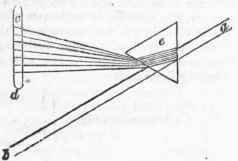
Dr. Wollaston found that guaiac, exposed to the violet rays, passed rapidly from yellow to green. MM. Gay Lussac and Thenard applied the same influence to a gaseous mixture of hydrogen and chlorine, when an explosion immediately took place. By placing small bits of card, coated with moist horn silver, or little phials of those mixed gases, in different parts of the spectrum, M. Berard verified the former observations, of the chemical power acquiring its maximum in the violet ray, and existing even beyond it; but he also found by leaving the tests a sufficient time in the indigo and blue rays, a perceptible effect was produced by them also. He concentrated by a lens all that portion of the spectrum which extends from the green to the extreme boundary of the violet, and by another lens he collected the other half of the spectrum, comprehending the red. The latter formed a focus of white light so brilliant that the eye could not endure it, yet in two hours it produced no sensible effect on muriate of silver. On the contrary, the focus of the other half of the spectrum, whose light and heat were far less intense, blackened the muriate in ten minutes.
The sun beams, in traversing a coloured glass, produce similar effects.
Thus, the chloride of silver acquires a black tint behind a blue or violet glass, but does not blacken behind a red or orange glass. On the other hand, it becomes red behind a red glass, and that much more quickly than even in the solar spectrum. With respect to the light emitted by gases, even the bright light of defiant gas, when concentrated so as to produce a sensible degree of heat, occasioned no change on the colour of muriate of silver, nor on a mixture of chlorine and hydrogen; while the light emitted by electrized charcoal speedily affects the muriate, and causes these gases to unite rapidly, and sometimes with explosion. Sir H. Davy has remarked, that the refraction and effects of the solar beam offer an analogy to the agencies of electricity. In the voltaic circuit, the maximum of heat seems to be at the positive pole, where the power of combining with oxygen is given to bodies, and the agency of rendering bodies inflammable is exerted at the opposite surface; and similar chemical effects are produced by negative electricity, and by the most refrangible rays of the solar beam In general, in nature, the effects of the solar rays are very compounded.
Healthy vegetation depends upon the presence of the solar beams, or of light; and whilst the heat gives fluidity and mobility to the vegetable juices, chemical effects likewise are occasioned - oxygen is separated from them, and inflammable compounds formed. Plants deprived of light become white, and contain an excess of saccharine and aqueous particles, and flowers owe the variety of their hues to the influence of the solar beams. Even animals require the presence of the rays of the sun, and their colours seem materially to depend upon the chemical influence of these rays; a comparison between the polar and tropical animals, and between the parts of their bodies exposed, and those not exposed to light, shows the correctness of this opinion. Light is produced in several natural operations, most of which may be considered in this place. If two pieces of quartz be rubbed together, light is produced even under water. Atmospheric air, or oxygen, quickly and violently compressed in a glass syringe, or a glass ball filled with the latter, and suddenly broken in vacuo, produces light. Light accompanies intense heat. Air heated up to 900° Fahr, and made to fall on pieces of metal, earth, &e. communicates to them the power of radiating light.
Continue to:


My Books

