


Chemistry. Part 9
Description
This section is from the book "The Engineer's And Mechanic's Encyclopaedia", by Luke Hebert. Also available from Amazon: Engineer's And Mechanic's Encyclopaedia.
Chemistry. Part 9
Accurate experiments made in vessels of ice, have, however, established the fact that liquids do conduct heat downwards, or by contact of their particles.
If it be desirable to heat a liquid, it is well known that the heat should be applied at the bottom of the vessel, by which means the stratum of particles nearest the fire becomes lighter, and ascends, being forced up by the descent of the colder, and therefore heavier parts. This process continues until the whole has attained that degree of heat at which the liquid boils; the same occurs in heating a confined portion of air. Any circumstance that tends to impede the motion of the particles of liquids will diminish the facility with which they are heated or cooled. Water-gruel, soups, and other thick drinks, retain their heat for a considerable time; while more dilute liquids become cooled at the surface, the cooler parts subside, and the hot ones rise and come into contact with the atmosphere; these become cooled and sink, and thus the process goes on till the whole attains the same temperature as the surrounding medium. It has been long known that the sun's rays proceed in right lines, and that they are capable of being reflected and refracted by mirrors and lenses so as to produce an intense heat. In like manner, if an iron ball be heated a little below redness, it will be found to emit rays of heat that are capable of being reflected and refracted in a similar way.
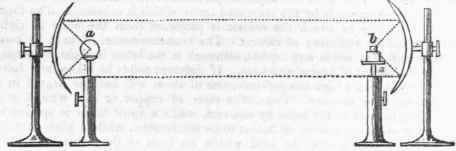
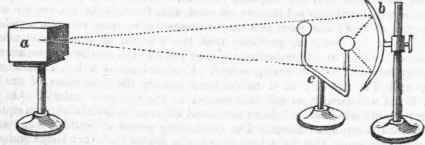
If two concave and polished metallic mirrors be placed opposite to each other, and at about eight or ten feet distant, (as in the annexed engraving,) and the hot iron ball be placed in the focus of one, as at a, while in that of the other we place a piece of phosphorus b, resting on a lump of charcoal, or any bad conductor, in a few seconds the phosphorus will inflame. Now to produce this effect, it is manifest that rays of heat must have emanated from the iron ball, and falling on the nearer mirror, must have been reflected to the second mirror, by which they have been concentrated on the phosphorus. In this experiment we observe two important facts, the radiation and reflection of heat. Radiation may be considerably modified so as to be nearly destroyed by an alteration of the surface of the radiating body. Instead of the hot ball, Sir John Leslie used a tin cubic cannister filled with hot water; and as a large body would stop the return of the rays, he used only one mirror, in the focus of which he placed one of the balls of his differential thermometer, as here represented.
Previous to placing the cubic canister a before the mirror b, its four vertical sides were coated with different substances - one with lamp-black, another with China ink, a third with isinglass, while the fourth was left naked, presenting a surface of polished tin. When this vessel, filled with hot water, was presented to the mirror, the thermometer c immediately indicated an increase of temperature, varying according to the surface presented; the lamp-black surface depressed the liquid of the thermometer 100°, the China ink 88°, the isinglass 80°, and the tin 12°. By a variety of similar experiments, Professor Leslie obtained the results in the following table: -
Radiating power | |
Lamp black . . . | 100 |
Water (by estimate) . | 100 |
98 | |
Resin............... | 96 |
Sealing wax . . . | 95 |
Crown glass . . . | 90 |
China ink | 88 |
Ice................ | 85 |
Radiating power | |
Isinglass .... | 80 |
Plumbago .... | 75 |
Tarnished lead . . | 45 |
Mercury .... | 20 |
Clean lead .... | 19 |
Iron polished . . | 15 |
Tin plate .... | 12 |
12 | |
The nature of the substance is not the only circumstance that influences radiation. In general, the more smooth and polished the surface, the more feeble in its radiating power. If the surface be roughened with a file, or otherwise, its radiation is increased. It also appears that the radiation occurs not only from the superficial particles, but also from those immediately beneath them. With one coating of jelly it was found that the radiation was 38°; while a film of the same substance, four times thicker, produced a depression of 54°. When the thickness of the coating amounted to one-thousandth part of an inch, the radiation became diminished. If the same radiating surface be presented to different mirrors, we shall discover the differences in the reflective powers. By various experiments of this kind, the reflective powers of several substances were found to be as follows: -
Reflective power. | |
Brass.............. | 100 |
Silver................ | 90 |
Tinfoil.................. | 85 |
Black tin .... | 80 |
Steel............. | 70 |
Lead............. | 60 |
Reflective power. | |
Tin foil softened with mercury ... | 10 |
Glass ... . . | 10 |
Ditto coated with wax or oil......... | 5 |
If we compare these tables, we shall find generally that the best radiators are the worst reflectors, and vice versa. It may easily be inferred, that those bodies that radiate most caloric, when heated above the temperature of the surrounding medium, will also absorb most rapidly when exposed to a temperature superior to their own. In the experiment with the lamp-black surface exposed to the mirror, the thermometer indicated a temperature of 100°; if, however, the glass ball of the thermometer be covered with tin foil, the indication will be reduced to 20°. In the same manner, if the bright side of the canister be presented, the temperature will be 12°, but with the bulb covered, only 2 1/2°. From these experiments, as well as from reasoning, it is evident that the absorptive power is equal to the radiating. Connected with this part of the subject is the effect of screens. When a thin deal board was placed between the canister and the focal ball, the thermometric effect was diminished, and this diminution was proportional to the thickness of the screen.
A pane of glass interposed reduced the effect of radiation from 100° to 20°.
The reduction was greatest when the screen was most distant from the canister: the thinnest gold leaf stopped the whole of the heat; in general, those bodies intercept heat most effectually which are the worst radiators. From some more recent experiments of M. de la Roche, it is found that caloric acquires a more penetrating power as it proceeds from a source of higher temperature. A curious experiment was made by the Florentine Academicians, in which, instead of the hot canister, a large mass of snow was placed before the mirror: in this case the thermometer indicated a rapid depression of temperature, and it was at first inferred that rays of cold emanated from the snow and acted on the thermometer; this supposition is, however, unnecessary, for it may easily be shown that all bodies radiate heat constantly. Even a mass of ice or snow may have its temperature higher than the surrounding air, and will, therefore, produce signs z z of heat in the thermometer. In the experiment just cited, the snow radiates caloric towards the mirror, and the thermometer, at the same time, radiates towards it, which is reflected towards the snow.
Continue to:


My Books

