


Cutler's Patent Stoves
Description
This section is from the book "The Engineer's And Mechanic's Encyclopaedia", by Luke Hebert. Also available from Amazon: Engineer's And Mechanic's Encyclopaedia.
Cutler's Patent Stoves
This invention, when first brought before the public in 1815, met with considerable patronage; but it is now, we believe, but little used, owing to some difficulties of a slight description, for which no sufficient remedy has yet been provided. The spirit of enterprise which originated the invention received, we have been informed, a severe check, by the numerous and combined attempts of rival manufacturers to invade and destroy the patent right, which is now expired. The principle of the contrivance is, however good, and will probably, under able management, become a valuable apparatus. The invention consists in the construction of stoves and fire-places in such a manner as that the fuel necessary for combustion shall be raised and supplied from a close chamber beneath, where the upper stratum of coal shall be constantly undergoing the process of coking, the gas from which becomes ignited in passing through the open part of the grate above, and by causing the said chamber to descend at pleasure, so as to extinguish the fire.
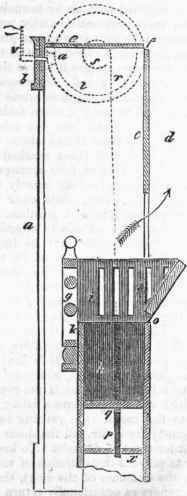
The figure represents a vertical section of a register stove, presenting an end or side view; a is one of the front pilasters; b the entablature; c the back; d the chimney, the entrance to which is shown by the curved arrow; e the top plate, turning upon hinge joints, to be raised up whenever required for sweeping; this top does not fill up the space accurately, but leaves a narrow opening at f, for the escape of the vapour and dust that may arise prior to the current being established in the direction of the arrow, by the effects of the combustion; g are the front grate bars; h the receptacle of the coals, including i, the place (as usual) where they are burned. As the air which finds its way into the close box h, is only sufficient to coke the coals, their perfect combustion is not effected until they are raised above the front plate k, at which place the air pours in on all four sides, between the bars in front, through the side grates, one of which is shown at l, and from an aperture at o, under the bottom edge of the back; p is a vertical groove, in which the bar q (seen endways) traverses up and down, supporting the movable bottom plate of the coal box h.
To each end of this bar, exteriorly, is attached a chain r, which thereby suspends the coal chamber (or movable bottom), by an horizontal roller s, extending across the stove. This roller is the shaft or axis of a cog-wheel t, and is put in motion by a pinion u; the axis of u is a small square pin, fitting into the cavity of the winch v; the turning round of the latter winds the chain upon the roller, and elevates the movable bottom q, which raises the coals, as they may be required for combustion, to supply the place of those which have been consumed. On turning the winch the contrary way, the bottom of the coal receptacle descends by its own gravity, and that of the coals resting on it, as far as the plate x, when the fire dies away for want of air. The patentee employs a pall and ratchet to stop the action of the roller, which is operated upon by pressing upon a pin, placed externally. Two objections have been urged against these stoves; one, that the current of air passing through it makes an unpleasant roaring noise, like that of an air furnace; the other, that the expansion of the coals in undergoing the process of coking prior to being raised into the open part of the fire, causes them to adhere so fast to the sides, as to render the friction excessive, and the labour great, of raising up and getting down the coals.
These objections are, however, we believe, not of an insuperable character, and may be overcome by mechanical skill.
Continue to:


My Books

