


Gas Lighting. Part 5
Description
This section is from the book "The Engineer's And Mechanic's Encyclopaedia", by Luke Hebert. Also available from Amazon: Engineer's And Mechanic's Encyclopaedia.
Gas Lighting. Part 5
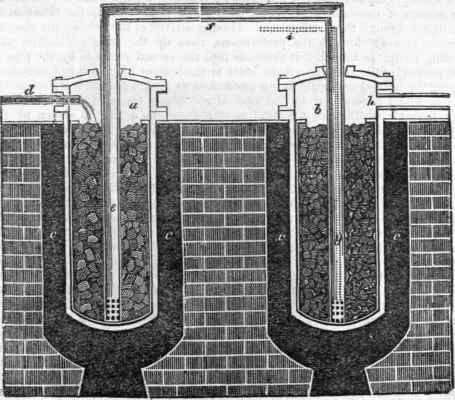
The figure gives a vertical section of two cast-iron retorts, a and b, fixed over a furnace constructed with fire-bricks; the retorts are about four feet long, of a cylindrical form, with covers accurately fitting their necks so as to render the vessels air-tight, when they are luted on and fastened down with keys or screws. They are placed erect in the brickwork by resting on their projecting flanges, leaving open spaces around them as at c c c, by which very extended surfaces are exposed to the direct action of the fire. Within each of the retorts a casing or shell of wrought iron is placed, exactly fitting the interior; these are filled with fragments of brick or coke, etc. and as these materials require to be frequently changed, each case is provided with ears or lugs, for the convenience of drawing them out, or letting them down into the cast-iron retorts. Vertical tubes, e g, are placed in the centre of each retort; they are connected at their upper ends by the horizontal tube f, and, passing through the covers, their other ends descend to the bottom of the retorts, when they are perforated with holes, as shown in the figure.
The internal cases, previously empty, are then filled with broken bricks or other substances before mentioned, and the covers and joints being all properly luted and secured, the retorts are exposed to the action of the fire until the material contained in them acquire a red heat. Thus prepared for operation, the fluid to be distilled is allowed to flow through the pipe d in a small quantity into the retort a; here, falling upon the red hot materials, the process of decomposition commences, which is assisted by the filtration of the liquid through these substances. Having arrived at the bottom, the gaseous portion, passing through the perforations, rises up the tube e; thence, proceeding along the branch f, it descends into the second retort b, by the pipe g, and passing out again through the holes at the bottom of g, the gas reascends among the ignited materials, being purified in its progress, until it arrives at the tube k, which conducts it to the gasholder. When the operation consists of only a single distillation, the fluid is introduced by a pipe i, shown by the dotted lines.
In this case the tube g does not extend higher than the cap of the retort, in the centre of which the pipe enters, and passes down the middle of the tube g, within six inches of the bottom; from thence the liquid, flowing through the perforations among the red hot materials, becomes quickly decomposed, and the resulting gas, filtering as it ascends, reaches in nearly a pure state, the tube h, which, as in the former case, conducts it to the gasholder.
Coal tar has already been noticed as one of the products resulting from the distillation of coal, and at the first establishment of public gas works, great profits were expected to be realized from the sale of this article; but from the large quantities produced, and from its inapplicability to most of the purposes for which vegetable tar is employed, it was soon found difficult to find a market, and it became an object to utilize the material by converting it into gas. For this purpose various processes were resorted to, nearly resembling that just described, for converting oil and other liquid matters into gas; but a serious inconvenience was found to result from the deposition of asphaltum in the pipes, (owing to the imperfect decomposition of the tar,) which quickly choked them up, and rendered them unserviceable, whilst the gas afforded but a feeble light, and emitted much smoke. Numerous plans have since been proposed for the remedy of these evils, of which we shall only notice the invention of Messrs.
Vere and Crane; the apparatus, it is stated in the specification, is also applicable to the distillation of all animal or vegetable solid or liquid matters, from which carburetted hydrogen may be obtained.
The process consists in introducing into the retort a constant stream of water, or a current of steam into the exit pipe, which, mixing with the volatile matters arising from the substance under decomposition, causes them to fall down again into the retort without proceeding further to choke up the pipe, while the more gaseous products pass on through the steam in a purer state to their destination, to be afterwards treated in the usual way. Fig. 1 is a front elevation of the improved retort set in the brickwork of the furnace; and Fig. 2 is a vertical section of the same; the letters have a reference to the same parts in each figure, a is the ash-pit, b the furnace, c c the flue winding round the retort; d the retort, with its lid fastened in the usual way by a cross bar and screw; e the exit pipe, through which the gas escapes as it is generated; f is a wrought-iron pan or tray, to hold tar or other liquid matter to be distilled; g a supply pipe to /, leading from the cistern or reservoir h; i is a water pipe, and k a cistern of water.
Fig. 1.
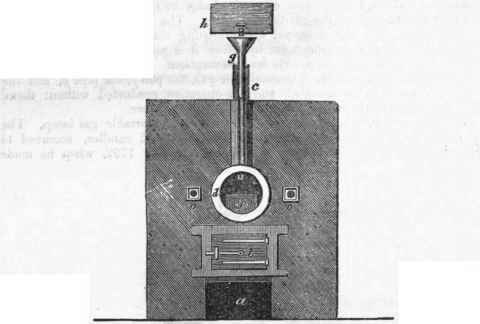


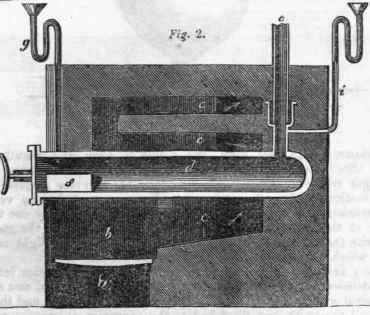
When tar, for instance, is to be operated upon, the retort, partly filled with coke or broken bricks, is to be brought to a bright red heat, which maybe ascertained by inspection through the holes o o, shown in Fig. 1, which are provided with stoppers; the cock of the water pipe is then opened, to admit the water to flow in a slender stream into the retort, the heat of which immediately converts it into vapour. This done, tar is to be admitted from the reservoir h to flow through the pipe g into the pan f, where it is quickly decomposed; the gas, as it ascends, enters the exit pipe, and necessarily passes through a large volume of steam, which, the patentees state, causes an instant precipitation of the carbonaceous matters, which would otherwise lodge in the pipes, and ultimately obstruct the passage of the gas through them. The gas thus relieved in the earliest stage from the principal contaminating matters, has then to pass through the ordinary purifications, by which it is ultimately delivered to the burners, in a state of great purity, for consumption.
Continue to:


My Books

