


Geometry Problems. Part 7
Description
This section is from the book "The Engineer's And Mechanic's Encyclopaedia", by Luke Hebert. Also available from Amazon: Engineer's And Mechanic's Encyclopaedia.
Geometry Problems. Part 7
Problem XXVIII
The transverse axis A B, and conjugate axis CD of any ellipsis, being given, to find the two foci, and from thence to describe the ellipsis.
Take the semi-transverse, A E, or E B, Fig. 29, and from C as a centre, describe an arc, cutting A B at F and G, which are the foci. Fix pins in these points; a string being stretched about the points, F, C, G, the ellipsis is described as above.
Problem XXIX
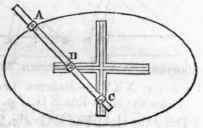
The same being given, to describe an ellipsis by a trammel.
The trammel, Fig. 30, is an instrument consisting of two rulers fixed at right angles to each other, with a groove in each. A rod, with two movable nuts, works in this groove, and, by means of a pencil fixed in the end of the rod, describes the curve. The operation is as follows: - Let the distance of the first pin at B, from the pencil at A, be equal to half the shortest axis, and the distance of the second pin at C, from A, to half the longest axis; the pins being put in the grooves, move the pencil at A, which will describe the ellipsis.
Fig. 29.
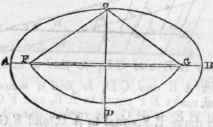
Fig. 30.
Problem XXX
To describe an ellipsis similar to a given one A D BC, to any given length IK, or to a given width M L.
Let AB and CD, Fig. 31, be the two axes of the given ellipsis. Through the points of contact A, D, B, C, complete the rectangle GEHF; draw the diagonals E F and GH: they will pass through the centre at R. Through l and K draw P N and O Q parallel to C D, cutting the diagonals E F and G H, at P, N, Q, O. Join P O and N Q, cutting C D at L and M; then l K is the transverse, and M L the conjugate axis of an ellipsis, that will be similar to the given ellipsis A D B C, which may be described by some of the foregoing methods.
Problem XXXI
To describe a parabola. If a thread equal in length to B C be fixed at C, Fig. 32, the end of a square ABC, and the other end be fixed at F; and if the side A B of the square be moved along the line A D, and if the point E be always kept close to the edge B C of the square, keeping the string tight, the point or pin E will describe a curve E G l H, called a parabola.
Fig. 31.
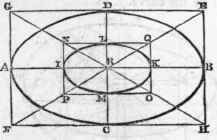
Fig. 32.
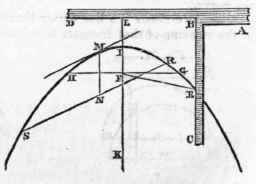
The focus of the parabola is the fixed point F, about which the string revolves.
The directrix is the line A D, which the side of the square moves along.
The axis is the line L K, drawn through the focus F, perpendicular to the directrix.
The vertex is the point l, where the line L K cuts the curve.
The latus rectum or parameter, is the line G H passing through the focus F, at right angles to the axis l K, and terminated by the curve.
The diameter is any line M N, drawn parallel to the axis l K.
A double ordinate is a right line R S, drawn parallel to a tangent at M, the extreme of the diameter M N, terminated by the curve.
The abscissa is that part of a diameter contained between the curve and its ordinate, as M N.
Continue to:


My Books

