


Jacomb's Patent Grates
Description
This section is from the book "The Engineer's And Mechanic's Encyclopaedia", by Luke Hebert. Also available from Amazon: Engineer's And Mechanic's Encyclopaedia.
Jacomb's Patent Grates
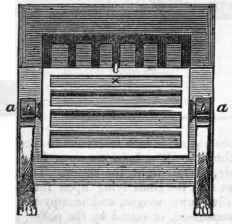
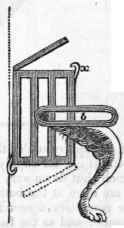
The principle of this invention also consists in placing the fresh fuel underneath the ignited portion; but the mode of carrying it into effect is peculiar. The stove is a kind of grated cage, cylindrical or parallelopipedal, turning upon axes, which are mounted on side standards. On two of the opposite sides of the said cage is a grated door, each of them serving alternately for admitting the fresh fuel, and as an ash grate. The coals are supplied at the top of the fire; the door of admission is then shut, and the grate turned half round, so as to bring the fresh fuel underneath, by which means the gas emitted becomes inflamed in its ascent through the ignited fuel above. The selection of the materials, and the diversification of designs and proportions for the construction of stoves, will of course depend upon the uses to which they are applied; but we will select, as an example, the following one adapted for a parlour. Fig. 1 is a front view, and Fig. 2 is a side view, a a are the axes, which rest and slide in horizontal grooves b.
The two doors before mentioned, represented in Fig. 5, are made fast by catches x x.
The stove is put into action by lighting a fire in the ordinary manner with coal or other fuel, as near as possible at the top, preferring to place uppermost the cinders, and green coal undermost; the fire will then gradually find its way to the bottom, burning with little or no smoke, which, together with the gas or vapour, is consumed as emitted. When fresh fuel is required, it is to be placed on the top of the ignited fuel, and the door shut down and secured by the catch x; the grate is then to be drawn forward in the groove b, and turned round one half of a revolution on its axis, and then be returned back again to its former position in the groove.
Fig. 1.
Fig, 2.
Lloyds Patent Stove consists in the adaptation of a box in a recess at the back of an ordinary register or other stove, for the reception of sufficient coals for a day's consumption, which are to be drawn forward into the fire as they may be wanted, and thus supersede the use of the coal scuttle, - an utensil which has certainly its inconveniences. That this operation may be performed with facility, the box at the back of the stove is closed with a sliding door, the weight of which is supported by a counterbalance suspended over a pulley; it is therefore drawn up or let down with ease, by means of a small handle placed conveniently, when the coals may be raked on to the fire by means of the poker.
Continue to:


My Books

