


Maw's Stove
Description
This section is from the book "The Engineer's And Mechanic's Encyclopaedia", by Luke Hebert. Also available from Amazon: Engineer's And Mechanic's Encyclopaedia.
Maw's Stove
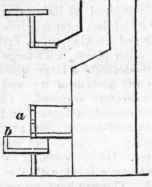
This apparatus, for which Lieut. Maw obtained a patent in 1831, consists in the introduction of a fuel drawer, or receptacle for the fuel, which is placed under a grate of the usual construction, in order that the most volatile portion of the fuel may be liberated and be consumed in its ascent through the fire; and when the coal has thus, by parting with its gaseous matter, been converted into coke, it is to be removed from the fuel receptacle, and placed upon the fire, leaving the receptacle at liberty for the introduction of another supply of fresh fuel. A front elevation of one of Lieut. Maw's fire grates is exhibited in the above cut at Fig. 1, and a sectional side view, Fig. 2, wherein a shows a grate of the usual construction, and b a fuel drawer or receptacle, having a grating underneath, for the admission of atmospheric air to maintain the combustion. The openings in the grating between the fire and the fuel receptacle are made at some distance from the front, that the volatile matter, in its ascent, may not pass so near the front of the fire as to be cooled, lest it escape without being consumed.
The advantages which would result from having the fuel supplied to a fire under the ignited portion, have been long acknowledged; and of the various plans that have been proposed, we do not think there is one so well calculated to answer the purpose of burning the smoke as that of Lieut. Maw.
Fig. 1.
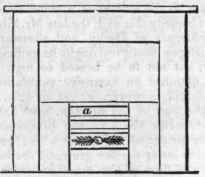
Fig. 2.
Continue to:


My Books

