


Pneumatic Transport. Part 2
Description
This section is from the book "The Engineer's And Mechanic's Encyclopaedia", by Luke Hebert. Also available from Amazon: Engineer's And Mechanic's Encyclopaedia.
Pneumatic Transport. Part 2
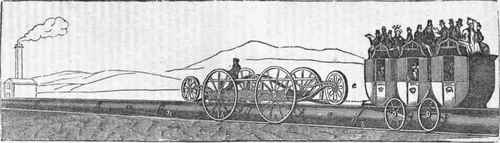
The sides of this cord, when not compressed, have a curved figure, as represented by the dotted lines: it is surrounded with a coat of felt, and on the top is attached a jointed band m of iron, resembling a continuous series of hinge-flaps, the joints admitting of the utmost pliability to the cord, and affording a compensation for the expansion or contraction of the metallic portion of the band; the other materials of the valvular cord are of too soft and yielding a nature to require any provision against the changes of temperature, and these are smeared over, or saturated with, unctuous matter, to keep them soft and more effectually air-tight. By reference to Fig. 2 it will be seen that the piston precedes the dynamic traveller in the tunnel; and by reference to Fig. 1 it will be perceived that there is a small wheel in the centre, (shown also at k, Fig. 3,) with the valvular cord I passing over its periphery, while there is another similar wheel in front, and a third at the hind part, which constantly keeps the valvular cord in its trough.
The office of the centre wheel is, therefore, simply to keep continually lifting out the valvular cord from its seat, and thereby expose the back of the piston to the full and direct action of the proximate atmosphere; the fore wheel, by its pressure upon the valvular cord, preserving the partial vacuum effected before the piston, and the hind wheel, by its pressure, restoring the valvular cord to its previous station. To enable the conductor to retard or stop the progress of the vehicle at pleasure, the patentee proposes to form a valve in the lower quadrant of the piston, to be opened or closed at pleasure by means of a lever, or a chain and pulleys. With a view to facilitate the operation of transit, and enable various parts of the same line of the pneumatic tunnel to be used simultaneously, the patentee proposes to divide it into sections, (of convenient lengths, which may be determined by the stations of the operating engines,) by intercepting station valves, which may be made similar in form and construction to the common gas valves usually applied to mains; and the connexion may, in this case also, be similar.
The patentee, however, prefers station valves of the nature of vertically sliding shutters, running down into sills below the line of the tunnel, as these admit of readier working than the gas main valves. Stationary exhausting engines, or air-pumps, are to be put in action by attached local steam-engines, or-other convenient first mover; communications between the exhausting engine and the pneumatic tunnel to be made by means of lateral tubes: and the connexions are to be made in the common manner upon the lower side, at the distance of about 200 feet from the station valve, and on the side of it that lies nearest to the station whence the governor, with its train of carriages, is to be drawn. The stations for the engines may be at three, four, or five miles apart, according to the power of the engines, the capacity of the pneumatic tunnel, the degree of rarefaction necessary, the average weight to be conveyed, the velocity required, and the height of any inclined plane to be surmounted.
As the power to be produced is by the pressure of the atmosphere acting against the piston, in advance of the dynamic traveller, by the rarefaction within the tube before it, the pressure will depend upon the degree of rarefaction; and that may be constantly ascertained by means of barometers placed at the different stations, which will indicate the approach of the governor and its train, and about its distance from the station. A barometer placed on the governor, and communicating by a small tube with the interior of the pneumatic cylinder, and through the piston to its vacuum side, will likewise indicate the degree of rarefaction, and, consequently, the pressure upon the piston, the sufficiency of power to propel, and the time for moving off. Action being given to the exhausting engines connected with the section of the tube through which propulsion is to be effected, the station valve being closed, and the air abstracted from that end of the section of the pneumatic cylinder, rarefaction will take place throughout the whole of the included atmosphere contained in the space lying between the station valve and the piston, which is attached to the dynamic traveller.
The partial vacuum thus effected at the station will cause the included column of air to move rapidly towards it; and the incumbent atmosphere pressing upon the valvular cord, will tend to aid the action of the weight of the cord in making the pneumatic valve sufficiently close to prevent the ingress of the external air, and preserve the required degree of rarefaction on the vacuum side of the piston. The unincluded atmosphere rushing into the cylinder through the aperture in the pneumatic valve over the dynamic traveller, (which is laid open by the lifting of the valvular cord over the central wheel of the governor, as before mentioned,) and impinging on the plenum side of the piston, will produce a pressure proportional to the degree of rarefaction on its opposite side, and consequently draw the train of carriages connected thereto after it. On the near approach of a train to a station valve, the latter will be quickly let down into its recess, to allow the former to pass. The valve may then be again raised; and the same engine continuing to abstract the air, as before, from the same section of the railway, it will be again soon prepared for another train in like manner; while the train that had passed into the next section is being operated upon in like manner by the engine belonging to it, and so on, from one section to the other, throughout the whole line of railway.
For further remarks on this interesting proposition, we must refer the reader to the article Railway.
Fig. 1.
Continue to:


My Books

