


Roasting Iron-Stone
Description
This section is from the book "The Engineer's And Mechanic's Encyclopaedia", by Luke Hebert. Also available from Amazon: Engineer's And Mechanic's Encyclopaedia.
Roasting Iron-Stone
The ores of iron require different treatment in the smelting process, according to the nature and extent of the heterogeneous matter with which the metal is combined. In all ores the iron is in the state of an oxide, and would require a strong heat in contact with combustible matter for their reduction. In most species, the oxide of iron is combined with a considerable proportion of earthy or stony matter, and they are thence denominated iron-stones. But besides the earthy matter and oxygen, many of these contain sulphur, arsenic, and manganese; and it is necessary that these should be extricated previously to melting, which is effected by calcination, called roasting. This is usually done by stratifying the ore, broken into small pieces, with small or refuse pit coal, and burning it in great heaps, either in the open air, or in a kiln; which dissipates the sulphureous, arsenical, and other volatile matters, leaving behind the earth and oxide of iron, which are then easily broken into convenient fragments for melting.
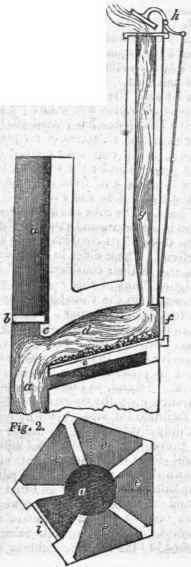
Teague's Patent Roasting Furnaces. - Mr. Teague, of the Park End Iron Works, near Calford, in Gloucestershire, took out a patent in 1832, for improvements in smelting, in which he proposes to economise the process of roasting the ore, both as respects the labour and the fuel. Instead of making the calcination a distinct process, conducted in another part of the works, he combines the operations of roasting and smelting, which go on simultaneously in the same furnace. For this purpose he constructs around the chimney shaft, near to the top or tunnel-head of an ordinary smelting furnace, a series of four or more small reverberatory furnaces or ovens, each provided with a chimney, a damper at top, and a lateral door, which opens externally. Through these doors the ores to be roasted are introduced, and deposited upon iron plates, which form the bottoms, and incline downwards towards the shaft of the smelting furnace. The ascending body of flame from the latter, when at work, is prevented from passing out vertically, as usual, by means of a valve or trap door, which closes the orifice, and the small chimneys to the surrounding reverberatory roasting furnaces being opened, causes the flame and heated matters to pass through these, and in their progress to impinge upon the ore, and deprive it of its volatile combinations.
When the ores have been thus sufficiently operated upon, they are thrust forward by a proper tool into the body of the smelting furnace; and whilst the roasting furnaces are being recharged, the valve or trap to the smelting shaft is opened, that the flames may take that course instead. Thus it would appear that a considerable saving of labour is effected, and that all the fuel employed in roasting by the ordinary process is likewise saved, as the flame which usually passes out of the tunnel-Dead to waste in the air, is made to calcine the ore, and this being discharged into the blast furnace at the high temperature it had acquired in the oven, the subsequent fusion of it is greatly accelerated. In Fig. 1, on the preceding page, is given a vertical section of one of these roasting ovens, in connexion with the tunnel-head, a a represents a portion of the tunnel-head, or upper end of the blast furnace, provided with a door or valve b, resting on a ledge at c; d is one of the four ovens; e the iron plate that contains the ore or "mine," supplied through a doorway at f; g the oven chimney, with its damper h.
Fig. 2 exhibits, on a smaller scale, a plan of the whole building, taken just above the oven plates; as designated by the four letters e; the fifth compartment i of the pentagon being for supplying the fuel and fluxes into the tunnel a, into which all of the compartments directly lead; each of these are closed externally by massive iron doors, suspended to stout iron lever beams to the opposite ends of which are hung counterbalancing weights, that enable the workmen to move them with facility. The dotted rectangle upon the plan is designed to explain the precise nature of the sectional view given in Fig 1. Jefferies' Coke and Iron Ore Furnace. - A patent for economizing the process of roasting ores was, however, taken out prior to the last-mentioned, by Mr. W. Jefferies, of Ratcliff, which was specified in August 1827. By this plan the roasting of the ore and the forming of the coke are performed together in one furnace; the process is thus described in the Journal of Patent Inventions, Vol. II. p. 66: "The ore is first broken by stampers, or crushed by rollers, until it is reduced to such fragments as will pass through a sieve of eight or ten holes to the square inch.
After which, instead of introducing the pulverized ore into a roasting oven or furnace, it is incorporated with a sufficient quantity of small coal, and the mixture put into a coke oven, previously heated in the usual way. Herein the ore is calcined by the heat of the coal, the latter being thereby converted into coke; for this purpose the door of the oven is left open until all the flame has passed off, in the ordinary manner, when the door is to be closed, and all access of air prevented. After this the charge is to be withdrawn, as if it were coke merely, and, when cooled, broken down into masses of a proper size for the smelting furnace, into which it is thrown; the metal is here ' smelted out' from the coke with which it was combined; the coke serving as the fuel to fuse and extract it."
Fig. 1.
Continue to:


My Books

