


Silvester's Patent Stove
Description
This section is from the book "The Engineer's And Mechanic's Encyclopaedia", by Luke Hebert. Also available from Amazon: Engineer's And Mechanic's Encyclopaedia.
Silvester's Patent Stove
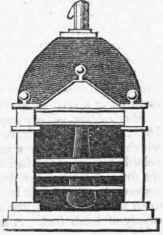
The common methods of heating buildings by means of hot air stoves had been much and justly complained of, from the salubrity of the air being frequently injured by its coming in contact with the surface of a stove comparatively small, but intensely heated; and to remedy this evil, the late Mr. Silvester introduced cockle stoves, first in the Infirmary of Derby, and afterwards in many other places, with large heating surfaces, that they might be sufficient to heat moderately a large quantity of air, but not to be heated so high as to injure any portion of it; and thus was obtained an extensive ventilation by air moderately warmed. (See Air.) Still, however, stoves of this kind, without considerable care and skill on the part of the firemen, were liable to become over-heated, and at times to deteriorate the air; and to obviate the possibility of this defect seems to be a principal object with the present patentee. He proposes, in the first place, to lower the fire grate, till the bottom bars are on a level with the surface of the floor of the room in which it is placed. The fire bars are prolonged and widened to touch each other in front of the fire, so as to form a hearth.
They require no fastening into their places, but simply to be laid upon appropriate bearings at each end.
There are grooves made on the under sides of the fire bars, for the admission of fresh air for supporting the combustion of the fuel within the grate, and for the escape of hot air into the room. It is stated that the bars may be either made of equal lengths, to constitute a rectilineal hearth, or of different lengths, to constitute a curvilineal one, at pleasure. When the ash pit, which is situated below the fire in the usual manner, requires clearing out, a few of the fire bars are to be removed, which can be effected with facility, as they are not made fast to any thing. Mr. Silvester proposes, in the second place, to surround at least three sides of his fire with a vessel containing water, and upon the exterior of this water vessel he causes a large quantity of cold air to impinge, that its temperature may be elevated sufficiently to communicate the required degree of heat or ventilation to any adjacent apartments to which it may be conveyed. For the purpose of conveying the cold air to, and the heated air from, the water vessel, the patentee proposes to employ apparatus of the same description as that employed with the hot air cockles invented by his father.
Continue to:


My Books

