


Sir George O. Paul's Stove
Description
This section is from the book "The Engineer's And Mechanic's Encyclopaedia", by Luke Hebert. Also available from Amazon: Engineer's And Mechanic's Encyclopaedia.
Sir George O. Paul's Stove
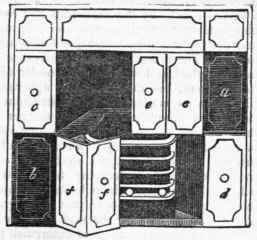
This stove may, at pleasure, be made either an open fire-place, or a close stove, heating the room by the radiation of the heat from its front wall; and when thus acting as a close stove, it serves as a ventilator of the apartments with which it is connected. The fire-place is of the ordinary dimensions. Folding doors are made to close the fronts of the ashpit, and to fall back against the hobs; other folding doors are made to close the front of the grate, and to fall back against the sides. The top of the fire grate was also provided with a floor, which formed a back when open, but when shut down horizontally, left only a small cavity, and produced a strong draught. It was supplied with air by tunnels underneath the hobs. Although the utility of this stove was satisfactorily proved in Gloucester gaol, and other places, its clumsy inelegant appearance prevented an extensive adoption. Mr. Marriott has, however, so modified it as to remove the above-mentioned objection, and has recently brought it before the public in the following form.
The shadowed compartments a and b are recesses just of sufficient depth to admit of the doors e e and f f, when folded back, to lie flush with the other parts of the front of the stove, as is the case with those marked e and d.
We have thus arranged them in the drawing merely to render the matter quite clear to the eye, not that such positions of the doors are peculiarly eligible, (nevertheless cases may be imagined wherein they would be so, such as screening particular objects from the influence of the fire, or increasing the combustion of a particular part of the fuel, by altering the direction of the current of air.) In lighting a fire, or in replenishing one that is low, the combustion is greatly excited by shutting the four upper door3, which act as a "blower." On the contrary, when a fire burns too rapidly, or is not much wanted, the four lower doors may be shut, which will damp it immediately, yet allow a great portion of the heat to radiate into the room. On retiring to bed, or wishing to leave the room in perfect security from fire, all the doors may be closed, when the fire will infallibly go out for want of draught. To keep in the fire, and yet leave the room in safety, or to prevent the radiation of much heat and light in a room (often desirable in the chamber of the sick), the doors may be placed thus V V.
For such chimneys as occasionally return their smoke, or in which the draught is feeble, these stoves will, we doubt not, be also found very convenient and advantageous
Continue to:


My Books

