


Valve. Part 3
Description
This section is from the book "The Engineer's And Mechanic's Encyclopaedia", by Luke Hebert. Also available from Amazon: Engineer's And Mechanic's Encyclopaedia.
Valve. Part 3
"The opening in the lower part of the box, which is fixed on the boiler-top, or, if more convenient, on any part of a pipe having a free communication with it, requires to be of such a size, as to allow a free discharge of all the steam the boiler is capable of generating. This opening is covered with a spherical valve,
Fig.l.

Fig. 2.

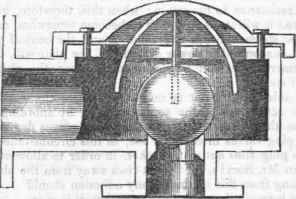
(the outer part of which is brass, filled with lead.) of such a size, and conse quently weight, as to press with as many pounds per square inch, as it is intended the strength of the steam, at a maximum, in the boiler, should ever be raised to; the obvious effect of which will be (owing to its being perfectly free from friction,) that, at the very instant the steam arrives at that degree of pressure, the ball will be raised, and a discharge instantly take place. The projections are merely to prevent the ball at any time from falling off its seat.
"From the nature of its construction, requiring no packing or attention, it can be entirely secured from the interference of careless attendants, and a pipe may be attached to the branch of the box, and continued into the chimney, or any other convenient place of discharge. 1 should not recommend this valve to be used as a substitute for the ordinary safety-valve, (improperly so called,) but in all cases in addition, and so loaded, as only to be brought into action at a very trifling additional pressure above that, to which the other valve is weighted. This valve would be found of the greatest advantage, in preventing the boiling over of the feed-pipes of boilers, when the rooms over them are used as drying-stoves in print-worke, bleach
"I ought to state that I have had this descriptionof valve in use for upwards of four years, with the greatest regularity of action."
Another valve, of a very peculiar description, and especially adapted to afford security against explosion in large boilers, was invented by Mr. Sockl, of Lambeth, who received an honorary reward from the Society of Arts, for the communication of the invention. It is represented in the subjoined cut.

Instead of the lid which covers the main hole, a copper plate or dish is to be substituted, as shown in the darkened part of above figure: this copper dish is surrounded by a ring of the same metal, by which the plate is firmly screwed down upon the rim of the main hole. In the middle of the plate is fixed the valve, of which f is the collar, made of iron or brass; d the plug, which is ground air-tightinto the collar, and is kept in its place by the spiral spring which surrounds its stem, and the stay c: over the whole is fixed a cross-piece a, which is firmly screwed down upon the ring that secures the dish. In the cross-piece, works the regulating screw e, which may be screwed down upon the head of the plug.
The operation of the valve is easy to understand. The copper dish is only about one-fourth the thickness of the other parts of the boiler, and will not therefore afford the same resistance to the steam: when this, therefore, gets beyond the ordinary pressure, it will cause the dish to become somewhat convex, and will thus leave a clear space between the collar , and the conical plug d, for the steam to escape; as soon as the power diminishes, the plate will, by its elasticity, return to its former place, and by closing down upon the plug, prevent any further escape of steam.
The object of this valve is not so much to regulate the working pressure of the steam, as to act in aid of the common valve, by affording an additional aperture, in case the steam should acquire a dangerous degree of force. It differs from the plug-valves in common use, in this circumstance, namely, that in the latter. the plug rises out of its socket, in order to allow of a vent for the steam, whereas in Mr. Sockl's, the socket rises away from the plug. The chief advantage resulting from this is, that if any adhesion should • have taken place between the plug and the socket, it is more likely to be overcome, on account of the great surface of the socket, with its attached copper plate, which is exposed to the action of the steam.
A substitute for the common ball-cock, used for regulating the height of liquids in reservoirs, has been introduced by Mr. Darnall, of Pentonville, the construction of which is exhibited in the annexed section: a is the supply pipe, b the valve, (shut,) c a float connected to the valve by an upright spindle. As the water is drawn off, the float descends from its seat into the chamber beneath, allowing the water to pour through the apertures shown, into the reservoir; the float, as it rises again with the water in the reservoir, closes the valve, and shuts off the supply of water, when it has attained its proper elevation.
We shall here close the article upon valves, referring the reader to the machinery before mentioned for further elucidations, and likewise to the article Water-Closet, which mainly consists of valves of a very ingenious construction.

Continue to:


My Books

