


How to Glaze Earthenware
Description
This section is from the book "American Library Edition Of Workshop Receipts", by Ernest Spon. Also available from Amazon: American Library Edition Of Workshop Receipts.
How to Glaze Earthenware
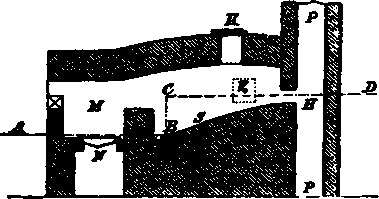
(1) For the glaze, a mixture of borax, Cornish stone, calcic carbonate, flint, and kaolin, is first fused in a small reverberatory furnace, shown in section in Fig. 127: A is the stoke hole; M, fire - place, N, grate; K, damper; HSB, bed on which the mixture rests, having been thrown in at V; P, chimney; R, opening by which the mixture, when thoroughly fused, is run out into an iron vessel containing water. The molten mass is broken up by the cold water, and is transferred to small mills, similar to those employed for grinding flint and Cornish stone. After prolonged grind.. jng with water, and passing through sieves of great fineness, it is purified by agitation in a blunger armed with horseshoe magnets. A proportion of this slip is mixed with a slip consisting of Cornish stone and plumbic carbonate, or an equivalent of plumbic oxide. Into this liquid mixture, contained in convenient tanks, the wares, rendered porous by burning, are dipped; the mixture is kept in constant agitation, and the porosity of the ware ensures enough being taken up to produce a sufficient glaze. Considerable skill is required to dip the different forms of ware in such a manner that the glaze may be equally distributed, and as little surface as possible be covered by the dipper's hand.
When the parts that have been rubbed, or insufficiently covered with the liquid glaze, have been retouched, and the ware has been thoroughly dried, it is replaced in saggers, preparatory to the fusion of the glaze. The ware can no longer be packed one piece upon another, as in the previous firing, for the fusion of the glaze would cause the pieces to adhere, and great damage would ensue. The ware is therefore separated by the insertion of props of refractory clay; made in such form that as small a part of the ware as possible shall be touched. The saggers with their contents are built up in a kiln similar to the one employed for the first firing, only somewhat smaller. The saggers, as in the previous case, are made airtight by the insertion of rolls of plastic clay. The firing lasts some 18 hours, and its progress is tested by the removal of pieces of ware similar to that being fired, and previously dipped in the same glaze. The test - pieces are usually made on purpose, and pierced in the centre to facilitate removal. (Powell.)
Fig. 127.
(2) Silicate of potash or soda at 35° B. may be used either alone or mixed with 20 Per cent. of red - lead and 5 Per cent. of silica. The thick varnish is brushed over the half - burnt articles, which are then dried and burnt. The same glaze can be used for statuettes, etc, being quite indestructible when properly burnt in. (Dtngled oL Jl.)
(3) a, Silicate of soda at 50° B., 100 parts; powdered quartz, 15; chalk from Meudon, 15. 6. Silicate of soda at 50° B., 100 parts; powdered quartz, 15; chalk, 15; borax, 10. This is quite free from poisonous ingredients, and is used at the Lanilis pottery, near Brest. (Salvetat.)
(4) For clay tobacco pipes, requiring only moderate heat, so that in burning the pipes will not be baked too hard. (a) Make a saturated solution of sugar of lead (lead acetate) in hot water. Dip the pipes in this, or apply it with a brush to the outside, then dry and expose in an open muffle at a low red heat until properly glazed. (6) Potassium carbonate, 1 part; borax, 5; melt together in a sand crucible, pour out on an iron plate to cool, powder, and mix into a paste with a little turpentine oil for use. Apply with a brush or clean rag, and heat slowly in a muffle or oven to incipient redness.
(5) White earthenware glaze: 35 Cornish stone, 20 borax, 10 crystal soda, 20 red - lead, 1/8 blue calx; calcine, pulverize coarsely, and grind with 20 lb. white - lead, 10 lb. Cornish stone, and 5 lb. flint.
Continue to:


My Books

