


Lubricants. Part 2
Description
This section is from the book "American Library Edition Of Workshop Receipts", by Ernest Spon. Also available from Amazon: American Library Edition Of Workshop Receipts.
Lubricants. Part 2
Now, if an oil of very high viscosity, such as castor or rapeseed, were used to lubricate an engine of low horse-power, in all probability, instead of reducing the friction to a minimum, it would itself become a source of resistance, and in crease the evil. Conversely, if an oil of very low viscosity were used to lubricate an engine of high horse-power, the friction would be but slightly if at all. reduced. Hence, looking at extreme cases, there exists a marked connection between viscosity and horse-power, and to ensure perfect lubrication, the viscosity must gradually increase with the ponderousness of the machinery. It is stated by one authority that the best method for mixing oils with this object is to take a basis of American or Scotch mineral oil at 0.885 to 0.903 sp. gr., and add olive, lard, rapeseed or castor oil to work up the viscosity. Olive and lard oils, when mixed with mineral oils in proportions of 10, 20, 25, and so on up to 75 per cent., are about equal in value as lubricants of the lighter class of machinery.
Rapeseed-oil in like proportions is valuable where the machinery is of a heavier kind, or where the lubricant has to be used throughout on works in which the machines vary much; but in such a case it is better to divide them into classes, and use a special oil for each class. Castor-oil, mixed with mineral oil in varying proportions, may be used in the case of the most ponderous machinery. Cold mixed oils are considered preferable to those mixed at a temperature over 100° F. (38° C).
Fire-testing is specially applicable to mineral oils. There are several forms of tester, as Taglisbue's, Millspaugh's, Abel's, Say bolt's, Parrish's, Salleron-Urbain's, Sintenis', Bernstein's, and Bailey's. The apparatus consists essentially of a receptacle for the oil to be tested, a water-bath surrounding the receptacle, a lamp for heating the water-bath, a thermometer to indicate the temperatures, an outlet for the vapour generated from the oil, and a means of reaching the oil itself.
The form of tester recognised in this country under the Petroleum Act, 1879, is shown in Fig. 149. The oil-cup A consists of a cylindrical vessel of 2 in diameter and 2 1/10 in. internal height, with an outward projecting rim h, 3/10 in wide, | in. from the top, and 1} in. from the bottom of the cup. It is made of gun-metal or brass, tinned inside. A bracket k, consisting of a short stout piece of wire bent upward. and terminating in a point, is fixed to the inside of the cup to serve as a gauge. The distance of the point from the bottom of the cup is 1} in. The cup is provided with a close-fitting overlapping cover made of brass, which carries the thermometer l and test-lamp m. The latter is suspended from two supports at the side by means of trunnions on which it oscillates, and is provided with a spout, whose mouth is 1/16 in. in diameter. The socket to hold the thermometer is fixed at such an angle, and its length is so adjusted, that the bulb of the thermometer, when inserted to its full depth, shall be 1 1/2 in. below the centre of the lid. The cover is provided with three square holes, one in the centre, 5/16 in. by 4/16in, and two smaller ones, 3/ 16 in. by 3/10 in., close to the sides and opposite each other.
These three holes may be closed and uncovered by means of a slide moving in grooves, and having perforations corresponding to those on the lid. In moving the slide so as to uncover the holes, the oscillating lamp is caught by a pin fixed in the slide, and tilted in such a way as to bring the end of the spout just below the surface of the lid. Upon the slide being pushed back so as to cover the holes, the lamp returns to its original position. On the cover, in front of and in line with the mouth of the lamp, is fixed a white bead i, the dimensions of which represent the size of the test-flame to be used. The bath or heated vessel B consists of two flat-bottomed copper cylinders, an inner one of 3 in. diameter and 2 1/2 in. height, and an outer one of 5 1/2 in. diameter and 5} in. height; they are soldered to a circular copper plate C, perforated in the centre, which forms the top of the bath, in such a manner as to enclose the space between the two cylinders, but leaving access to the inner cylinder. The top of the bath projects both outwards and inwards about 3/5 in.; that is, its diameter is about 5/8in. greater than that of the body of the bath, while the diameter of the circular opening In the centre is about the same amount less than that of the inner copper cylinder.
To the inner projection of the top is fastened, by six small screws, a flat ring of ebonite, the screws being sunk below the surface of the ebonite, to avoid metallic contact between the bath and the oil-cup. The exact distance between the sides and the bottom of the bath and of the oil-lamp is 1/2 in. A split socket similar to that on the cover of the oil-cup, but set at a right angle, allows a thermometer e to be inserted-into the space between the two cylinders. The bath is further provided with a funnel d, and overflow pipe /, and two loop handles g.
Fig. 149.
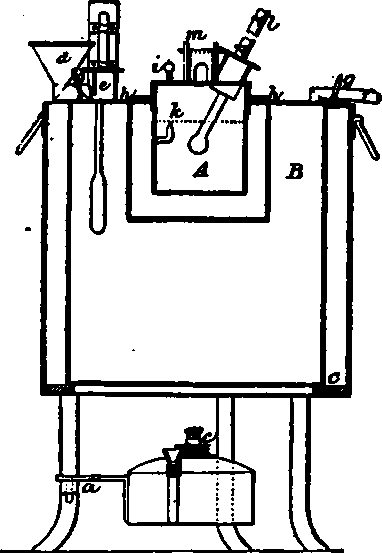
The bath rests upon a cast-iron triped stand, to the ring of which is attached a copper cylinder or jacket, flanged at the top, and of such dimensions that the bath, while firmly resting on the iron ring, just touches with its projecting top the inward-turned flange. The diameter of this outer jacket is 6 1/2 in. One of the three legs of the stand serves as support for the spirit-lamp attached to it by means of a small swing-bracket a. The distance of the wick-holder o from the bottom of the bath is 1 in.
Two thermometers go with the apparatus, one for ascertaining the temperature of the bath, the other for determining the flashing-point. The former has a long bulb and a space at the top. Its range is from about 90° to 190° F. (32° to 88° C). It is furnished with a metallic collar fitting the socket, and the part of the tube below the scale should have a length of about 3 1/2 in., measured from the lower end of the scale to the end of the bulb. The thermometer for ascertaining the temperature of the oil is similarly fitted with collar and ivory scale; it has a round bulb, a space at the top, and ranges from about 55° to 150° F. (13° to 66° C.); it measures from end of Ivory back to bulb 2 1/4in.
Continue to:


My Books

