


How To Harness A Horse
Description
This section is from the book "Scientific American Reference Book. A Manual for the Office, Household and Shop", by Albert A. Hopkins, A. Russell Bond. Also available from Amazon: Scientific American Reference Book.
How To Harness A Horse
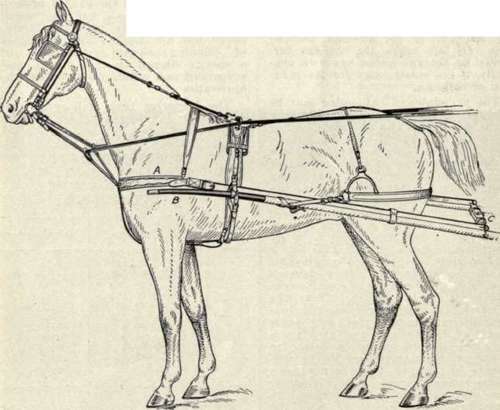
Every one should know how to harness a horse, and our second engraving shows the harness placed on a horse with the buckles unfastened and an English collar. The first engraving shows the harness fastened to the shaft and a Dutch collar in place of the English collar. If a Dutch collar is used, slip this over the horse's head, then put on the rest of the harness. If an English collar is used, reverse the collar so that the wide part will be uppermost, and force it over the horse's head, slipping it over the ears, then at the narrow part of the horse's neck turn the collar around so that the narrow part will be uppermost and slip it back on to the horse's shoulders.
If the hames are too tight to allow the collar to slip over the ears, unfasten the hames, and after the collar is on, buckle them once more in front. Next, put on the saddle and breeching, slipping the crupper over the horse's tail by doubling the hair of the tail with the right hand and slipping the crupper over the bunch thus formed, drawing out the hair completely through the crupper. Fasten the inner belly band, first passing it through the loop of the collar strap No. 15 or the martingale, and then pushing the saddle forward as far as the crupper will allow it to go.
The time has now arrived to bridle the horse. The halter being removed, the horse's head is taken by the forelock with three fingers of the right hand, leaving the forefinger and thumb free, and holding the bridle in the left hand. Pass the head piece of the bridle to the thumb and forefinger of the right hand and slip the bit into the horse's mouth with the left hand, which is then raised to assist the right hand in pulling the head piece back over the horse's ears. Should there be any difficulty in making the horse open his mouth, the bit should be held to his teeth while dangling from the right hand, and then with the thumb and second finger of the left hand press the gums of the horse's mouth at the junction of the lips gently against the teeth. This will quickly force any horse to open his mouth. When the bit is in place, the throat strap is buckled. If a curb bit is used, the
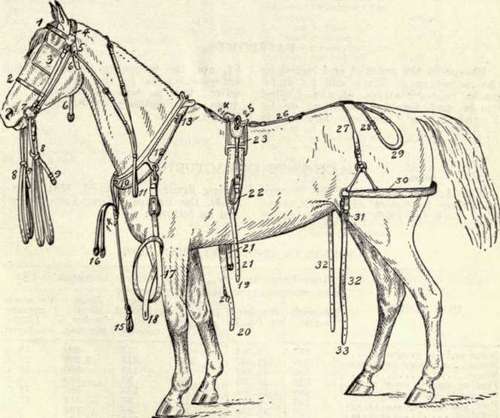
A Horse Harnessed With The Buckles Unfastened.
1, is the brow band; 2, nose band; 3, blinders; 4, head band; 5 and 6, throat strap; 7, bit; 8 and 9, reins; 10, hame fastener; 11, check rein; 12, collar; 13, terrets; 14 and 15, collar straps; 16, martingale; 17 and 18, traces; 19, inner bellyband: 20, outer bellyband; 21, part of inner bellyband; 22, shaft loops; 23, saddle; 24, check-rein hook; 25, saddle terrets; 26, crupper strap; 27, breeching strap; 28 and 29, crupper; 30, breeching; 31 32, and 33, hold-back straps.
curb chain must be twisted until it becomes flat, and then hooked, passing under the jaw of the horse to the curb chain hook in the opposite side
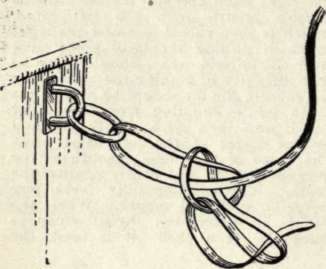
of the bit. The reins are now buckled in the slots at the curb next below the bit ring. Lift up the shafts above the horse's back, then draw up the carriage, slipping the ends of the shafts through the shaft tugs on the sides of
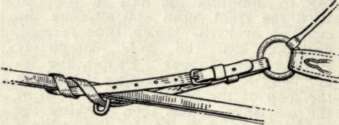
the saddle. The traces are then run through the loop at the side of the shafts and secured to the trace hooks on each side of the whiffletree. After the traces are taut, fasten the breeching or hold-back straps.
Continue to:


My Books

