


The Forest Tent Caterpillar. Clisiocampa Disstria (HÜBner.)
Description
This section is from "Scientific American Supplement". Also available from Amazon: Scientific American Reference Book.
The Forest Tent Caterpillar. Clisiocampa Disstria (HÜBner.)
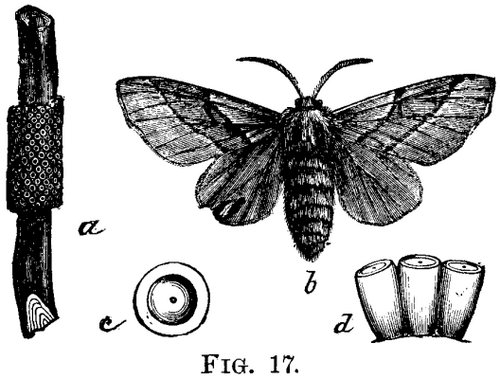
This species, commonly known as the forest tent caterpillar, closely resembles the apple tree tent caterpillar, but does not construct a visible tent. It feeds on various species of forest trees, such as oak, ash, walnut, hickory, etc., besides being very injurious to apple and other fruit trees. The moth, Fig. 17, b, expands an inch and a half or more. The general color is brownish yellow, and on the fore wings are two oblique brown lines, the space between them being darker than the rest of the wing. The eggs, Fig. 17, c and d, which are about one twenty fifth of an inch long and one fortieth wide, are arranged, three or four hundred in a cluster, around the twigs of the trees, Fig. 17, a. These clusters are uniform in diameter and cut off squarely at the ends. The eggs are white, and are firmly fastened to the twigs and to each other, by a brown substance, like varnish, which dries, leaving the eggs with a brownish covering.
The eggs hatch about the time the buds burst, or before, and the young caterpillars go for some time without food, but they are hardy and have been known to live three weeks with nothing to eat, although the weather was very cold.
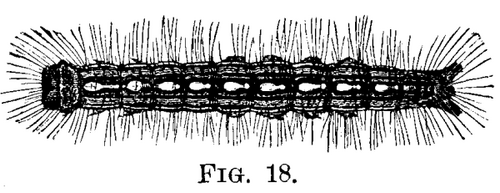
As soon as hatched they spin a silken thread wherever they go, and when older wander about in search for food. The caterpillars are about one and a half inches long when fully grown, Fig. 18. The general color is pale blue, tinged with greenish low down on the sides, and everywhere sprinkled with black dots or points, while along the middle of the back is a row of white spots each side of which is an orange yellow stripe, and a pale, cream yellow stripe below that. These stripes and spots are margined with black. Each segment has two elevated black points on the back, from each of which arise four or more coarse black hairs. The back is clothed with whitish hairs, the head is dark bluish freckled with black dots, and clothed with black and fox-colored hairs, and the legs are black, clothed with whitish hairs.
At this stage the caterpillars may be seen wandering about on fences, trees, and along the roads in search of a suitable place to spin their cocoons, which are creamy white, and look very much like those of the common tent caterpillar, except that they are more loosely constructed.
Within the cocoons, in two or three days they transform to pupae of a reddish brown color, densely clothed with short pale yellowish hairs. The moths appear in two or three weeks, soon lay their eggs and then die. The insects are not abundant many years in succession, as their enemies, the parasites, increase and check them.
Many methods have been suggested for their destruction, but the most available and economical are to remove the clusters of eggs whenever found, and burn them, and to shower the trees with Paris green in the proportion of one pound to one hundred and fifty gallons of water.
Continue to:


My Books

