


Historical Development Of The Horseshoe. Part 4
Description
This section is from "Scientific American Supplement". Also available from Amazon: Scientific American Reference Book.
Historical Development Of The Horseshoe. Part 4
Stephen I., the first king of Hungary, formerly was a heathen, and was named "Najk." He reigned from 997 to 1038. His important events were the many victorious wars led against rebellious chieftains of his country, and he was canonized in 1087. His equestrian monument in Bomberg Dom was, in consequence, hardly made before the year 1087. Notwithstanding that the Huns had been defeated 500 years before on the plains of Catalania, the horse of the above mentioned monument carries, as I have convinced myself personally, Hunish horseshoes, modified, however, by blade-shaped calks just then coming into use. This is proof that, at least in Hungary, the Hunish method of shoeing was preserved an extraordinary long time. By this it has not become improbable that at least the many shoes of this kind which were found on the Lechfield come, not directly from the Huns, but from their successors, the Hungarians, whose invasions took place in the first half of the tenth century.
About the same time of the Hungarian invasions, the Normans began to disturb the southwestern part of Europe with their Viking expeditions. Their sea kings seem to have been equestrians at very early times, and to have had their horses shod, although perhaps only in winter; at least the excavation of the Viking ship in 1881 disclosed the remains of a horse which was shod. The shoeing consisted only of a toe protection - "Brodder" (Bruder, Brother) - provided with a small sharp calk, and fastened by two nails.
When later, in the year 1130, the Norwegian king Sigard Yorsalafar, during his journey to Jerusalem, entered Constantinople, his horse is said to have carried only the small toe-protecting shoes.
The art of horseshoeing, immediately after the migration of the nations, came near our improvement of the same to-day; especially near the reputed discoveries met with, which consist simply of iron protection for the margin of the hoof, fastened by nails. The heads were sunk into the shoe so as to increase its firmness. Special consideration was given to local and climatic conditions through the introduction of toes and heels.
The mechanism of the hoof also found remarkable consideration, inasmuch as they apparently avoided driving nails too close to the heel end of the shoe. Notwithstanding this early improvement in the art of horseshoeing, the Huns (as stated before) took a prominent part. It appears to have taken a long time after the migration of the nations for shoeing to become general, as is shown by various descriptions of tournaments, pictures of horses, etc.
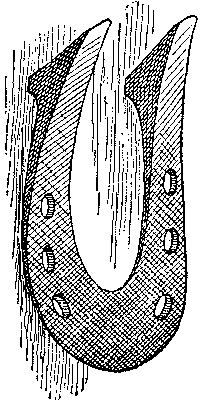
FIG. 18.
We will mention in the first place the "Percival des Wolfram von Eschenbach," as well as "Christ von Troies," where there is a great deal said about horses, horse grooms, and tournaments, but nowhere in those works is any mention made of horseshoeing. Likewise is found the horse on the coat of arms of Wolfram von Eschenbach, in the Manessi collection in Paris, which was begun in Switzerland in the fourteenth century; but, although we find this horse most beautifully finished, it was not shod.
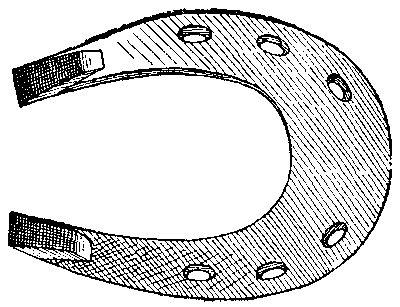
FIG. 19.
During the time of the crusades, 1096-1291, however, there appeared suddenly in Germany a plate-like horseshoe of southern character (Figs. 18 and 19), which was occasionally bent upward at the heel end, and was very heavy. The toe was very broad sometimes, and was also bent upward. In this form we have seen the shoes of the Balkan and Pyrean peninsula. The shoe was remarkably narrow at the heel, and was supplied with calks, which accounts for the highness of the back part of the shoe. Frequently we find one calk set diagonally, but the other drawn out wedge shaped, and sharp; so that there existed a great similarity between this iron shank and that used by Count Einsiedel for winter shoeing. Sometimes both shanks were sharpened in this way, or were provided with blade-shaped calks well set forward. The form of nail holes used was very characteristic of that of the Huns, but they were decidedly smaller and square, as were seen in the African shoe of the twelfth century. The nail heads were slightly sunk, which was according to southern customs.
That this shoe really belongs to the period of the crusades is proved by the numerous horse pictures which have been preserved from that time; of which we will mention the manuscript of Heinrich von Veldecka ("Eneidt")4 in the year 1180, which belongs to the most valuable parts of German history of art.
This south European Hunish horseshoe had remained the standard form during the middle ages and until the thirty years war, at least in South Germany. The shoe was continually improved, and reached its highest point of perfection about the time of the "Bauern-krieg" (Revolution of the Peasants), at a time when, under the leadership of the Renaissance, the whole art of mechanics, and especially that of blacksmithing, had taken an extraordinarily great stride (Figs. 20 and 21).
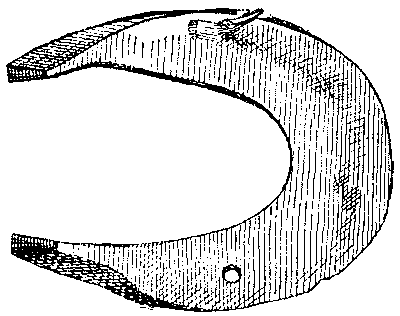
FIG. 20.
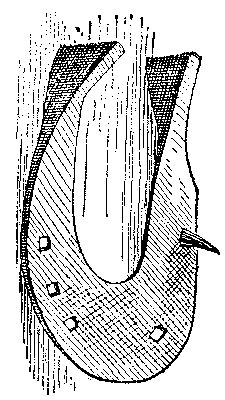
FIG. 21.
The shoe (Figs. 22 and 23) is found in Franconia, in all places where, in the sixteenth century, battles had been fought with the rebellious peasants. We may, therefore, be justified in fixing its origin mainly from that period, for which also speaks its high perfection of form. We find here still the bent-up heel and toe (the latter broad and thin) of the south European form.
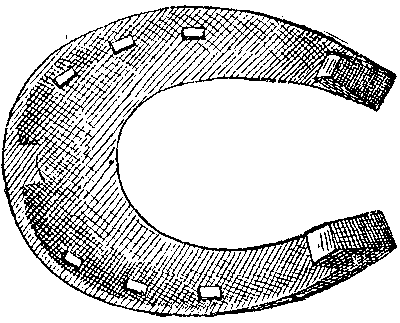
FIG. 22
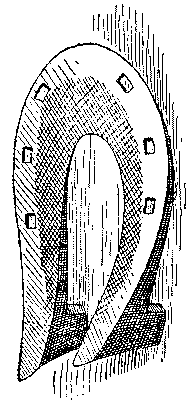
FIG. 23.
The staved rim of the Spanish Arabic Turkomanic shoe is observed to be undergoing a change to that of a groove. The broad surface of the shoe evidently led to the beveling of the same, so as to lessen sole pressure. The size of the nail holes remains still like that of the Huns; but the unsunk southern nail heads yet serve to improve the hold on the ground. The calks were next placed forward, perhaps from an uncultivated sense of beauty, or from the high bending up of the hind part of the shoe, which would necessitate a high and heavy unsightly calk.
From this time on horseshoeing in south Germany fell back very quickly, and loses all scientific holds of support after the thirty years war. In the mean time toe protection in the form of a calk had spread from the colder north over southern Germany; whereas this north German invention did not find favor in England in consequence of her mild oceanic climate.
Also, the calks in England, as well as in the southern countries, on the same ground, therefore, with good reason, could at no time be adopted. This did, however, not interfere with the use of the calk in the colder south Germany, where after a use of nearly 1,500 years it has maintained its local and climatic adaptation. Notwithstanding the occasional aping by foreigners, it has remained victorious in its original form, and has been chosen in many countries.
The historical development of the horseshoe in general, from about the time of Emperor Maximilian until the seven years war, furnishes a true picture of the confused condition of things at that period of time, which, to make intelligible, would require a separate and complete treatise. Interesting as it is to the scientist to follow up this development and mode of present German horseshoeing, which, aside from the national toe and calk, is the English form and has become influential, and with full right, for a periodical of this kind further, more comprehensive, statement would under all circumstances take up too much room; therefore I must drop the pen, although reluctantly.
[1]From Theirarztliche Mittheilungen, organ des Vereins badischer Theirarzte, Karlsruhe, No. IV., April, 1891. - Veterinary Archives.
[2]Until the time Menes, with whom historical times begin, ruled in Egypt among visionary heroes or mythological gods.
[3]Not illustrated.
[4]"Wanderungen des Aeneas" (Travels of Aeneas).
Continue to:


My Books

