


Weldless Steel Chains
Description
This section is from "Scientific American Supplement". Also available from Amazon: Scientific American Reference Book.
Weldless Steel Chains
At the Royal Naval Exhibition, London, Messrs. William Reid & Co. are exhibiting their weldless steel chains, which we now illustrate.
Of the many advantages claimed for steel chains, it may be prominently noted that a very important saving of weight is effected on account of their possessing such a high breaking strain, compared with the ordinary welded iron chains. To illustrate this, it may be stated that a given length of the weldless steel chain is 35 to 40 per cent. less in weight than an equivalent length of iron chain, will stand the same breaking strain as the latter, and indeed, where steel of special quality is used in making the weldless chains, this difference can be increased as much as 70 to 80 per cent. Whereas superior iron chains break at a strain at 17 tons per square inch, these weldless steel chains will stand a strain of 28 to 30 tons, with 20 to 26 per cent. elongation.
Again, there is greater security in their use from the fact that there are no welds, and they give warning of the limit of strain to which they can bear being approached, by elongation, which can be carried to a considerable extent before the chain breaks. Moreover, over, in chains made by this process, the links are all exactly alike. Though the life of a weldless steel chain is said to be twice that of an ordinary one, the price per length is little more than that of best iron chains.
They are made in lengths of from 40 to 50 feet, being compressed from a solid rolled steel bar, the section of which is shaped like a four-pointed star. In the first place holes are pierced at intervals down the length of the bar, thus determining the length of the several links. Then the bar is notched between the holes so as to give the external form of the links. The next step is "flattening out," which presses the links into shape on their inner side, but leaves the openings still closed by a plate of metal. They are then stamped out so as to round them up, and the metal inside them is punched out, and the edges "cleaned," or trimmed off. The links are now parted from one another and stamped again, to insure equal thickness in all parts of the chain. The only processes now to be gone through are dressing and finishing. According to the die used, the shape of the links can be varied to suit any required pattern. The lengths of chain thus made are joined by spiral rings made of soft steel, the convolutions being afterward hammered together till they become solid.
A ring of this description, ¾ inch diameter, underwent a strain of 46,200 lb., that is, 23 tons to the square inch, its elongation being 21 per cent.
These chains have passed satisfactorily the tests of the Bureau Veritas, and both that association and Lloyd's have accepted their use on the same conditions and under the same tests as ordinary chains.
So much for the general idea of punching steel chains. We will now describe a recent invention by which superior steel chains are produced, the author of which is Mr. Hippolyte Rongier, of Birmingham, Eng. He says:
My invention has for its object the manufacture of weldless stayed chains, whereof each link, together with its cross strut or stay, is made of one piece of metal without any weld or joint; and the invention consists in producing a chain of stayed links from a bar of cruciform section by the consecutive series of punching, twisting and stamping operations hereinafter described, the punching operations being entirely performed on the metal when in the cold state.
Figs. 1 to 10 show the progressive stages in the manufacture of the chain, and the remaining figures show the series of tools that are employed.
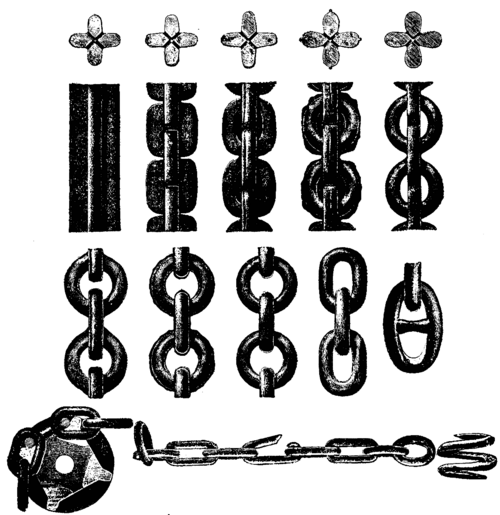
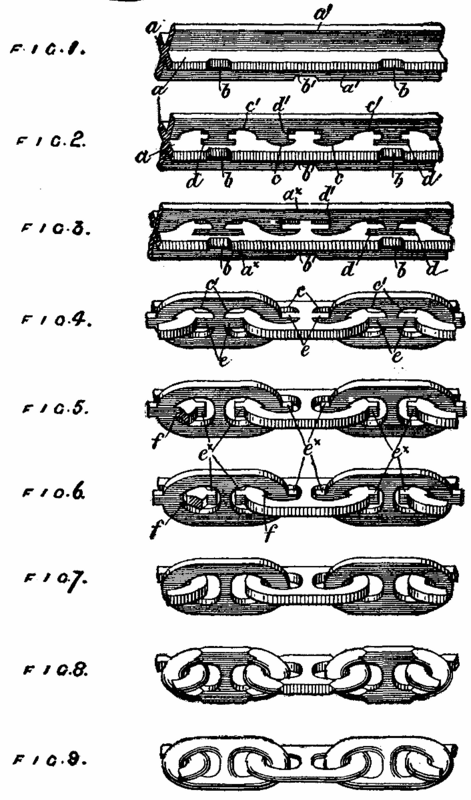
MANUFACTURE OF WELDLESS CHAINS.
The general method of operation of making stayed chains according to my invention is so far similar to the methods heretofore proposed for making unstayed chains from the bar of cruciform section that the links are formed alternately out of the one and the other pair of diametrically opposite webs of the rod, the links, when severed and completed, being already enchained together at the time of their formation. The successive operations differ, however, in many important practical respects from those heretofore proposed, as will appear from the following detailed description of the successive steps in the process illustrated by Figs. 1 to 10.
I will distinguish the one pair of diametrically opposite webs of the bar and the notches and mortises punched therein and the links formed therefrom from the other pair by an index figure 1 affixed to the reference letters appertaining thereto.
a a are one pair of diametrically opposite webs, and a' a' the other pair of webs of the bar.
The first operation illustrated in Fig. 1 is to punch out of the edge of one of the webs, a, a series of shallow notches, b, at equal intervals apart, corresponding to the pitch of the links to be formed out of that pair of webs and situated where the spaces will ultimately be formed between the ends of that series of links. The notches are made with beveled ends, and are no deeper than is absolutely necessary (for the purpose of a guide stop in the subsequent operations, as hereinafter described), so as to avoid, as far as possible, weakening the bar transversely. This operation is repeated upon one of the pairs of webs a'; but whereas in the first operation of notching the web the "pitch" of the notches is determined by the feed mechanism, in this second operation of notching the notches, b, cut in the web, a, serve as guides to influence and compensate for any inaccuracy of the feed mechanism, so that the second set of notches, b', shall be intermediate of and rigorously equidistant from the first set of notches, b. This compensation is effected by the notches, b, fitting on to a beveled stop on the bed of the punching tool by which the notches, b', are cut, the beveled ends of the notches, b, causing the bar under the pressure of the punch to adjust itself in the longitudinal direction (if necessary) sufficiently to rectify any inaccuracy of feed. These notches, b b', similarly serve as guides to insure uniformity of spacing in the subsequent operations of punching out the links.
Continue to:


My Books

