


1. Isnárdia L. Sp. Pl. 120. 1753
Description
This section is from the book "An Illustrated Flora Of The Northern United States, Canada And The British Possessions Vol2", by Nathaniel Lord Britton, Addison Brown. Also available from Amazon: An Illustrated Flora of the Northern United States, Canada and the British Possessions. 3 Volume Set..
1. Isnárdia L. Sp. Pl. 120. 1753
Annual or perennial succulent herbs. Stems prostrate or decumbent, creeping or floating; leaves opposite, fleshy, narrowed into petioles which are slightly shorter than the blades. Flowers perefect, axillary, sessile, commonly apetalous. Calyx turbinate, its segments 4, shorter than the tube or slightly longer, persistent. Petals none, or 4, inconspicuous. Stamens 4; filaments very short; anthers ovoid or oblong. Ovary 4-celled, very short; styles often almost wanting; stigma 4-lobed; ovules numerous, in several rows. Capsule 4-angled, obovoid or turbinate, straight, flat at the apex, septicidal. Seeds numerous, often transversely wrinkled. [In honor of Antoine Dante Isnard, a French botanist, died 1724.]
About 4 species in Europe, North America, the West Indies and Mexico, the following typical.
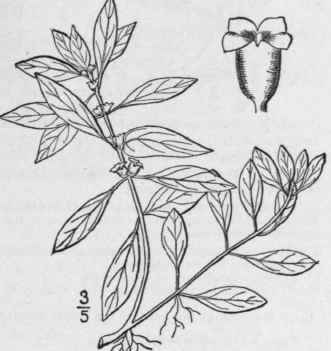
1. Isnardia Palústris L. Marsh Purslane
Fig. 3013
Isnardia palustris L. Sp. Pl. 120. 1753. Ludwigia palustris Ell. Bot. S. C. 1: 211. 1817.
Procumbent or floating, glabrous, rooting at the nodes, succulent. Stems branching, 4'-15' long; leaves opposite, oval, ovate or spatulate, acute or obtuse at the apex, 6"-12" long, narrowed into slender petioles; flowers axillary, solitary, sessile, about 1" broad; bractlets at base of the calyx usually none; calyx-lobes triangular, acute; petals small, reddish or often wanting; capsule slightly longer than wide, about 1 1/2" high, somewhat exceeding the calyx lobes.
In muddy ditches and swamps, Nova Scotia to Manitoba and Oregon, Florida, Louisiana, California and Mexico and the West Indies. Widely distributed in the Old World. Also called false or bastard loose-strife. Water-purslane. Phthisic-weed. June-Nov.
Continue to:


My Books

