


12. Heuchera L. Sp. Pl. 226. 1753. Part 2
Description
This section is from the book "An Illustrated Flora Of The Northern United States, Canada And The British Possessions Vol2", by Nathaniel Lord Britton, Addison Brown. Also available from Amazon: An Illustrated Flora of the Northern United States, Canada and the British Possessions. 3 Volume Set..
12. Heuchera L. Sp. Pl. 226. 1753. Part 2
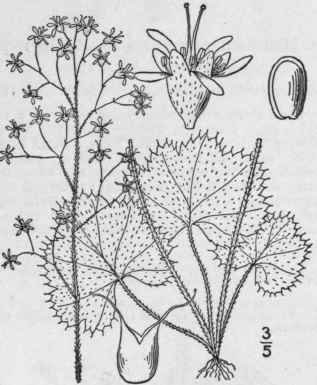
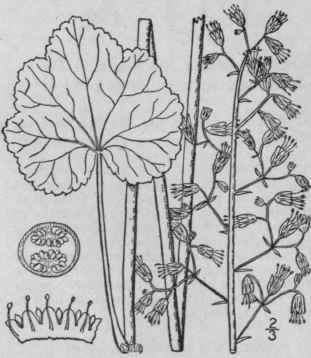
1. Heuchera Parviflòra Bartl. Rugel's Heuchera
Fig. 2173
Heuchera parviflora Bartl. Ind. Sem. Hort.
Gotting. 1838. - Linnaea 13: Litt. 96. 1839. H. Rugelii Shuttlw.; Kunze, Linnaea 20: 43.
1847.
Stems slender, 6'-24' long, weak, glandular-hirsute or villous, leafless or bearing a few leaves below. Basal leaves with long slender glandular-villous petioles, broadly reniform, 2'-5' wide, cordate at the base, with 7-9 broad rounded or rarely pointed lobes, crenately toothed, the teeth mucronate; inflorescence very loosely paniculate; flowering calyx regular, campanulate, about 1" long; petals linear-spatulate, 2-3 times as long as the calyx-lobes; stamens somewhat exserted.
Shaded cliffs, Missouri and Illinois to western Virginia and northern Georgia. July-Sept.
2. Heuchera Pubérula Mackenzie & Bush. Puberulent Heuchera
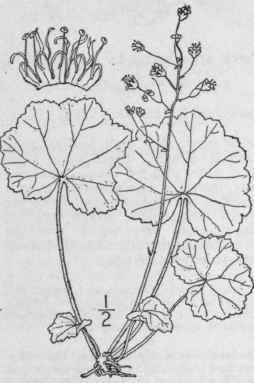
Fig. 2174
H. puberula Mackenzie & Bush, Rep. Mo. Bot. Gard. 16: 103. 1905.
Stems very slender, 4'-12' long, puberulent, leafless. Basal leaves with very slender puberulent petioles, suborbicular to reniform, 1'-2 3/4' wide, shal-lowly or deeply cordate at the base, with 5-9 rounded lobes and broad mucronate teeth, finely pubescent on both sides; inflorescence lax, few- or many-flowered; flowering calyx regular, campanulate or turbinate, about 1" long, the lobes broader and the tube relatively shorter than in H. parviflora; petals spatulate or linear-spatulate, about twice as long as the calyx-lobes; stamens exserted.
On bluffs, Kentucky and Missouri. July-Oct.
3. Heuchera Villòsa Michx. Hairy Heuchera
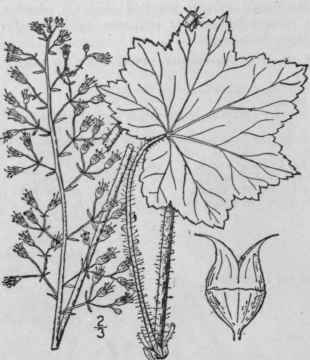
Fig. 2175
H. villosa Michx. Fl. Bor. Am. 1: 172. 1803.
Stem erect, leafless, or rarely bearing a few small leaves below, generally villous-pubescent with brownish hairs, as are also the long petioles and the veins on the lower surfaces of the leaves. Basal leaves 3'-5' wide, ovate to orbicular, sharply or obtusely and deeply 7-9-lobed, the lobes dentate or serrate, the terminal lobe usually longer than wide; flowering calyx 1"-1 1/2" long, campanulate, regular; petals linear-spatu-late, white or nearly so, twice as long as the calyx-lobes or more; stamens much exserted.
In rocky places, Virginia, West Virginia and Kentucky to Georgia and Tennessee. June-Sept. Called also American sanicle.
4. Heuchera Macrorhiza Small. Big-Rooted Heuchera
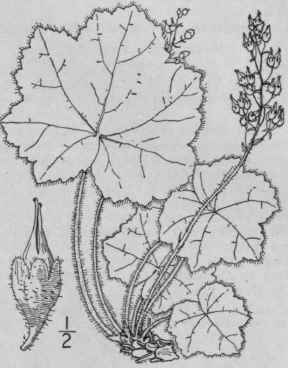
Fig. 2176
H. macrorhiza Small, Bull. Torr. Club 25: 466. 1898.
Stem erect, usually leafless, stout, from a very thick scaly rootstock, densely villous or hirsute-villous with usually sordid hairs. Basal leaves, 3'-8' wide, suborbicular in outline, shallowly lobed, with the terminal lobe usually wider than long, the teeth broad, mucronate; flowering calyx short-hairy, often larger than in H. villosa, regular; petals linear or nearly so, about twice as long as the calyx-lobes or less; stamens much-exserted.
On bluffs and river banks, West Virginia, Kentucky and Tennessee. July-Oct.
Heuchera crinita Rydb., from Kentucky and adjacent states, seems to be a robust form of H. macrorhiza.
Continue to:


My Books

